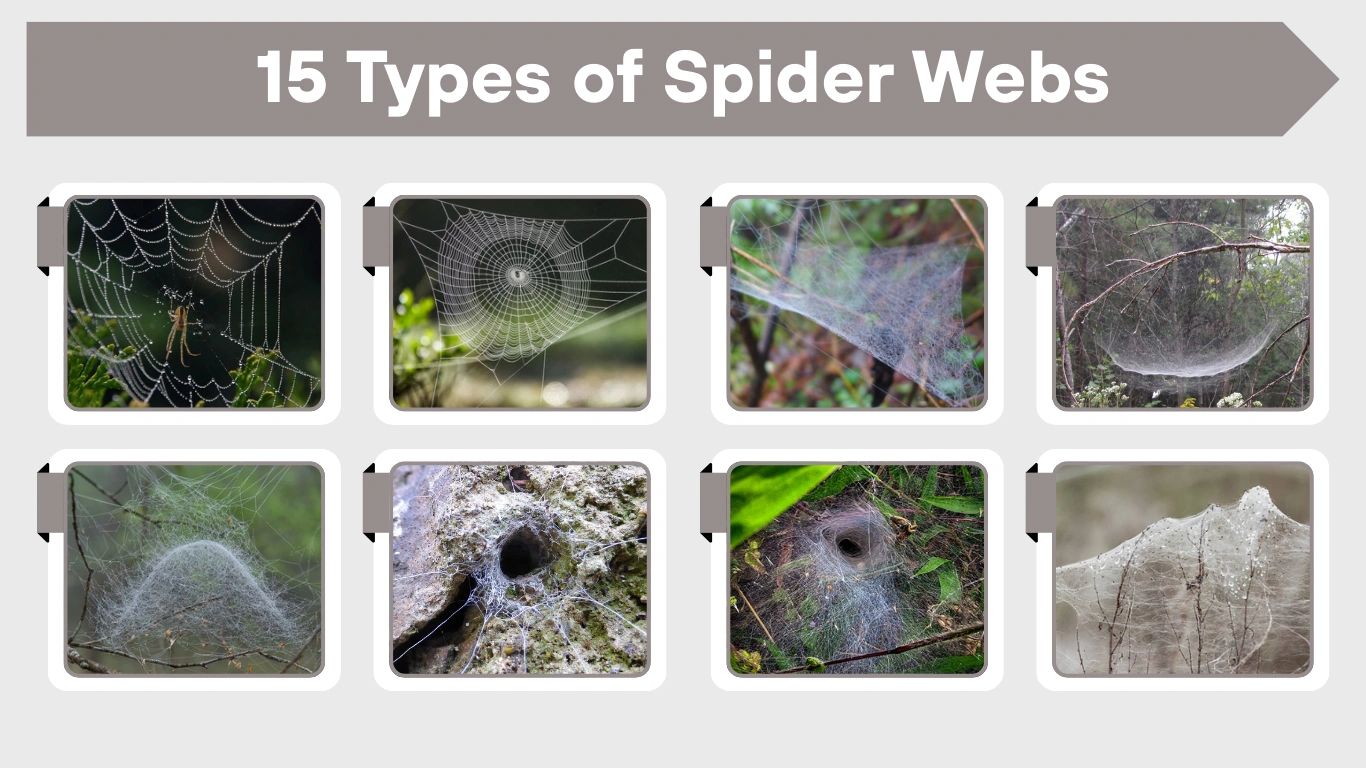
Spider webs are remarkable natural structures, each designed to match a spider’s hunting style, environment, and prey type. From perfectly symmetrical designs to chaotic tangles, no two web types function in exactly the same way. Some webs rely on sticky silk, while others use vibration, tension, or physical barriers to capture insects. Understanding the different types of spider webs not only helps with identification but also reveals how spiders have adapted their silk engineering for survival across diverse habitats.
1. Orb Web

Orb webs are the classic circular spider webs most people recognize from gardens, forests, and even window corners. Designed for efficiency, these webs use a precise radial structure combined with sticky spiral threads to capture flying insects. Orb webs are typically rebuilt frequently, often daily, allowing spiders to maintain strength and cleanliness while adapting to changing prey activity and environmental conditions.
Identification
- Circular or wheel-shaped design
- Radiating spokes from a central hub
- Sticky spiral threads for trapping prey
- Usually positioned vertically
Structure and Design
Orb webs consist of non-sticky radial threads that provide support and sticky spiral threads that trap insects. The center may be open or include a small resting area where the spider waits or monitors vibrations through the silk.
Purpose and Function
The primary function of an orb web is prey capture. Its symmetrical design maximizes surface area while using minimal silk, making it one of the most energy-efficient web types in nature.
Common Locations
Orb webs are commonly found between trees, shrubs, tall grasses, fences, and buildings—anywhere flying insects frequently pass through.
2. Funnel Web

Funnel webs are ground-level or low-lying spider webs known for their distinctive tunnel-shaped retreat. These webs are built to guide insects toward a narrow funnel where the spider hides and ambushes prey with speed and precision. Funnel webs are especially common in grassy areas and corners where surfaces meet.
Identification
- Flat sheet-like surface with a funnel-shaped tunnel
- Non-sticky silk used to detect vibrations
- Funnel opening leads to a hidden retreat
- Often built close to the ground
Structure and Design
The web consists of a horizontal sheet that spreads outward, narrowing into a funnel or tube. When prey walks across the sheet, vibrations travel through the silk, alerting the spider inside the funnel.
Purpose and Function
Funnel webs function as vibration traps rather than sticky snares. The design allows spiders to conserve silk while reacting quickly to prey that enters the web’s surface.
Common Locations
These webs are typically found in lawns, bushes, rock crevices, garden edges, and building foundations where insects move along surfaces rather than flying.
3. Sheet Web

Sheet webs are flat, blanket-like spider webs that spread across vegetation or ground surfaces. Instead of relying on sticky threads, these webs work by creating a physical barrier that disrupts insect movement. Prey becomes disoriented or falls onto the web, allowing the spider to attack from below or above.
Identification
- Broad, flat sheet of silk
- Usually non-sticky threads
- Spider often hides underneath the web
- Lacks a central hub or spiral pattern
Structure and Design
Sheet webs are loosely woven and can vary in size from a few inches to several feet wide. Some include a few supporting threads above the sheet that knock flying insects downward onto the web surface.
Purpose and Function
The main function of a sheet web is to intercept insects in flight or on vegetation. The web’s layout increases the chances of prey stumbling or dropping onto the silk.
Common Locations
Sheet webs are commonly found in grass, low shrubs, hedges, and forest undergrowth, especially in areas with high insect traffic.
4. Tangle Web

Tangle webs are irregular, messy-looking spider webs with no obvious pattern or symmetry. Often mistaken for abandoned or broken webs, they are intentionally chaotic and highly effective at trapping crawling and flying insects. The spider usually waits within the web or nearby, responding quickly when vibrations occur.
Identification
- Irregular, three-dimensional structure
- No circular or radial pattern
- Sticky silk strands arranged randomly
- Spider often hangs upside down
Structure and Design
Tangle webs are made from crisscrossing silk threads placed at different angles. Some strands act as trip lines, causing insects to lose balance and fall deeper into the web where escape becomes difficult.
Purpose and Function
The disorderly design increases trapping efficiency by confusing prey and limiting escape routes. Sticky silk ensures insects remain suspended long enough for the spider to subdue them.
Common Locations
These webs are frequently found in corners of buildings, basements, garages, shrubs, and cluttered outdoor areas where insects regularly pass through.
5. Cobweb

Cobwebs are loosely structured, dusty-looking spider webs commonly found in undisturbed indoor and outdoor spaces. Despite their fragile appearance, cobwebs are functional trapping webs used by spiders to catch small insects. Over time, inactive cobwebs collect dust, which is why the term is often associated with neglect or abandonment.
Identification
- Irregular and messy appearance
- Fine, tangled silk threads
- Often accumulates dust and debris
- Usually built in quiet, undisturbed areas
Structure and Design
Cobwebs are made of non-uniform silk strands woven in a random pattern. Some threads act as sticky capture lines, while others provide structural support, allowing the web to hang freely.
Purpose and Function
The web’s main purpose is to trap crawling or flying insects that accidentally brush against the silk. Vibrations alert the spider, which quickly moves in to secure the prey.
Common Locations
Cobwebs are frequently found in ceilings, corners of rooms, attics, basements, sheds, barns, and behind furniture where human activity is minimal.
6. Tube Web

Tube webs are silk structures that form a long, narrow tunnel serving as both a retreat and a hunting base for the spider. The spider stays hidden inside the tube, waiting to rush out when prey touches the surrounding silk lines. These webs emphasize protection and ambush rather than open trapping.
Identification
- Cylindrical or tube-shaped silk retreat
- Entrance often lined with signal threads
- Non-sticky silk used for vibration detection
- Spider remains hidden inside the tube
Structure and Design
Tube webs consist of a dense silk tunnel attached to a surface, with multiple strands extending outward. These strands act as early warning lines, transmitting vibrations directly to the spider inside.
Purpose and Function
The primary function of a tube web is ambush hunting. The enclosed design protects the spider from predators while allowing rapid strikes when prey triggers the signal threads.
Common Locations
Tube webs are typically found in tree bark crevices, rock gaps, fence posts, soil banks, and building cracks where narrow shelter is available.
7. Dome Web

Dome webs are three-dimensional spider webs shaped like a small dome or tent. Unlike flat webs, these structures rise upward, creating a protective canopy that intercepts insects from multiple directions. The spider usually waits beneath the dome, monitoring vibrations through the silk.
Identification
- Dome- or tent-shaped structure
- Fine silk forming a raised canopy
- Spider positioned below the web
- No clear radial or spiral pattern
Structure and Design
The web consists of a curved sheet of silk supported by anchor threads. Some dome webs also include additional threads below the canopy to further disrupt insect movement.
Purpose and Function
Dome webs function as interception traps. When insects collide with the dome or supporting threads, they lose balance and become vulnerable to capture by the spider below.
Common Locations
These webs are commonly found in low vegetation, bushes, tall grass, and forest edges where insects fly at varying heights.
8. Bowl Web

Bowl webs are delicately curved spider webs shaped like a shallow bowl or cup. They are designed to intercept insects flying at low heights, using a combination of curved silk and supporting threads to disrupt movement. The spider usually waits below the bowl, ready to strike when vibrations are detected.
Identification
- Bowl- or cup-shaped silk structure
- Fine, non-sticky threads
- Spider positioned beneath the web
- Often supported by surrounding vegetation
Structure and Design
The web forms a gentle concave shape, held in place by multiple anchor lines. Additional threads above or around the bowl help guide insects downward into the web’s curved surface.
Purpose and Function
Bowl webs function as interception traps. Insects flying into the structure lose balance or drop into the bowl area, allowing the spider to quickly capture them.
Common Locations
These webs are typically found in tall grass, shrubs, gardens, and forest undergrowth where insects fly close to vegetation.
9. Lace Web

Lace webs are finely woven spider webs with a delicate, net-like appearance resembling lace fabric. Though they look fragile, these webs are carefully constructed to intercept small insects moving through vegetation. The spider usually stays close to the web, relying on subtle vibrations to detect prey.
Identification
- Fine, lace-like silk pattern
- Thin, closely spaced threads
- Lightweight and delicate appearance
- Often difficult to see unless backlit
Structure and Design
Lace webs are made of tightly arranged silk strands that form a light mesh rather than a solid surface. The design balances coverage with minimal silk use, making it efficient for capturing tiny insects.
Purpose and Function
The primary purpose of a lace web is to snare small, slow-moving insects. The fine threads reduce escape chances while allowing the spider to sense even minor disturbances.
Common Locations
These webs are commonly found in shrubs, tall grasses, hedges, and garden plants where small insects frequently move through foliage.
10. Hammock Web

Hammock webs are loosely suspended spider webs that hang between plants or structures like a hanging sling. These webs rely on layered silk and surrounding support threads to catch insects that fall or fly into them. The spider usually rests on or just beneath the web surface.
Identification
- Sagging, hammock-like shape
- Loosely woven silk threads
- Supported by multiple anchor lines
- Spider positioned on or below the web
Structure and Design
The web forms a shallow, hanging sheet held in place by surrounding vegetation or objects. Additional silk strands above the hammock help deflect insects downward into the web.
Purpose and Function
Hammock webs function as passive traps. Insects that collide with the support threads lose balance and drop into the web, where the spider can quickly secure them.
Common Locations
These webs are often found in bushes, garden plants, tall grasses, and forest understory areas with dense vegetation.
11. Triangle Web

Triangle webs are small, geometric spider webs shaped like a partial triangle rather than a full circle. These webs are known for their unique tension-based design, where the spider actively manipulates the web to capture prey instead of relying solely on sticky silk.
Identification
- Triangular or wedge-shaped web
- Missing one side compared to orb webs
- Non-sticky capture threads
- Spider holds a tension line
Structure and Design
The web consists of a few radiating lines connected by cross threads, forming a triangular frame. The spider holds a signal line attached to the web and releases it when prey hits, causing the web to snap forward.
Purpose and Function
Triangle webs are designed for active prey capture. By releasing tension, the spider instantly entangles insects, making this web highly effective despite its small size.
Common Locations
These webs are typically found on tree trunks, fence posts, rock faces, and building walls where space is limited but insect traffic is steady.
12. Mesh Web

Mesh webs are dense, net-like spider webs made of closely spaced silk threads. Unlike orderly orb webs, mesh webs form a compact webbing that acts as a physical barrier, making it difficult for insects to pass through without becoming trapped.
Identification
- Dense, net-like silk pattern
- Closely spaced intersecting threads
- Lacks a clear central hub
- Appears thicker than sheet webs
Structure and Design
The web is constructed with multiple overlapping strands that create a tight mesh. This layered design increases durability and improves the chances of stopping fast-moving insects.
Purpose and Function
Mesh webs function as interception and entanglement traps. Insects that attempt to pass through the web become tangled in the dense silk, allowing the spider to immobilize them quickly.
Common Locations
These webs are commonly found in bushes, hedges, tall grasses, forest edges, and garden vegetation where insects move frequently through narrow spaces.
13. Radial Web

Radial webs are spider webs built around straight silk lines that extend outward from a central point. While similar to orb webs, they lack the full spiral pattern and focus more on structural support and vibration detection than sticky trapping.
Identification
- Straight radial lines from a central point
- Minimal or no spiral threads
- Open, skeletal appearance
- Spider positioned near the center
Structure and Design
The web is made primarily of strong radial threads anchored to nearby surfaces. These threads act as both support and sensory lines, allowing the spider to detect movement quickly.
Purpose and Function
Radial webs are mainly used for detecting and intercepting prey rather than long-term entanglement. The spider often relies on speed and precision instead of sticky silk.
Common Locations
These webs are typically found between branches, stems, fences, and building structures where anchor points are readily available.
14. Signal Web

Signal webs are specialized spider webs designed to transmit vibrations rather than trap prey directly. They rely on tensioned silk lines that act as sensory extensions, alerting the spider when an insect approaches nearby.
Identification
- Long, stretched signal threads
- Minimal trapping silk
- Designed for vibration detection
- Often connected to a retreat
Structure and Design
The web consists of a few carefully placed silk lines extending from the spider’s hiding place. These lines amplify vibrations, allowing the spider to detect prey movement without exposing itself.
Purpose and Function
Signal webs function primarily as early-warning systems. Once vibrations are detected, the spider rushes out to capture prey using speed instead of entanglement.
Common Locations
These webs are commonly found near crevices, bark gaps, soil burrows, and building cracks where spiders can remain hidden while monitoring their surroundings.
15. Curtain Web

Curtain webs are vertical or slightly angled spider webs that resemble hanging sheets of silk. Instead of sticky capture threads, these webs work by blocking insect movement and guiding prey toward the spider’s waiting position.
Identification
- Vertical, curtain-like silk sheet
- Fine, closely spaced threads
- Non-sticky structure
- Spider waits along the edge or behind the web
Structure and Design
The web forms a flat or slightly curved silk barrier attached to plants, rocks, or structures. Supporting threads hold the curtain in place, creating a stable surface for vibration detection.
Purpose and Function
Curtain webs function as interception traps. Insects flying or crawling into the web are slowed or redirected, allowing the spider to quickly seize them.
Common Locations
These webs are typically found between tall grasses, shrubs, rock faces, fence lines, and garden structures where insects travel through narrow vertical spaces.
FAQs
1. Do all spiders build webs?
No, many spiders hunt actively and do not build webs. Examples include jumping spiders and wolf spiders, which rely on speed and vision instead of silk traps.
2. Why do some spider webs look messy while others are symmetrical?
Web shape depends on the spider species and hunting strategy. Messy webs trap prey through confusion, while symmetrical webs are designed for efficient interception of flying insects.
3. How often do spiders rebuild their webs?
Some spiders rebuild their webs daily, especially orb-weavers, while others repair and reuse the same web for long periods.
4. Are spider webs always sticky?
No, many webs use non-sticky silk and rely on structure, tension, or vibration detection rather than adhesive threads.
5. Why are spider webs more visible in the morning?
Morning dew and moisture collect on silk strands, reflecting light and making the web easier to see than during dry conditions.