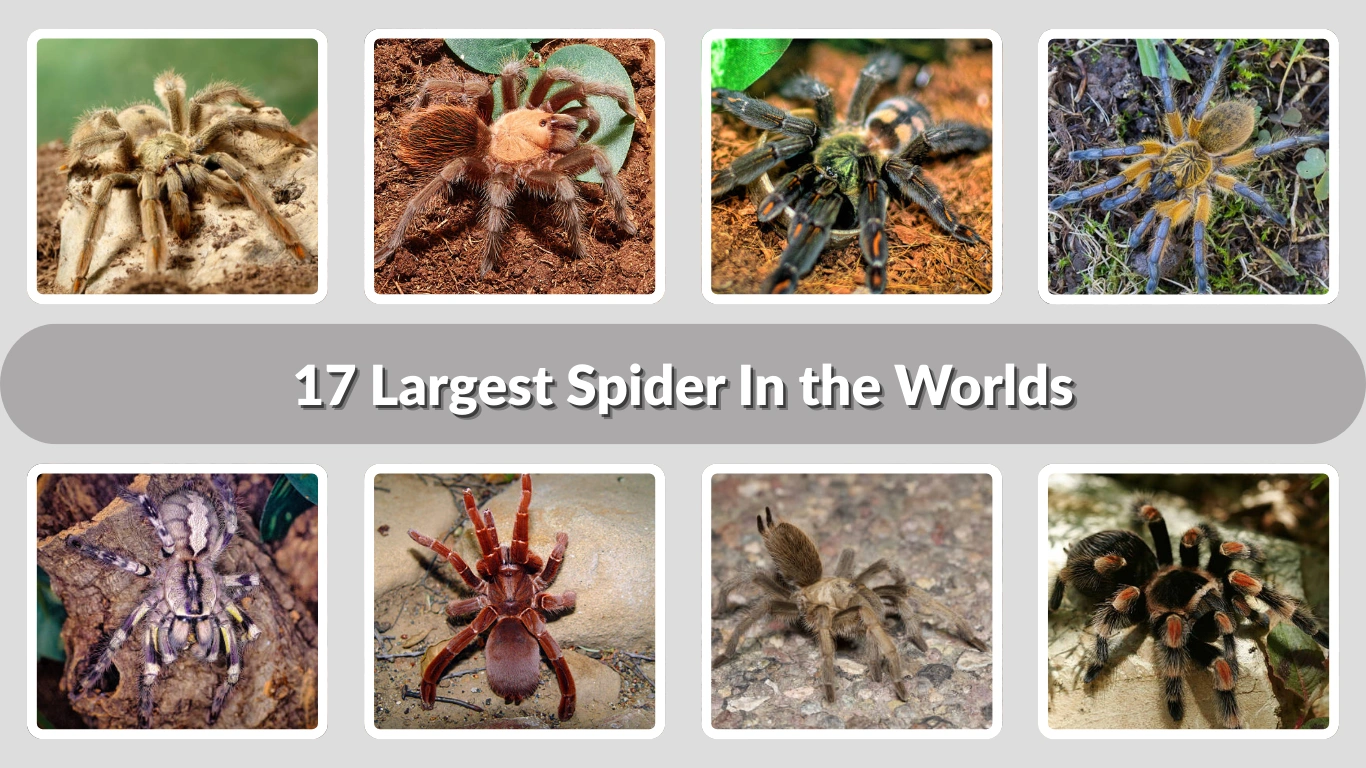
The world’s largest spiders are remarkable creatures known for their impressive size, strength, and unique behaviors. From massive tarantulas to fast-moving arboreal hunters, these giant species inhabit forests, deserts, and tropical regions across the globe. This guide highlights 17 of the biggest spiders ever recorded, exploring their physical traits, habitats, and lifestyles to help readers better understand and appreciate these extraordinary arachnids.
1. Goliath Birdeater

The Goliath Birdeater is the largest spider in the world by mass and size. Native to the rainforests of South America, this enormous tarantula is known for its powerful presence, heavy body, and ability to produce a hissing sound when threatened.
Identification
- Massive, heavy-bodied tarantula
- Brown to dark reddish coloration
- Thick legs with hair-like setae
- Leg span reaching up to 30 cm (12 inches)
- Large fangs capable of delivering deep punctures
Habitat
Goliath Birdeaters inhabit tropical rainforests, living in deep burrows located in soft, moist soil. They often occupy abandoned rodent holes or dig their own retreats. The dense vegetation and humid environment of the Amazon basin provide ideal shelter and hunting grounds.
Behaviors
These spiders are primarily nocturnal and rely on ambush hunting. When disturbed, they may produce a hissing sound by rubbing body hairs, or flick urticating hairs as a defense mechanism. They are generally solitary and spend most of their time hidden inside burrows.
Diet and Lifecycle
Despite their name, they rarely eat birds. Their diet mainly includes insects, rodents, frogs, worms, and occasionally small reptiles. Females lay hundreds of eggs in silk sacs and guard them carefully. They have long lifespans—females can live up to 20 years, while males typically survive only a few years.
2. Giant Huntsman Spider

The Giant Huntsman Spider holds the record for the largest leg span of any spider in the world. Known for its incredible reach and swift movements, this species is native to Laos and thrives in warm, humid environments.
Identification
- Extremely long legs reaching up to 30 cm (12 inches)
- Flat body shape adapted for squeezing into tight spaces
- Light brown to yellowish coloration
- Long, crab-like legs extending sideways
- Typically 4–5 cm body length
Habitat
Giant Huntsman Spiders inhabit caves, forests, and rocky environments in Southeast Asia. They prefer dark, sheltered areas where they can hunt and hide. Their flattened bodies allow them to navigate narrow crevices, making caves an ideal habitat.
Behaviors
These spiders rely on speed and agility rather than webs to capture prey. They are nocturnal hunters and may move extremely quickly when disturbed. Despite their frightening size, they are generally shy and avoid human contact unless threatened.
Diet and Lifecycle
Their diet consists of insects, moths, small reptiles, and other arthropods. Females lay eggs in silk sacs and guard them until hatching. Spiderlings disperse after emerging and go through several molts before reaching adulthood. The lifecycle usually spans a few years.
3. Brazilian Salmon Pink Bird-Eating Tarantula

The Brazilian Salmon Pink Bird-Eating Tarantula is one of the largest and most visually striking tarantulas in the world. Known for its fast growth and impressive size, this species is popular among enthusiasts and native to eastern Brazil.
Identification
- Large, heavy-bodied tarantula
- Dark brown body with salmon-pink hairs on legs
- Thick, robust legs
- Leg span reaching 25–28 cm
- Body length typically 8–10 cm
Habitat
This tarantula inhabits tropical forests, grasslands, and humid regions of eastern Brazil. It constructs burrows or shelters under logs and rocks, preferring moist environments where temperature and humidity remain stable throughout the year.
Behaviors
These spiders are generally bold and may display defensive postures when threatened. They are powerful ambush hunters, waiting at burrow entrances to strike prey. They can flick urticating hairs as a defense mechanism and are mostly active at night.
Diet and Lifecycle
Their diet includes insects, small rodents, frogs, and occasionally birds. Females produce large egg sacs containing hundreds of spiderlings. They have long lifespans—females often live 15 years or more, while males have much shorter lifespans, typically 3–5 years.
4. Hercules Baboon Spider

The Hercules Baboon Spider is one of the rarest and largest tarantulas in the world. Native to Africa, this elusive species is known from very few specimens, making it one of the most mysterious giant spiders ever documented.
Identification
- Extremely large and robust tarantula
- Dark brown to reddish coloration
- Thick legs with dense hair
- Strong fangs suited for powerful prey
- Leg span estimated up to 20 cm
Habitat
The exact natural habitat of the Hercules Baboon Spider is not well documented, but it is believed to inhabit dry savannas and scrublands in central Africa. It likely lives in deep burrows or under natural debris, similar to other baboon spiders.
Behaviors
Due to limited observations, much of its behavior is inferred from related species. It is likely nocturnal and highly defensive, capable of strong threat postures. Like other baboon spiders, it probably relies on ambush hunting from a secure burrow.
Diet and Lifecycle
Its diet likely consists of insects, small lizards, and other ground-dwelling animals. Females presumably lay egg sacs in burrows and guard them until hatching. Lifespan details are unknown, but related species live 10–15 years in the wild.
5. Colombian Giant Redleg Tarantula

The Colombian Giant Redleg Tarantula is a massive and striking species known for its vivid red legs and intimidating size. Native to Colombia and surrounding regions, it is one of the largest tarantulas kept by enthusiasts.
Identification
- Large, heavy-bodied tarantula
- Dark body with bright red or orange legs
- Thick, powerful legs with dense hair
- Leg span reaching 20–23 cm
- Body length typically 7–9 cm
Habitat
This species inhabits tropical and subtropical forests, living in burrows or under natural ground cover. It prefers humid environments with soft soil suitable for digging. These conditions provide stability for molting, nesting, and temperature regulation.
Behaviors
Colombian Giant Redlegs are ambush hunters that remain near burrow entrances waiting for prey. They may display defensive postures when disturbed, raising their front legs and exposing fangs. Despite their intimidating size, they usually avoid direct confrontation.
Diet and Lifecycle
Their diet includes insects, frogs, small reptiles, and occasionally rodents. Females produce egg sacs containing hundreds of spiderlings. Like many large tarantulas, females may live over 15 years, while males have significantly shorter lifespans.
6. King Baboon Spider

The King Baboon Spider is one of Africa’s largest and most powerful tarantulas. Known for its impressive size, strength, and burrowing ability, this species is highly respected for its defensive nature and striking appearance.
Identification
- Large, heavy-bodied spider
- Copper, reddish-brown, or dark bronze coloration
- Thick legs with velvety hair
- Strong fangs capable of delivering painful bites
- Leg span reaching 18–20 cm
Habitat
King Baboon Spiders inhabit savannas, grasslands, and scrublands in East Africa. They create deep, silk-lined burrows that provide protection from predators and extreme temperatures. These burrows are often several inches wide and can stretch over a meter deep.
Behaviors
This species is known for being defensive and will drum its legs or stridulate (produce sound) when disturbed. King Baboons are solitary and remain close to their burrows, emerging at night to hunt. They rarely retreat when threatened, relying on intimidation displays.
Diet and Lifecycle
Their diet includes insects, small reptiles, frogs, and other invertebrates. Females create egg sacs within their burrows and guard them until hatching. Spiderlings remain nearby until mature enough to disperse. Females live 15–20 years, while males have much shorter lifespans.
7. Brazilian Giant Tawny Red Tarantula

The Brazilian Giant Tawny Red Tarantula is a large, impressive species known for its vivid coloration and strong presence. Native to Brazil, this tarantula is admired by keepers for its size and striking tawny-red hues.
Identification
- Large, bulky tarantula
- Tawny red or reddish-brown coloration across body and legs
- Thick legs with dense, velvety hair
- Leg span reaching 18–20 cm
- Body length typically 7–9 cm
Habitat
This species inhabits tropical and subtropical regions of Brazil. It prefers humid environments and shelters in burrows, under logs, or within natural ground cavities. The warm climate and dense vegetation provide ideal hunting and hiding conditions.
Behaviors
The Brazilian Giant Tawny Red Tarantula is generally calm but may show defensive postures when provoked. It is nocturnal, emerging at night to hunt for prey. Like many large tarantulas, it relies on ambush hunting rather than actively chasing food.
Diet and Lifecycle
Its diet includes insects, small rodents, frogs, and occasionally other spiders. Females lay egg sacs containing up to several hundred eggs and guard them closely. Spiderlings disperse after hatching and develop through multiple molts. Females may live over 15 years; males much less.
8. Grammostola anthracina (Chaco Gray Tarantula)

The Chaco Gray Tarantula is a large, impressive species native to South America. Known for its calm temperament and considerable size, it is popular among enthusiasts and recognized for its striking gray and brown coloration.
Identification
- Large, heavy-bodied tarantula
- Gray to dark brown coloration with subtle striping
- Thick legs with dense setae (hairs)
- Leg span reaching 17–18 cm
- Body length typically 6–8 cm
Habitat
This species inhabits grasslands, savannas, and semi-arid regions in Paraguay, Uruguay, and Argentina. It builds burrows in soft soil where temperature and humidity remain stable. These burrows provide safe retreats for molting, resting, and ambushing prey.
Behaviors
Chaco Gray Tarantulas are generally docile and slow-moving. They spend much of their time inside or near burrow entrances. When threatened, they may flick urticating hairs or adopt a defensive pose. They are primarily nocturnal hunters.
Diet and Lifecycle
Their diet includes insects, small vertebrates, and other ground-dwelling prey. Females produce egg sacs containing dozens to hundreds of spiderlings. Like many tarantulas, females may live over 15 years, while males have shorter lifespans, often just a few years.
9. Mexican Redknee Tarantula

The Mexican Redknee Tarantula is one of the most iconic and recognizable tarantulas in the world. Known for its striking red-orange leg bands and calm demeanor, it is native to western Mexico and highly popular among tarantula keepers.
Identification
- Large, heavy-bodied tarantula
- Black body with bright red or orange leg joints
- Thick legs covered in fine hairs
- Leg span reaching 15–18 cm
- Body length typically 6–7 cm
Habitat
Mexican Redknees inhabit dry scrublands, deserts, and arid foothills. They live in burrows dug into the ground or use abandoned rodent holes. The warm, dry climate of their native region provides ideal conditions for their burrow-based lifestyle.
Behaviors
These tarantulas are generally docile and slow-moving. They spend most of their time near burrow entrances and may flick urticating hairs as a defense mechanism. They are nocturnal hunters and rarely wander far from their territory unless searching for mates.
Diet and Lifecycle
Their diet consists of insects, worms, small reptiles, and occasional vertebrates. Females lay egg sacs containing dozens to hundreds of spiderlings. This species is known for its longevity—females may live over 20 years, while males typically survive just 5–7 years.
10. Arizona Blonde Tarantula

The Arizona Blonde Tarantula is a large, calm species native to the southwestern United States. Known for its striking golden coloration and gentle temperament, it is popular among beginners in the tarantula hobby.
Identification
- Large, heavy-bodied tarantula
- Golden-blonde hairs on the cephalothorax
- Dark brown to black abdomen
- Thick legs with dense setae
- Leg span reaching 15–17 cm
Habitat
Arizona Blonde Tarantulas inhabit deserts, scrublands, and arid foothills across Arizona and surrounding states. They live in deep burrows that help regulate temperature and humidity, offering essential protection from extreme desert heat.
Behaviors
These spiders are calm and slow-moving. They spend much of their time inside burrows and emerge at night to hunt. When threatened, they may flick urticating hairs but typically avoid confrontation. They are solitary and territorial around their burrows.
Diet and Lifecycle
Their diet includes insects, beetles, small lizards, and other invertebrates. Females lay egg sacs inside their burrows and guard them closely. Arizona Blondes have long lifespans—females can live 20–25 years, while males usually live just a few years after maturity.
11. Chinese Bird Spider

The Chinese Bird Spider is one of Asia’s largest and most intimidating tarantulas. Known for its potent venom and aggressive temperament, this species is native to southern China and Vietnam, where it inhabits forest floors and burrows.
Identification
- Large, robust tarantula with dense hair
- Dark brown, black, or reddish coloration
- Prominent fangs capable of deep punctures
- Thick, powerful legs
- Leg span reaching 14–16 cm
Habitat
Chinese Bird Spiders live in humid forests, bamboo groves, and mountainous regions. They construct deep burrows in soft soil or hide beneath fallen logs, creating stable environments for ambush hunting and molting. They prefer secluded, shaded areas with consistent moisture.
Behaviors
These spiders are highly defensive and will readily display threat postures when disturbed. They are nocturnal hunters, emerging from their burrows at night to capture prey. Their aggressive nature and potent venom make them one of Asia’s most feared tarantulas.
Diet and Lifecycle
Their diet includes insects, small rodents, frogs, and other spiders. Females lay egg sacs within burrows and guard them until hatching. Spiderlings remain nearby until strong enough to disperse. Females can live over a decade, while males have much shorter lifespans.
12. Sri Lankan Ornamental Tarantula

The Sri Lankan Ornamental Tarantula is a striking, fast-moving species known for its bold patterns and impressive size. Native to Sri Lanka’s forests, it is a highly agile arboreal tarantula with potent venom and striking coloration.
Identification
- Large, slender-bodied tarantula
- Distinctive white, black, and gray ornamental patterns
- Long legs suited for climbing
- Fast, agile movement
- Leg span reaching 18–20 cm
Habitat
This species inhabits tree hollows, crevices, and dense forest canopies in Sri Lanka. It prefers high humidity and shaded environments, often creating silk retreats inside tree trunks or cracks. As an arboreal species, it rarely lives on the ground.
Behaviors
Sri Lankan Ornamentals are extremely fast and defensive. They rely on speed to escape threats and may display warning postures when cornered. They primarily hunt at night, using their agility to ambush prey from elevated positions.
Diet and Lifecycle
Their diet includes insects, moths, small lizards, and other arboreal prey. Females lay egg sacs in secure silk retreats and protect them until spiderlings hatch. Young tarantulas disperse gradually and molt multiple times before adulthood. Females may live 10–15 years, while males live only a few years.
13. Burgundy Goliath Birdeater

The Burgundy Goliath Birdeater is a massive tarantula closely related to the Goliath Birdeater, known for its deep reddish-brown coloration and impressive size. Native to South America, it is one of the heaviest spiders in the world.
Identification
- Large, heavy-bodied tarantula
- Deep burgundy or reddish-brown coloration
- Thick, powerful legs covered in dense hairs
- Prominent fangs capable of deep punctures
- Leg span reaching 25–28 cm
Habitat
These spiders inhabit tropical rainforests in the Amazon basin, living in deep burrows dug into moist soil. The dense vegetation and constant humidity provide ideal conditions for burrow stability, hunting, and molting.
Behaviors
Burgundy Goliaths are nocturnal ambush predators. When threatened, they may hiss by rubbing body hairs or flick urticating hairs as a defensive tactic. They spend most of their lives inside or near burrow entrances and rarely wander far.
Diet and Lifecycle
Their diet includes insects, small rodents, amphibians, and occasionally small reptiles. Females lay large egg sacs with hundreds of spiderlings. They grow slowly, and females may live 15–20 years, while males typically survive only a few years after reaching maturity.
14. Venezuelan Suntiger Tarantula

The Venezuelan Suntiger Tarantula is a vibrant and fast-moving arboreal species known for its striking coloration and impressive size. Native to Venezuela’s tropical forests, this tarantula is admired for its stunning appearance and agility.
Identification
- Slender, elongated body
- Bright orange, black, and patterned markings
- Long legs adapted for climbing
- Very fast and agile
- Leg span reaching 15–18 cm
Habitat
This species inhabits tropical rainforests, especially in tree hollows, bark crevices, and dense vegetation. It prefers humid, shaded environments and constructs silk retreats above ground. As an arboreal tarantula, it spends little time on the forest floor.
Behaviors
Venezuelan Suntigers are known for their speed and defensive nature. They often retreat quickly when disturbed but may display threat postures if cornered. They are skilled nocturnal hunters, using their agility to ambush insects and other small prey from elevated positions.
Diet and Lifecycle
Their diet includes insects, moths, small lizards, and other arboreal invertebrates. Females create egg sacs in secure silk retreats and guard them until hatching. Spiderlings disperse gradually, molting several times before adulthood. Females typically live 10–12 years; males live only a few years.
15. Golden Blue Leg Baboon Tarantula

The Golden Blue Leg Baboon Tarantula is a visually stunning species known for its brilliant golden body and metallic blue legs. Native to West Africa, it is highly sought after by collectors due to its vivid coloration and impressive size.
Identification
- Bright golden or yellow body
- Iridescent blue legs
- Slender yet powerful build
- Fast-moving and highly agile
- Leg span reaching 15–17 cm
Habitat
This species inhabits dry savannas and scrublands in West Africa. It constructs deep burrows in the ground, using silk to reinforce the walls. These burrows provide protection from predators, heat, and harsh environmental conditions.
Behaviors
Golden Blue Leg Baboons are defensive and quick to retreat or display threat postures when disturbed. They are nocturnal hunters and rely on speed to ambush prey. Their temperament makes them more suitable for experienced handlers.
Diet and Lifecycle
Their diet includes insects, small vertebrates, and other ground-dwelling invertebrates. Females lay egg sacs inside their burrows and guard them until spiderlings emerge. Like many large tarantulas, females may live 10–15 years, while males typically have shorter lifespans.
16. Pinkfoot Goliath Tarantula

The Pinkfoot Goliath Tarantula is an enormous and impressive species native to South America. Known for its thick legs and distinctive pink-tipped feet, it is one of the largest tarantulas in the world and a powerful nocturnal predator.
Identification
- Large, heavy-bodied tarantula
- Brown to dark reddish coloration
- Distinctive pink or pale tips on feet
- Thick, robust legs
- Leg span reaching 25–28 cm
Habitat
This species inhabits tropical rainforests across the Amazon basin. It lives in deep burrows dug into soft, moist soil or under large logs and roots. The dense forest canopy provides the humidity and shelter necessary for survival.
Behaviors
Pinkfoot Goliaths are nocturnal ambush hunters that wait near burrow entrances for prey. When threatened, they may hiss or flick urticating hairs. They are generally solitary and rarely wander far from their established burrows unless searching for mates.
Diet and Lifecycle
Their diet includes insects, worms, amphibians, small reptiles, and occasionally small mammals. Females produce large egg sacs containing hundreds of offspring. Spiderlings grow slowly, and females may live up to 15–20 years, whereas males typically live only a few years after maturity.
17. Trinidad Chevron Tarantula

The Trinidad Chevron Tarantula is a large, fast-moving arboreal species known for its striking chevron patterns and impressive climbing abilities. Native to Trinidad and parts of Venezuela, it is admired for its agility and beautiful markings.
Identification
- Slender body with distinctive chevron pattern on the abdomen
- Dark brown or gray coloration with subtle striping
- Long legs adapted for climbing
- Fast and agile movements
- Leg span reaching 14–16 cm
Habitat
This tarantula inhabits tropical forests, living primarily in tree hollows and bark crevices. It constructs silk-lined retreats high above the ground where humidity remains stable. The forest canopy provides ideal conditions for hunting and protection from predators.
Behaviors
Trinidad Chevron Tarantulas are quick-moving and moderately defensive. They rely on speed to escape threats and may display warning postures when cornered. They are nocturnal hunters, ambushing prey from elevated hiding spots.
Diet and Lifecycle
Their diet includes insects, small lizards, moths, and other arboreal invertebrates. Females lay egg sacs inside secure silk retreats and guard them until spiderlings hatch. Young tarantulas disperse gradually, molting several times before adulthood. Females may live 10–15 years; males live far shorter lives.
FAQs
1. What is the largest spider in the world?
The Goliath Birdeater is considered the largest spider in the world by mass and overall size. It can reach a leg span of up to 30 cm and weigh over 170 grams. Despite its intimidating size, it rarely threatens humans and primarily preys on insects and small animals.
2. Are the world’s largest spiders dangerous to humans?
Most of the largest spiders, including tarantulas, are not highly dangerous to humans. Their bites can be painful but are usually not life-threatening. However, some species—such as the Chinese Bird Spider—have potent venom. Generally, these spiders prefer avoiding humans unless threatened.
3. Why do large spiders grow so big?
Large spiders often evolve in warm, humid environments that provide abundant prey and stable climates. Their size helps them overpower larger animals, defend burrows, and survive extended periods without food. Many live long lives, allowing them to grow slowly over many years.
4. Do giant spiders eat birds?
Although some species are called “bird-eaters,” they rarely eat birds. The name originated from historical observations rather than common behavior. Most large tarantulas feed on insects, frogs, lizards, small rodents, and other invertebrates. Bird predation is extremely rare and usually opportunistic.
5. How long do the world’s largest spiders live?
Large spiders, especially female tarantulas, can live remarkably long lives. Many species live 10–20 years, with some surpassing two decades. Males have much shorter lifespans, often surviving just a few years after reaching maturity due to their sole focus on reproduction.