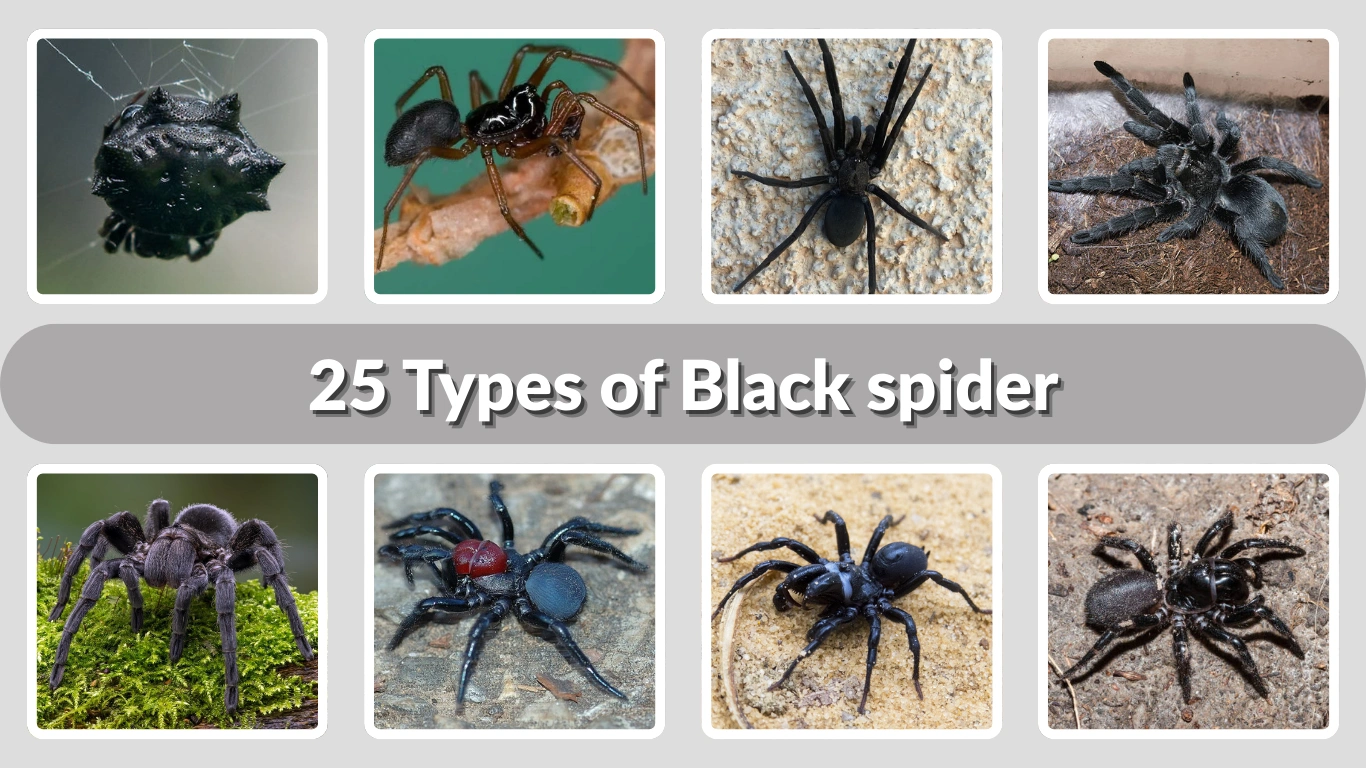
Black spiders appear in homes, gardens, forests, and desert regions worldwide. Though many look intimidating, most are harmless and play an important role in controlling insect populations. From jumping spiders to tarantulas, each species has unique traits and behaviors. This guide highlights 25 types of black spiders, helping you recognize their appearances, habits, and lifecycles so you can better understand and identify the dark-colored spiders you encounter.
1. Black Widow Spider (Latrodectus mactans)

The black widow spider is one of the most recognizable spiders in the world, known for its glossy black body and distinctive red hourglass marking. Often misunderstood, this species is shy by nature but possesses a potent venom that has made it both famous and feared.
Identification
- Shiny black body with a red hourglass on the underside of the abdomen
- Females larger than males, with rounded abdomens
- Long, slender legs
- Silk webs appear messy and irregular
Habitat
Black widows prefer dark, sheltered environments such as woodpiles, sheds, basements, garages, and under outdoor furniture. They build irregular webs in quiet corners where they can stay hidden. Outdoors, they thrive in dry, warm climates and often hide beneath rocks or debris.
Behaviors
These spiders are nocturnal and remain hidden during the day. Females rarely leave their webs except to feed or reproduce. When threatened, they usually retreat rather than attack. Males wander in search of females and are much less commonly seen by people.
Diet
Black widows feed on small insects such as flies, beetles, grasshoppers, and ants. They rely on their sticky, tangled webs to trap prey. After immobilizing their catch with venom, they wrap it in silk and feed by liquefying the internal tissues.
Lifecycle
Females lay eggs in silk sacs containing hundreds of eggs. Spiderlings emerge after several weeks and disperse by ballooning on silk strands. Males reach adulthood sooner than females but live shorter lives. Females can live up to three years, while males often survive only a few months.
2. False Black Widow (Steatoda grossa)

The false black widow is often mistaken for the true black widow due to its dark coloration and rounded abdomen. However, it is less venomous and far more common in homes, making it one of the most encountered dark-colored spiders in urban areas.
Identification
- Dark brown to black, glossy body
- Round, smooth abdomen without the red hourglass marking
- Subtle cream or reddish patterns on some individuals
- Females larger and bulkier than males
Habitat
False black widows thrive in sheltered, undisturbed indoor and outdoor locations. They commonly build webs in garages, basements, storage rooms, outdoor sheds, and under stairwells. Outdoors, they hide in crevices, fences, rock piles, and hollow logs.
Behaviors
These spiders are mostly nocturnal and prefer to remain hidden during the day. They create messy, three-dimensional webs similar to black widows. False black widows are shy and rarely aggressive. They typically bite only when accidentally pressed or disturbed.
Diet
Their diet includes ants, flies, beetles, millipedes, and other small arthropods. They rely on their irregular webs to trap prey, immobilizing it with venom before feeding. They can survive for long periods with minimal food.
Lifecycle
Females lay several egg sacs throughout the year, each holding dozens of eggs. Spiderlings emerge in a few weeks and disperse nearby. Adults can live one to two years, with females usually living longer than males. Their populations often increase indoors during warmer months.
3. Black House Spider (Badumna insignis)

The black house spider is a common dark-colored spider known for its funnel-shaped webs and preference for buildings and outdoor structures. Though it may appear intimidating, it is generally shy and avoids human contact.
Identification
- Dark brown to black, velvety body
- Females have large, oval abdomens
- Legs appear thick and slightly hairy
- Funnel-like retreat at the corner of their messy web
Habitat
Black house spiders prefer sheltered locations around homes, such as window frames, door corners, eaves, sheds, and fences. Outdoors, they build webs in tree bark crevices, rock walls, and garden structures. They favor dry, stable environments where their webs remain undisturbed.
Behaviors
These spiders are mostly sedentary and remain inside their funnel retreat unless hunting or repairing their web. They are nervous when approached and quickly retreat when disturbed. Females often stay in the same web for long periods, enlarging it over time.
Diet
Black house spiders feed on moths, flies, beetles, mosquitoes, and other small insects that wander into their sticky web. They wait inside their funnel until prey is detected, then rush out, bite, and drag it back inside for feeding.
Lifecycle
Females create several egg sacs during the warm season. Spiderlings hatch within a few weeks and disperse nearby. Black house spiders can live for several years, with females outliving males significantly. Males wander in search of mates and rarely survive long after breeding.
4. Bold Jumping Spider (Phidippus audax)

The bold jumping spider is one of the most recognizable black spiders due to its striking iridescent chelicerae and lively behavior. Known for its excellent vision and agile movements, it is a harmless yet fascinating species often seen around homes and gardens.
Identification
- Black body with white or orange spots on the abdomen
- Iridescent green or blue mouthparts (chelicerae)
- Compact, sturdy body with short, strong legs
- Large forward-facing eyes for sharp vision
Habitat
Bold jumping spiders inhabit a wide variety of environments, including gardens, walls, fences, tree trunks, and outdoor buildings. They prefer sunny, open areas where they can actively hunt. Indoors, they may appear on windowsills, ceilings, or corners but do not build webs to catch prey.
Behaviors
These spiders rely on jumping and visual hunting rather than webs. They stalk prey with precision, leaping accurately using their powerful legs. Curious by nature, they often turn to look at approaching humans. They are diurnal, most active during daylight hours.
Diet
Bold jumping spiders feed on flies, ants, moths, small beetles, and even other spiders. They actively hunt rather than trap, using stealth and fast movements to capture prey. Their excellent eyesight helps them detect motion and track targets effectively.
Lifecycle
Females lay eggs in silk sacs hidden in sheltered areas. Spiderlings hatch and stay in the sac briefly before dispersing. Males mature earlier and search actively for mates, while females live longer and may produce multiple egg sacs. Their lifespan typically ranges from one to two years.
5. Regal Jumping Spider (Phidippus regius)

The regal jumping spider is a large, visually striking jumping spider often found in the southeastern United States. Known for its bold appearance and curious nature, it is admired by enthusiasts for its intelligence and vibrant coloration.
Identification
- Black body with distinct white or orange abdominal markings
- Iridescent chelicerae (green, blue, or purple)
- Large, robust jumping spider build
- Females often larger and more patterned than males
Habitat
Regal jumping spiders prefer warm, sunny habitats such as gardens, shrubs, fences, tree bark, and outdoor structures. They are common in coastal areas and fields. Indoors, they may wander near windows or ceilings while searching for prey but do not rely on webs to hunt.
Behaviors
Like other jumping spiders, they use keen eyesight to stalk and leap onto prey with precision. They are active during the day and exhibit curious behaviors, often observing human movement closely. They construct silk retreats for resting, molting, or egg-laying rather than web traps.
Diet
Their diet consists of flies, moths, small beetles, crickets, and other spiders. They hunt by sight, slowly approaching prey before delivering a quick leap. Larger individuals may even capture small insects that other spiders cannot handle.
Lifecycle
Females create silk sacs where they lay their eggs and guard them until hatching. Spiderlings develop through several molts, gradually increasing in size. Males mature faster for mating, while females may live longer and produce multiple clutches. The species generally lives for 1–2 years.
6. Zebra Jumping Spider (Salticus scenicus – Dark Morph)

The zebra jumping spider (dark morph) is a compact, agile species known for its excellent vision and rapid movements. While the typical form has bold black-and-white stripes, some individuals appear much darker, giving them a more uniformly black appearance.
Identification
- Dark gray to black body with faint or reduced striping
- Small, compact jumping-spider shape
- Large forward-facing eyes
- Short legs adapted for quick jumps
Habitat
These spiders thrive in sunny outdoor areas such as walls, fences, rocks, garden furniture, and window ledges. They prefer warm, open surfaces where they can hunt actively. Indoors, they may appear near windows or ceilings but do not build webs to catch prey.
Behaviors
Zebra jumping spiders are diurnal hunters that rely on vision to stalk prey. They make calculated jumps, often pausing to observe movement. Their curiosity is notable—they sometimes turn toward approaching humans. They build small silk retreats for resting and molting.
Diet
Their diet includes small flies, gnats, aphids, and tiny insects. They hunt by slowly approaching prey and leaping with accuracy. Once captured, they immobilize prey with a quick bite before feeding.
Lifecycle
Egg sacs are laid in silk retreats attached to sheltered surfaces. Spiderlings hatch and disperse to nearby hunting areas. The species undergoes several molts before reaching adulthood. Adults typically live about one year, with females slightly outliving males.
7. Black Lace-Weaver (Amaurobius ferox)

The black lace-weaver is a dark-colored spider commonly found in homes, sheds, and gardens. It is known for its cribellate silk, which gives its webs a wool-like texture. Despite its intimidating appearance, it is generally shy and avoids confrontation.
Identification
- Dark brown to black body
- Oval abdomen with subtle patterns
- Legs thick and slightly hairy
- Webs made of fuzzy, non-sticky lace-like silk
Habitat
Black lace-weavers prefer sheltered, dim environments such as basements, crawl spaces, garages, woodpiles, and garden walls. Outdoors, they hide under stones, logs, and debris. They frequently live near human structures where stable humidity and cover are available.
Behaviors
They build flat, lace-like webs connected to a tubular retreat where they hide. Primarily nocturnal, they wait inside the retreat and dash out when prey touches the web’s vibrations. They are not aggressive and usually flee when disturbed.
Diet
Their diet includes beetles, flies, ants, moths, and other small insects. They rely on their woolly silk to entangle prey without stickiness. After capturing prey, they bite and drag it to their retreat to consume it safely.
Lifecycle
Females produce egg sacs within their retreats and guard them until hatching. Spiderlings remain nearby before dispersing. Adults reach maturity in about a year and may live one to two years. Females typically survive longer than males and maintain the same web for long periods.
8. Black Fat-Tailed Scorpion Spider (Family: Trochanteriidae)

The black fat-tailed scorpion spider gets its name from its rounded abdomen and low, flattened body shape, which give it a scorpion-like silhouette. This secretive species is known for its strong legs and ground-dwelling habits.
Identification
- Matte black or very dark brown body
- Flattened, wide cephalothorax
- Thick, rounded “fat-tail” abdomen
- Long, strong legs adapted for running
Habitat
These spiders prefer dark, sheltered environments such as leaf litter, under rocks, bark crevices, and fallen logs. They are ground-dwellers and thrive in forests, grasslands, and dry scrub habitats. Indoors, they appear only when accidentally wandering inside.
Behaviors
Black fat-tailed scorpion spiders are nocturnal hunters that do not use webs to trap prey. Instead, they rely on speed and stealth, ambushing insects at night. They are shy, quick to flee when disturbed, and rarely display aggressive behavior toward humans.
Diet
Their diet consists mainly of small insects and ground-dwelling arthropods. They capture prey using rapid bursts of movement, overpowering it with strong jaws. They may also scavenge if food is scarce in their environment.
Lifecycle
Females lay eggs in well-hidden silk retreats under debris. After hatching, spiderlings remain near the mother briefly before dispersing. The species develops slowly, with several molts before adulthood. Adults can live one to two years in stable conditions.
9. Black Funnel-Web Spider (Family: Agelenidae / Atracidae species varies)

The black funnel-web spider is known for its dark coloration and distinctive funnel-shaped retreat. While some funnel-web species are highly venomous (such as Australian Atracidae), many harmless black funnel-web spiders exist worldwide. Their appearance and web structure make them easy to recognize.
Identification
- Dark brown to black body
- Shiny cephalothorax with a more matte abdomen
- Long legs adapted for fast movement
- Creates a horizontal sheet web with a tubular funnel retreat
Habitat
Black funnel-web spiders inhabit forests, gardens, and areas with thick vegetation. They build webs in crevices, under logs, between rocks, and along fences or walls. Indoors, they may appear in garages, basements, or corners where they can anchor their funnel webs safely.
Behaviors
These spiders rely on speed rather than sticky silk. They hide inside the funnel and rush out when prey vibrates the web. They are shy and retreat quickly when approached. Some species can be defensive if threatened but typically avoid confrontation.
Diet
Their diet includes beetles, moths, ants, and small crawling insects. They detect prey through vibrations on the web and capture it swiftly with a quick bite. After subduing their target, they drag it into their funnel retreat for consumption.
Lifecycle
Females lay egg sacs inside the funnel retreat, guarding them until spiderlings hatch. The young remain nearby before dispersing to build their own webs. Depending on the species, adults may live several years, with females often outliving males significantly.
10. Black Ground Spider (Family: Gnaphosidae)

The black ground spider is a fast-moving, nocturnal hunter commonly found at ground level. Known for its dark coloration and cylindrical spinnerets, it rarely uses webs to catch prey and instead relies on stealth and speed.
Identification
- Matte black or dark gray body
- Elongated abdomen with visible, tube-like spinnerets
- Flat, low-profile body shape
- Quick-moving legs suited for running
Habitat
Black ground spiders live in leaf litter, under stones, logs, bark, and debris. They prefer dry ground environments such as grasslands, forests, gardens, and even urban landscapes. Indoors, they may wander into basements, garages, or ground-level rooms.
Behaviors
These spiders are active hunters that roam at night searching for prey. They do not spin sticky webs but create small silk retreats for resting and molting. They are shy, solitary, and quick to hide when disturbed, rarely showing aggression.
Diet
Their diet includes ants, small beetles, flies, and other ground-dwelling insects. They capture prey through ambush or rapid pursuit, using powerful jaws to subdue their targets. They typically feed inside their silk retreats for protection.
Lifecycle
Females lay eggs in silk sacs inside sheltered retreats. Spiderlings stay with the mother briefly before dispersal. The species matures over several molts, taking months to reach adulthood. Adults generally live one to two years, with females usually living longer than males.
11. Black Trapdoor Spider (Family: Ctenizidae / Idiopidae)

The black trapdoor spider is a burrowing species known for its unique hinged door made of soil and silk. Its dark coloration and robust body give it a powerful appearance, though it rarely emerges from its tunnel except to hunt.
Identification
- Shiny black or very dark brown body
- Thick, robust cephalothorax
- Large fangs and strong front legs
- Stocky, rounded abdomen
Habitat
Black trapdoor spiders live underground in carefully built burrows. They prefer moist, stable soil in forests, grasslands, garden beds, and woodland edges. Their burrows are lined with silk and topped with a camouflaged “trapdoor” that blends into the ground surface.
Behaviors
These spiders are ambush predators. They wait just inside their burrow with the trapdoor slightly open; when prey passes by, they burst out with remarkable speed. They are solitary, nocturnal, and rarely wander far from their tunnel.
Diet
Their diet includes ground-dwelling insects such as beetles, crickets, ants, and other small arthropods. They quickly seize prey near their burrow entrance and drag it inside for feeding. Their strong jaws allow them to overpower prey larger than themselves.
Lifecycle
Females may live many years, maintaining the same burrow for most of their lives. They lay eggs inside the burrow, and spiderlings stay with the mother until they are ready to disperse and dig their own tunnels. Males leave their burrows upon maturity to search for mates and live much shorter lives.
12. Black Purseweb Spider (Family: Atypidae)

The black purseweb spider is a primitive mygalomorph known for its unusual tubular web that lies along the ground or tree trunks. Its dark, glossy body and secretive habits make it difficult to spot in the wild.
Identification
- Shiny black or deep brown body
- Cylindrical abdomen
- Large, strong fangs typical of mygalomorph spiders
- Builds long, sock-like tubular webs
Habitat
Black purseweb spiders prefer humid environments such as forests, wooded areas, mossy ground, and the bases of trees. They create their distinctive purse-like silk tubes along soil, rocks, or bark. They rarely enter homes, staying close to shaded, natural environments.
Behaviors
These spiders hide inside their tubular silk webs, waiting for prey to walk across them. When vibrations are detected, they bite through the silk from inside and pull prey into the tube. They are extremely secretive, seldom seen outside their shelter except when males seek mates.
Diet
They feed on ants, beetles, termites, and other small insects. Prey is captured by detecting footsteps on the web’s outer surface. Their strong fangs allow them to pierce the silk and drag prey inside to consume safely.
Lifecycle
Females live for many years in the same tube, enlarging it as needed. They lay eggs inside the web’s protected chamber. Spiderlings remain with the mother briefly before dispersing to build their own tubes. Males mature faster and leave the tube permanently to search for mates.
13. Black Wolf Spider (Family: Lycosidae – Dark Species/Forms)

The black wolf spider is a fast, powerful ground hunter known for its excellent eyesight and impressive speed. Unlike web-building spiders, wolf spiders chase and ambush prey directly, making them active and agile predators.
Identification
- Dark brown to black body
- Sturdy, robust legs
- Large eyes arranged in three reflective rows
- Females often larger and heavier than males
Habitat
Black wolf spiders inhabit grasslands, forests, gardens, rocky areas, and leaf litter. They shelter under stones, logs, and soil crevices. Indoors, they may wander into basements or garages while hunting. They prefer cool, shaded locations close to the ground.
Behaviors
Wolf spiders do not build webs for catching prey. Instead, they patrol or lie in wait, striking quickly when prey passes nearby. Females exhibit strong maternal behavior—carrying egg sacs on their spinnerets and spiderlings on their back after hatching.
Diet
Their diet includes beetles, ants, crickets, small spiders, and other ground-dwelling insects. They overpower prey using speed and strength. They may stalk prey over short distances or ambush it from cover.
Lifecycle
Females create round egg sacs and carry them until hatching. Spiderlings ride on the mother’s back for several days before dispersing. Wolf spiders mature over multiple molts, typically reaching adulthood within a year. Females often live longer than males, sometimes up to two years.
14. Mouse Spider (Missulena spp. – Black Morph)

The mouse spider (black morph) is a burrowing mygalomorph spider known for its shiny black body and powerful fangs. Although some species resemble black widows, mouse spiders are generally less aggressive and spend most of their lives underground.
Identification
- Shiny black cephalothorax and abdomen
- Large, powerful fangs
- Thick, sturdy legs
- Males often have a glossy jet-black appearance
Habitat
Mouse spiders live in underground burrows sealed with a trapdoor-like lid. They prefer moist soil in woodlands, scrublands, riverbanks, and garden beds. Their burrows may extend deep into the ground, offering protection from predators and temperature extremes.
Behaviors
These spiders are solitary ambush predators. They wait near the burrow entrance for prey to pass. Although they possess strong venom, they are typically shy and avoid confrontation. Males wander during mating season and are more likely to be seen above ground.
Diet
Mouse spiders feed on beetles, ants, small spiders, and ground-dwelling insects. They ambush prey near the burrow opening, using quick strikes and powerful jaws. Prey is often dragged inside the burrow before being consumed.
Lifecycle
Females can live for many years in the same burrow. They lay eggs in silk sacs protected inside their tunnel. Spiderlings remain with the mother briefly before dispersing to dig their own burrows. Males mature faster and live shorter lives, often surviving only one mating season.
15. Black Recluse (Loxosceles spp. – Rare Dark Variant)

The black recluse refers to rare dark-colored variants of recluse spiders, which are more commonly tan or brown. These darker forms maintain the same distinctive body shape and behaviors typical of recluse species.
Identification
- Dark brown to nearly black coloration
- Distinct violin-shaped marking on the cephalothorax
- Long, thin legs with fine hairs
- Uniform, smooth abdomen without patterns
Habitat
Black recluse variants prefer undisturbed, dry environments such as attics, basements, closets, sheds, woodpiles, and storage areas. Outdoors, they hide under bark, rocks, and debris. Their habitats are typically quiet, sheltered, and low in activity.
Behaviors
Recluse spiders are shy, slow-moving, and nocturnal. They avoid confrontation and bite only when trapped or pressed. They build irregular, thin webs used as retreats rather than hunting tools. Most of their activity happens at night while searching for prey.
Diet
Their diet includes small insects, beetles, and other soft-bodied arthropods. They hunt by stalking rather than relying on webs. Recluse spiders use venom to immobilize prey quickly before feeding on liquefied tissues.
Lifecycle
Females produce several egg sacs per year, each containing dozens of spiderlings. Young spiders develop slowly, molting multiple times before reaching maturity. Adults can live up to two or three years, with females typically outliving males.
16. Black Garden Spider (Araneus spp. – Juvenile Dark Form)

Juvenile black garden spiders are darker versions of orb-weaver spiders commonly found in gardens and outdoor areas. While adults often develop bright patterns, young individuals may appear almost entirely black.
Identification
- Dark brown to black juvenile coloration
- Rounded abdomen that may show faint patterning
- Long, banded legs typical of orb-weavers
- Builds classic circular orb webs
Habitat
These spiders thrive in gardens, hedges, shrubs, fences, and outdoor structures where they anchor their webs. They prefer areas with abundant flying insects. Juveniles usually stay in shaded or hidden spots, gradually moving to more open spaces as they mature.
Behaviors
Like all orb-weavers, juveniles create circular webs to capture prey. They rebuild or repair their webs daily, often consuming old silk at dawn. They are shy, retreating to the edge of the web or a nearby hiding place when disturbed.
Diet
Their diet consists of flies, gnats, moths, mosquitoes, and other small flying insects. They wait at the web’s center or retreat, sensing vibrations when prey becomes trapped. They immobilize prey with silk before feeding.
Lifecycle
Egg sacs hatch in spring, and spiderlings disperse by ballooning. Juveniles molt several times throughout the season, gradually developing the distinctive patterns seen in adults. Most orb-weavers live for one year, with adults maturing by late summer or fall.
17. Black Sac Spider (Cheiracanthium spp. – Dark Variant)

The black sac spider is a nocturnal hunter known for its smooth body and habit of creating small silk sacs instead of webs. While many sac spiders are pale, some species and variants appear dark brown to nearly black.
Identification
- Smooth, dark brown to black body
- Elongated abdomen with no distinct markings
- Long front legs adapted for fast movement
- Builds small silk sacs for resting, not for trapping prey
Habitat
Black sac spiders prefer quiet indoor spaces such as wall corners, ceilings, closets, and behind furniture. Outdoors, they hide under bark, stones, leaf litter, and garden debris. They often enter homes during cooler weather seeking shelter.
Behaviors
These spiders are active nighttime hunters that patrol walls and surfaces in search of prey. During the day, they hide inside their small silk sacs. They can move quickly when disturbed but generally avoid confrontation. Their bite is defensive, not aggressive.
Diet
Their diet consists of small insects such as flies, ants, beetles, and other spiders. They do not use webs to catch prey; instead, they ambush or chase down insects with speed and precision, using venom to quickly immobilize them.
Lifecycle
Females lay eggs inside the protective silk sacs and guard them until hatching. Spiderlings stay close for a short period before dispersing. The species matures through several molts and typically lives about one year, with females sometimes surviving longer.
18. Black Tarantula (Various Species – Dark Forms)

The black tarantula refers to several tarantula species that naturally exhibit deep black or near-black coloration. These large, heavy-bodied spiders are known for their calm temperament, impressive size, and striking appearance.
Identification
- Large, hairy body in deep black or charcoal tones
- Thick, powerful legs
- Prominent fangs typical of tarantulas
- Slow, deliberate movement
Habitat
Black tarantulas inhabit deserts, forests, grasslands, and tropical regions depending on the species. They live in burrows, rotten logs, underground tunnels, or natural cavities. Some species prefer dry, sandy soil, while others thrive in humid rainforest floors.
Behaviors
These spiders are mostly nocturnal and rely on ambush hunting. They spend much of their time inside burrows, emerging at night to hunt or explore. Generally calm, they prefer retreating over confrontation. When threatened, they may rear up or flick hairs (in New World species).
Diet
Black tarantulas feed on insects, beetles, grasshoppers, roaches, small lizards, and occasionally small mammals. They overpower prey with strength rather than webs. After injecting venom, they break down prey tissues to consume them.
Lifecycle
Tarantulas have long lifespans. Females can live 10–25 years, while males typically survive only 3–6 years. Females lay egg sacs inside burrows and guard them until spiderlings hatch. Young tarantulas molt multiple times as they grow, taking several years to reach maturity.
19. Black Baboon Spider (Family: Theraphosidae – Southern African Species)

The black baboon spider is a large, burrowing tarantula native to southern Africa. Known for its dark coloration and powerful build, this spider is respected for its defensive behavior and impressive size.
Identification
- Deep black or very dark brown, hairy body
- Thick, powerful legs
- Prominent fangs and robust cephalothorax
- Stocky, tarantula-like appearance
Habitat
Black baboon spiders live in underground burrows typically found in dry savannas, scrublands, and semi-desert regions. They choose compact soil for burrow stability. Their tunnels may be lined with silk and can extend deep underground for temperature and moisture control.
Behaviors
These spiders are nocturnal and spend most of the day hidden inside burrows. They are defensive when threatened and may rear up to display their fangs. Despite their intimidating behavior, they prefer retreating to their burrow rather than engaging predators.
Diet
Their diet includes beetles, crickets, roaches, small lizards, and other arthropods. They ambush prey near the burrow entrance or actively hunt at night. Strong fangs and venom help subdue larger prey.
Lifecycle
Females can live 10–20 years, while males live much shorter lives. Egg sacs are laid deep inside burrows, where spiderlings develop safely. Young spiders disperse after a few molts and dig their own burrows, reaching maturity after several years.
20. Black Chilean Tarantula (Grammostola porteri / Grammostola spatulata – Dark Form)

The black Chilean tarantula is a calm, hardy species native to Chile’s arid regions. While these spiders often display brown or gray hues, some individuals appear nearly black, giving them a striking and intimidating look.
Identification
- Dark brown to black, velvety body
- Thick, hairy legs
- Broad cephalothorax with a smooth appearance
- Slow-moving, robust tarantula build
Habitat
Black Chilean tarantulas inhabit dry scrublands, rocky hillsides, and semi-desert environments. They create burrows in firm soil or occupy natural crevices. In captivity, they are known for their adaptability and preference for dry, stable enclosures.
Behaviors
These spiders are calm and slow-moving. They spend much of their time resting inside burrows or under natural cover. While generally non-aggressive, they may flick urticating hairs when threatened. They are nocturnal, becoming active at night to feed.
Diet
Their diet consists of insects like crickets, roaches, beetles, and other small invertebrates. Larger individuals may also capture small vertebrates. They ambush prey with quick strikes, using strong fangs and venom to subdue it before feeding.
Lifecycle
Females have long lifespans, often living 15–20 years, while males typically survive only a few years after maturity. Egg sacs may contain dozens to hundreds of spiderlings. Young tarantulas grow through multiple molts, taking several years to reach adulthood.
21. Black Pinktoe Tarantula (Avicularia avicularia – Dark Morph)

The black pinktoe tarantula is an arboreal species known for its dark body and distinctive pink-tipped feet. While the typical form appears brownish or bluish, the dark morph displays a striking black appearance.
Identification
- Deep black or charcoal body
- Bright pink or reddish tips on the feet
- Slender legs adapted for climbing
- Fuzzy, arboreal tarantula body structure
Habitat
These spiders live in tropical rainforests, residing in tree hollows, bark crevices, and dense foliage. They build tube-like silk retreats above ground. In captivity, they require vertical space, high humidity, and ample ventilation.
Behaviors
Black pinktoe tarantulas are active climbers, spending most of their lives off the ground. They are generally calm but move quickly when startled. They build silk nests in elevated spaces and may create multiple layers of silk as they grow.
Diet
Their diet includes flying insects such as moths, flies, crickets, and roaches. They ambush prey from their silk retreats and rely on speed to capture it. Young spiders frequently feed on small insects like fruit flies or tiny roaches.
Lifecycle
Females live 8–12 years, while males have shorter lifespans. Egg sacs contain dozens of spiderlings that disperse after emerging. Growth occurs through multiple molts, with young tarantulas gradually darkening into their adult coloration.
22. Black Fishing Spider (Dolomedes spp. – Dark Morph)

The black fishing spider (dark morph) is a semi-aquatic species known for its ability to glide across water and even dive beneath the surface. Darker variants appear nearly black, giving them a more intimidating look than their patterned forms.
Identification
- Dark gray to nearly black coloration
- Long, slender legs often spanning several inches
- Flattened body adapted for water movement
- Subtle markings may be present but muted in dark morphs
Habitat
Black fishing spiders inhabit wetlands, lakeshores, ponds, streams, and marshes. They hide under rocks, vegetation, docks, and debris near water. Indoors, they may enter basements or bathrooms in search of moisture but do not breed inside homes.
Behaviors
These spiders are adept hunters that can walk on water, sense vibrations, and dive to escape predators. They ambush prey at the water’s surface or along shorelines. Though large and startling, they are shy and avoid confrontation.
Diet
Their diet includes aquatic insects, tadpoles, small fish, and terrestrial insects. They detect prey through surface vibrations and capture it using quick lunges. They inject venom to immobilize prey before consuming it.
Lifecycle
Females carry egg sacs in their jaws until ready to hatch. Spiderlings emerge into a protective nursery web built near water. Growth involves several molts, with maturity reached in one to two years. Females generally live longer than males.
23. Black Crevice Weaver (Family: Filistatidae)

The black crevice weaver is a secretive, dark-colored spider that builds tubular webs deep within cracks and crevices. Its flattened body and long legs help it navigate tight spaces where it stays hidden during the day.
Identification
- Dark brown to nearly black body
- Flattened cephalothorax for fitting into tight spaces
- Long, thin legs with fine hairs
- Creates tube-like webs in cracks and corners
Habitat
Black crevice weavers prefer dry, sheltered environments such as wall cracks, foundations, rock crevices, and under wooden structures. Indoors, they hide behind baseboards, inside wall gaps, or under furniture. Outdoors, they favor rocky areas and old buildings with plenty of hiding spots.
Behaviors
These spiders are nocturnal and emerge at night to patrol the entrance of their tubular web. They wait for vibrations from passing insects before lunging out to capture prey. They are shy and rarely roam far from their chosen crevice.
Diet
Their diet includes ants, beetles, roaches, and other small insects that wander near their web entrance. They rely on quick strikes and strong jaws to subdue prey, pulling it into the tube for safe consumption.
Lifecycle
Females lay eggs inside protected silk chambers within their webs. Spiderlings hatch and stay close until they disperse to find their own crevices. They grow slowly, molting several times before reaching adulthood. Females may live multiple years, while males live much shorter lives.
24. Black Dwarf Spider (Family: Linyphiidae)

The black dwarf spider is a tiny, ground-dwelling species known for its dark coloration and extremely small size. Despite being nearly invisible to the casual observer, these spiders play an important role in controlling small insect populations.
Identification
- Very small, often only a few millimeters long
- Dark brown to nearly black body
- Compact abdomen with minimal patterning
- Fine, delicate legs typical of dwarf spiders
Habitat
Black dwarf spiders live in leaf litter, moss, soil surfaces, and beneath stones or logs. They thrive in forests, gardens, meadows, and moist shaded areas. They rarely enter homes, but may appear in basements or ground-level rooms with high humidity.
Behaviors
These spiders build small sheet webs close to the ground, using them to detect and capture tiny insects. They are secretive, spending most of their time hidden among debris. Active mostly at dawn and dusk, they avoid open spaces and bright light.
Diet
Their diet focuses on tiny insects and arthropods, including springtails, mites, small flies, and other minute soil creatures. They trap prey in their fine webs or grab it directly when it walks close enough.
Lifecycle
Females lay small egg sacs hidden under debris or within the leaf litter. Spiderlings emerge and remain in sheltered microhabitats as they grow. Development occurs through multiple molts, with adults typically living one year.
25. Black Spiny Orb-Weaver (Gasteracantha spp. – Dark Morph)

The black spiny orb-weaver is a distinctive orb-weaving spider known for its hard, spiky abdomen. While many species are brightly colored, some individuals exhibit a nearly all-black form that appears bold and striking in contrast to their patterned relatives.
Identification
- Hard, glossy black abdomen with prominent spines
- Flattened, crab-like body shape
- Short legs compared to other orb-weavers
- Builds circular orb webs in open spaces
Habitat
Black spiny orb-weavers inhabit gardens, forests, shrubs, and wooded edges where flying insects are abundant. They anchor their webs between branches, fences, or garden plants. They are rarely found indoors, as they prefer open-air environments for constructing their wide webs.
Behaviors
These spiders build classic orb webs and remain near the center during the day. They are not aggressive and rely on their spiky armor for defense. When disturbed, they may drop from the web or retreat to nearby foliage.
Diet
Their diet consists mainly of small flying insects such as gnats, flies, mosquitoes, and tiny beetles. They rely on their webs to detect prey through vibrations, then quickly immobilize the insect before feeding.
Lifecycle
Females lay egg sacs attached to nearby vegetation or web supports. Spiderlings hatch and disperse by ballooning on silk strands. They grow through several molts before reaching maturity, usually within one season. Females often outlive males and build larger webs as they age.
FAQs
1. Why are so many spider species black in color?
Many spiders evolve dark coloration for camouflage, helping them blend into soil, bark, shadows, and crevices. Black coloration also aids in heat absorption, helping ground-dwelling and nocturnal species regulate body temperature. Additionally, some dark spiders mimic more dangerous species as a form of protection.
2. Are all black spiders dangerous to humans?
No. Only a few black spiders, such as black widows, possess medically significant venom. Most black spiders—like jumping spiders, orb-weavers, and ground spiders—pose no threat to humans. They may look intimidating, but they generally avoid confrontation and rarely bite unless provoked.
3. Why do some spiders not use webs to catch prey?
Spiders like wolf spiders, jumping spiders, and ground spiders rely on speed, vision, and stealth to hunt actively. They evolved away from web-based hunting because their environments favor movement and ambush strategies. These adaptations help them catch prey efficiently without relying on webs.
4. What attracts black spiders to homes and buildings?
Spiders enter homes seeking shelter, prey, or stable temperatures. Dark corners, cluttered spaces, basements, and attics offer ideal hiding spots. Indoor insects attract hunting spiders, while cracks and gaps allow entry. Moisture can also draw species that like humid conditions.
5. How can I safely manage or reduce black spiders around my home?
Seal cracks, reduce clutter, and keep areas clean to limit hiding spots. Remove webs, fix moisture issues, and reduce outdoor lighting that attracts insects (spider food). Natural barriers like essential oils may help. If spiders are not dangerous, gently relocating them outdoors is usually the best option.