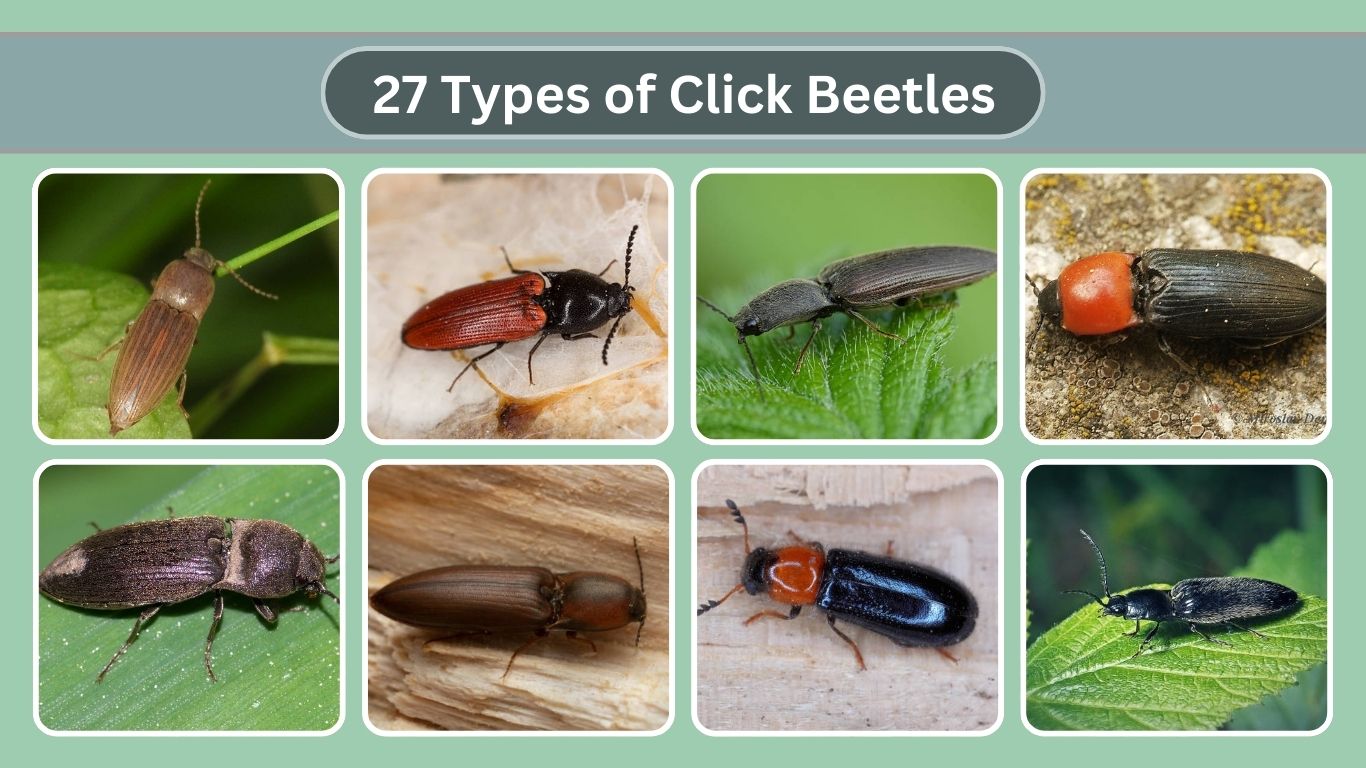
Click beetles (family Elateridae) are fascinating insects known for their unique ability to snap their bodies with an audible click, flipping themselves upright when overturned. Found worldwide in various habitats, these beetles play both ecological and agricultural roles. While adults often feed on nectar or plant juices, their larvae, known as wireworms, are infamous pests of crops. Below is a detailed look at 27 notable types of click beetles.
1. Eastern Eyed Click Beetle (Alaus oculatus)

The Eastern eyed click beetle is one of the largest and most striking click beetles found in North America. Its name comes from the two bold, eye-like spots on its thorax, which serve as a defense mechanism to deter predators. Known for its clicking sound and the ability to flip itself upright when overturned, this beetle is both fascinating and easily recognizable.
Identification
- Large beetle, ranging from 25–45 mm in length
- Black body covered with tiny white speckles
- Two large black oval “eye spots” on the pronotum, outlined in white
- Elongated and flat body shape typical of click beetles
- Strong mandibles and short antennae
Habitat
This beetle is commonly found in forests, woodlands, and areas with decaying logs. It prefers habitats where there is ample rotting wood, which provides food and shelter for its larvae.
Behavior
Eastern eyed click beetles are famous for their clicking mechanism. When threatened or flipped on their backs, they snap their bodies, producing a loud click and propelling themselves into the air. This sudden movement often startles predators and helps the beetle escape.
Diet
Adults primarily feed on nectar and plant juices, while the larvae, known as “wireworms,” are predatory and feed on the larvae of wood-boring insects inside decaying logs.
2. Alaus lusciosus

Alaus lusciosus is a large species of click beetle, closely related to the Eastern eyed click beetle. Like its relatives, it has a striking appearance and is capable of producing a loud click when flipped onto its back. This defensive adaptation makes it difficult for predators to capture and eat them.
Identification
- Size ranges from 20–40 mm in length
- Elongated, flattened body typical of click beetles
- Dark brown to black coloration with lighter mottling across the body
- Distinctive eye-like spots on the pronotum, though smaller and less vivid than those of Alaus oculatus
- Antennae are serrated and moderately long
Habitat
This species is often found in wooded areas, particularly in places with rotting logs or decaying stumps. They prefer warm and moist environments where their larvae can thrive.
Behavior
Like other click beetles, Alaus lusciosus is known for its clicking mechanism, which it uses to escape predators and flip itself over. They are nocturnal and often attracted to lights at night.
Diet
Adults feed mostly on nectar, plant sap, and sometimes soft plant tissues. The larvae (wireworms) are wood-dwellers and are believed to prey on other insect larvae within decaying wood.
3. Alaus myops

Alaus myops is another large and eye-catching member of the click beetle family. Closely related to Alaus oculatus and Alaus lusciosus, it also features the characteristic “false eyes” on its thorax that serve as a defense mechanism. Its size and striking appearance make it one of the more noticeable click beetles in its range.
Identification
- Medium to large beetle, usually 20–38 mm long
- Elongated, somewhat flattened body typical of click beetles
- Dark brown to black coloration, often speckled with lighter markings
- Two smaller eye-like spots on the pronotum compared to Alaus oculatus
- Serrated antennae and strong mandibles
Habitat
Alaus myops is most commonly found in forested regions, especially around dead trees and fallen logs. The decaying wood provides shelter and a food source for its larvae.
Behavior
Like its relatives, this beetle can make a sharp clicking noise and launch itself into the air when threatened or overturned. It is mostly nocturnal and often attracted to artificial lights during the night.
Diet
Adult beetles feed primarily on nectar and plant fluids. The larvae, like other click beetle wireworms, develop inside rotting wood and prey on the larvae of other wood-boring insects.
4. Alaus melanops

Alaus melanops is a dark-colored species of click beetle belonging to the same genus as the well-known eyed click beetles. While it lacks the dramatic eye spots of Alaus oculatus, it is still a large and impressive insect with the characteristic clicking mechanism for defense and self-righting.
Identification
- Medium to large size, usually 22–38 mm long
- Elongated, narrow body with a slightly flattened appearance
- Dark brown to nearly black coloration with faint mottling
- Pronotum without prominent eye-like spots, making it less conspicuous than other Alaus species
- Serrated antennae and well-developed legs
Habitat
This beetle is most commonly found in woodland environments, especially in areas with abundant fallen logs and decaying stumps. The larvae depend on rotting wood habitats to survive and develop.
Behavior
Alaus melanops demonstrates the same “clicking” behavior as other click beetles. When flipped over, it can arch and snap its body to produce a click, propelling itself upright and startling potential predators.
Diet
Adults typically consume nectar, sap, and other plant-based fluids. Larvae (wireworms) live inside rotting logs and prey on the larvae of other insects, contributing to the natural recycling of forest ecosystems.
5. Lacon punctatus

Lacon punctatus is a widespread species of click beetle, notable for its smaller size compared to the large Alaus beetles. It is common across Europe and Asia, where it inhabits woodlands and meadows. This beetle is often overlooked due to its dark, camouflaged body but still has the same clicking ability to escape threats.
Identification
- Medium-sized click beetle, about 10–15 mm long
- Elongated body with a slightly flattened shape
- Dark brown to black coloration with fine punctures (tiny pits) covering the surface
- Antennae short, slightly serrated
- Less striking appearance compared to eye-spotted Alaus species
Habitat
This beetle is usually found in forests, grasslands, and gardens, especially in moist soils rich in organic matter. It often hides under bark, stones, or decaying vegetation.
Behavior
Lacon punctatus displays the typical click beetle defense mechanism, flipping itself upright with a sharp click when disturbed. It is also attracted to lights at night and can be found resting in shaded spots during the day.
Diet
Adults mainly feed on nectar and plant juices. The larvae, which develop underground, are known as wireworms and feed on the roots of grasses and crops, sometimes causing damage to agricultural plants.
6. Agrypnus murinus

Agrypnus murinus is a common European click beetle, easily recognized by its mottled, earthy coloration that helps it blend into soil and leaf litter. Unlike the large and eye-spotted Alaus beetles, this species is more subdued in appearance but still shares the same clicking mechanism for defense and self-righting.
Identification
- Medium-sized beetle, about 12–18 mm in length
- Elongated, somewhat flattened body typical of click beetles
- Grayish-brown to dark brown coloration with a mottled, “dusty” look
- Body surface covered with fine scales, giving a rough texture
- Short serrated antennae
Habitat
This species is found in fields, meadows, gardens, and woodland edges across Europe and parts of Asia. It prefers moist soil environments where larvae can burrow and feed on roots.
Behavior
Agrypnus murinus is active mainly at night and is frequently attracted to lights. Like other click beetles, it uses its clicking action to evade predators and flip itself upright when overturned.
Diet
Adults feed on nectar and plant juices. The larvae, known as wireworms, live underground and consume plant roots, making them pests in agricultural fields, especially for cereals, potatoes, and grasses.
7. Melanotus communis

Melanotus communis, often referred to as the common click beetle, is one of the most widespread agricultural species in North America. Its larvae, known as wireworms, are particularly notorious for causing damage to the roots of crops, making it an economically important beetle for farmers to monitor.
Identification
- Medium-sized beetle, typically 12–16 mm long
- Elongated, cylindrical body with a smooth surface
- Dark brown to nearly black coloration
- Antennae are moderately long and slightly serrated
- Larvae are slender, hard-bodied, and yellow to orange in color
Habitat
This species is found in agricultural fields, grasslands, and gardens throughout much of North America. It thrives in moist soils where crops like corn, wheat, and potatoes are grown.
Behavior
Melanotus communis is primarily nocturnal and is often attracted to lights at night. Like other click beetles, it can produce a sharp clicking sound and flip itself upright when overturned, helping it escape predators.
Diet
Adults feed on plant sap and sometimes nectar, while the larvae (wireworms) feed on the underground parts of crops, particularly roots, seeds, and stems. This feeding behavior often leads to reduced yields in staple crops.
8. Limonius californicus (Sugarbeet Wireworm)

Limonius californicus, commonly called the sugarbeet wireworm, is a well-known agricultural pest in North America. Its larvae, or wireworms, attack the roots and seeds of a wide variety of crops, causing significant economic losses. Farmers often struggle to control this beetle due to the resilience of its larvae in the soil.
Identification
- Adult beetle length: 8–12 mm
- Body elongated, narrow, and slightly flattened
- Brown to dark brown coloration with a smooth, shiny surface
- Antennae moderately long and serrated
- Larvae are slender, hard, yellowish to orange, and wormlike in appearance
Habitat
This species inhabits cultivated fields, grasslands, and gardens, particularly in the western United States and Canada. It prefers loose, moist soils, where the larvae can burrow and feed undisturbed.
Behavior
Limonius californicus is mostly nocturnal, hiding during the day and becoming active at night. Adults are attracted to lights. The wireworm stage can last for several years underground, making management difficult.
Diet
Adults feed lightly on plant material such as sap and leaves, but the larvae are the real pests. They feed on seeds, sprouts, and underground stems of crops including sugarbeets, potatoes, corn, and wheat.
9. Limonius infuscatus

Limonius infuscatus is another species of wireworm click beetle that poses risks to agriculture, though it is less notorious than Limonius californicus. Found in North America, it is part of the same genus known for its soil-dwelling larvae that feed on the roots of various crops, often causing unseen but serious damage below ground.
Identification
- Adult beetle length: 8–11 mm
- Elongated, narrow body typical of click beetles
- Dark brown to nearly black coloration with a subtle metallic sheen
- Smooth body surface with fine punctures
- Larvae (wireworms) are thin, cylindrical, and yellowish-brown
Habitat
This species inhabits agricultural fields, meadows, and grassy soils across western North America. It thrives in moist, cultivated soils, especially where cereal crops and potatoes are grown.
Behavior
Like other click beetles, L. infuscatus can flip upright with a snapping motion when overturned. Adults are nocturnal and commonly attracted to lights. The larval stage is long-lasting, often remaining underground for several years.
Diet
Adults feed sparingly on plant fluids and nectar, but the larvae are root feeders. They attack seeds, seedlings, and underground plant stems, making them destructive to crops such as wheat, corn, and potatoes.
10. Limonius canus

Limonius canus is a species of click beetle native to North America and is considered one of the major agricultural wireworms. Its larvae feed extensively on underground plant parts, damaging crops and reducing yields. Like its close relatives, it can survive underground for years, making control difficult.
Identification
- Adult beetle length: 9–12 mm
- Elongated, narrow body with a slightly flattened appearance
- Grayish-brown to dark brown coloration with fine punctures on the surface
- Antennae moderately serrated and fairly long
- Larvae are yellowish to orange-brown, hard-bodied, and wormlike
Habitat
This beetle inhabits agricultural fields, grasslands, and gardens, especially in moist, fertile soils. It is common in the western United States and Canada, where cereal crops and potatoes are widely grown.
Behavior
Adults are nocturnal and are often drawn to artificial lights. Like other click beetles, Limonius canus produces a snapping click to right itself when overturned, startling predators. The larvae remain underground, sometimes for several years, before pupating.
Diet
Adult beetles feed lightly on plant fluids, while larvae (wireworms) feed on seeds, roots, and underground stems. They are serious pests of potatoes, corn, wheat, and sugar beets, causing wilted or stunted crops.
11. Conoderus vespertinus

Conoderus vespertinus is a North American click beetle species whose larvae are commonly referred to as wireworms. While not as destructive as some other species, it is still an agricultural concern, particularly in fields where root crops are grown. Adults are often seen during the evening hours, which is reflected in the name “vespertinus,” meaning “of the evening.”
Identification
- Adult length: 7–10 mm
- Elongated, narrow, and slightly flattened body
- Brown to dark brown coloration with a smooth, somewhat glossy surface
- Antennae moderately long and serrated
- Larvae are yellowish to orange, slender, and cylindrical, typical of wireworms
Habitat
This species is usually found in crop fields, grasslands, and gardens throughout parts of North America. It thrives in moist soils where larvae can burrow and feed on underground vegetation.
Behavior
Adults are crepuscular to nocturnal, most active at dusk and during the night. They are often attracted to artificial lights. Like other click beetles, Conoderus vespertinus produces a sharp click when threatened or flipped over, enabling it to leap back onto its feet.
Diet
Adults feed on nectar, sap, and sometimes soft plant tissues. The larvae (wireworms) are more problematic, as they feed on the roots, seeds, and underground stems of crops such as corn, wheat, and potatoes.
12. Conoderus lividus

Conoderus lividus is a small to medium-sized click beetle native to North America. Like its close relatives, its larvae are wireworms that feed underground and can become minor pests in agricultural fields. Though less destructive than some species, it plays a role in soil ecosystems and is often encountered in cultivated areas.
Identification
- Adult size: 7–11 mm long
- Elongated, slender body with a smooth texture
- Color ranges from light brown to reddish-brown, sometimes with a faint metallic sheen
- Antennae are moderately serrated and proportionate to body length
- Larvae are thin, hard-bodied, and yellow to orange in color
Habitat
This beetle inhabits agricultural lands, meadows, and grasslands across North America. It prefers moist soils with plenty of organic matter, where larvae can burrow and feed on plant roots.
Behavior
Adults are mostly nocturnal and are attracted to lights at night. When overturned, Conoderus lividus snaps its body to produce the typical click, enabling it to right itself and startle predators.
Diet
Adult beetles feed on nectar, sap, and occasionally soft plant tissues. Larvae (wireworms) are underground feeders, consuming roots and stems of crops like corn, wheat, potatoes, and other vegetables.
13. Ampedus sanguineus

Ampedus sanguineus is a striking species of click beetle known for its reddish coloration. Belonging to the diverse Ampedus genus, this beetle is often found in wooded habitats, especially where decaying logs provide shelter for its larvae. Its vibrant appearance sets it apart from the more subdued brown click beetles.
Identification
- Adult length: 8–12 mm
- Elongated, narrow body typical of click beetles
- Bright reddish to orange elytra (wing covers) with a contrasting black head and pronotum
- Fine punctures visible on the surface of the elytra
- Larvae (wireworms) are slender, hard-bodied, and yellowish-brown
Habitat
This species prefers forests, woodlands, and areas with decaying timber. Fallen logs, stumps, and rotting wood are common sites where larvae develop.
Behavior
A. sanguineus is mostly nocturnal, often hiding during the day in wood crevices or under bark. Like other click beetles, it can produce a snapping click to escape predators or flip itself upright when overturned.
Diet
Adults feed on nectar and plant fluids. The larvae live in rotting wood, preying on other insect larvae and sometimes feeding on decomposing organic matter, contributing to forest nutrient cycling.
14. Ampedus nigricollis

Ampedus nigricollis is a member of the Ampedus genus, known for its bright coloration and association with woodland habitats. Like other click beetles, it uses its clicking mechanism for defense and self-righting. Its larvae develop in decaying wood, playing an important role in forest ecosystems.
Identification
- Adult length: 9–13 mm
- Elongated, narrow body form
- Elytra (wing covers) reddish to orange, often bright and glossy
- Pronotum (area behind the head) distinctly black, creating a sharp contrast with the red elytra
- Larvae are wireworm-like, slender, hard, and yellowish-brown
Habitat
This beetle inhabits deciduous and mixed forests, especially areas with fallen logs, rotting stumps, and decaying timber. It is often found under bark or within wood crevices.
Behavior
A. nigricollis is active primarily at night and is sometimes drawn to artificial lights. When threatened or overturned, it produces the characteristic click that launches it into the air.
Diet
Adults feed on nectar, sap, and occasionally pollen. The larvae live in decayed wood and are predatory, feeding on other insect larvae, though they may also consume decomposing organic matter.
15. Ampedus pomorum

Ampedus pomorum is a woodland click beetle frequently found in association with old trees and rotting timber. Its attractive reddish body makes it easier to recognize compared to many dull-colored click beetles. Like other members of the Ampedus genus, it plays an ecological role in forest decomposition and insect population control.
Identification
- Adult size: 8–12 mm long
- Elongated, narrow body shape
- Elytra (wing covers) bright reddish-orange, smooth with fine punctures
- Pronotum black, forming a sharp contrast with the red elytra
- Larvae are yellowish-brown, slender, and hard-bodied, typical wireworms
Habitat
This species thrives in deciduous forests and orchards, especially in areas rich with fallen logs, old stumps, and decaying branches. It is often found beneath bark or inside rotting wood.
Behavior
Mostly nocturnal, A. pomorum hides in wood crevices during the day. When disturbed, it uses the characteristic click-jump to startle predators and right itself if overturned.
Diet
Adult beetles feed on plant sap, nectar, and occasionally pollen. The larvae are predatory, living inside decaying wood and feeding on other insect larvae, contributing to the breakdown of organic matter.
16. Athous haemorrhoidalis

Athous haemorrhoidalis is a widespread click beetle species found across Europe and parts of Asia. It is often seen in meadows, grasslands, and agricultural fields. Unlike many brightly colored Ampedus beetles, this species is more subdued in appearance but is important because of its larvae, which can become agricultural pests.
Identification
- Adult length: 9–12 mm
- Elongated, slender body with a smooth surface
- Brown to reddish-brown coloration, sometimes with a lighter underside
- Antennae are long and slightly serrated
- Larvae are yellowish to brown, cylindrical, and hard-bodied (wireworms)
Habitat
This beetle inhabits grasslands, farmlands, gardens, and woodland edges. It is especially common in cultivated soils, where its larvae thrive underground.
Behavior
Adults are active during the day and can often be seen on grass stems and low vegetation. Like all click beetles, they produce a clicking sound and flip themselves upright when overturned.
Diet
Adult beetles feed on plant material, including pollen and soft plant tissues. Larvae live underground and feed on the roots of cereals, grasses, and vegetable crops, sometimes causing significant agricultural damage.
17. Athous campyloides

Athous campyloides is a click beetle species primarily found in Europe, especially in grassy and open habitats. Though less studied than some of its relatives, it shares the same body structure and behavior typical of click beetles. Its larvae, like other Athous species, are soil-dwelling wireworms that can cause harm to crops.
Identification
- Adult size: 8–11 mm long
- Slender, elongated body with smooth dorsal surface
- Coloration ranges from light brown to dark brown
- Antennae moderately long and serrated
- Larvae are elongated, yellow to light brown, with a tough outer shell
Habitat
This species inhabits grasslands, meadows, farmland, and field margins. It prefers moist, cultivated soils where its larvae can develop underground.
Behavior
Adults are diurnal and can often be seen on grasses and flowers. When disturbed, they employ the typical “click” mechanism to escape danger or to flip back upright. They are less attracted to lights compared to some other click beetles.
Diet
Adults feed on pollen, nectar, and occasionally plant tissues. Larvae are underground feeders that consume the roots of grasses and cereal crops, sometimes causing localized agricultural damage.
18. Selatosomus latus

Selatosomus latus is a click beetle species native to Europe, commonly encountered in open fields, meadows, and lightly wooded areas. It is recognized for its dark, somewhat glossy appearance. Like other Selatosomus species, its larvae are soil-dwelling wireworms that feed on plant roots, occasionally becoming agricultural pests.
Identification
- Adult size: 9–14 mm long
- Elongated, narrow body with a slightly flattened profile
- Dark brown to nearly black coloration, often with a faint metallic sheen
- Elytra covered with fine punctures and hairs, giving a rough texture
- Larvae are cylindrical, yellowish-brown, and hard-bodied
Habitat
This species inhabits meadows, pastures, field edges, and occasionally forests. It prefers moist soils where its larvae can burrow and feed underground.
Behavior
Adults are most active during spring and summer, often found crawling on low vegetation or resting under stones. When overturned, they employ the familiar “click” jump to right themselves and evade predators.
Diet
Adult beetles feed on plant sap, nectar, and occasionally pollen. Larvae feed underground on roots of grasses, cereals, and other plants, which may result in crop damage in cultivated lands.
19. Selatosomus impressus

Selatosomus impressus is a European click beetle species that thrives in open habitats and farmland. Like other members of its genus, it is often dark in color and not easily noticed, yet its larvae (wireworms) can affect agricultural productivity by feeding on crop roots.
Identification
- Adult size: 8–13 mm in length
- Slender, elongated body form typical of click beetles
- Dark brown to black coloration, with a slightly matte or dull surface
- Elytra finely punctured with shallow impressed lines, giving the species its name
- Larvae are long, thin, and yellowish-brown, with a hard, shiny body
Habitat
This beetle is found in meadows, grasslands, cultivated fields, and sometimes forest edges. It prefers damp soils, particularly in areas with abundant vegetation or crops.
Behavior
Adults are active in warm months, often seen crawling on grass or hiding under stones and debris. Like all click beetles, S. impressus uses its snapping mechanism to right itself when overturned and to avoid predation.
Diet
Adults feed lightly on plant sap, nectar, and pollen. The larvae are soil-dwellers and feed on plant roots, including cereals and grasses, occasionally causing crop damage.
20. Hypnoidus bicolor

Hypnoidus bicolor is a small click beetle species distributed across Europe and parts of Asia. Though modest in size and appearance, it is agriculturally significant because of its larvae, which are root-feeding wireworms that can damage cereal and vegetable crops.
Identification
- Adult length: 5–8 mm
- Small, elongated body with a slightly flattened profile
- Bicolored: typically dark brown to black body with lighter brown or reddish elytra
- Elytra finely punctured, giving a textured appearance
- Larvae are slender, shiny, and yellowish to light brown
Habitat
This species is most common in meadows, pastures, gardens, and agricultural fields. It thrives in moist, fertile soils where its larvae can burrow and feed on plant roots.
Behavior
Adults are mostly nocturnal, hiding in vegetation or under stones during the day. At night, they may be attracted to lights. Like other click beetles, they produce a snapping click to right themselves or escape predators.
Diet
Adults feed lightly on nectar, sap, and plant tissues. The larvae feed underground on seeds, sprouts, and roots of cereals, vegetables, and grasses, sometimes causing localized agricultural losses.
21. Hypnoidus riparius

Hypnoidus riparius is a click beetle species often found in damp environments, such as near rivers, streams, and wetlands. Like its close relative Hypnoidus bicolor, its larvae are known as wireworms and can become pests of grasses and crops by feeding on their underground parts.
Identification
- Adult size: 6–9 mm in length
- Elongated, narrow body with a slightly flattened appearance
- Dark brown to black coloration, sometimes with faint reddish tones
- Elytra covered with fine punctures and shallow grooves
- Larvae are shiny, hard-bodied, and yellowish-brown
Habitat
This beetle favors wet habitats including riverbanks, marshes, meadows, and moist agricultural soils. It is distributed across parts of Europe and Asia.
Behavior
Adults are most active at night and may be drawn to artificial lights. They hide under debris, stones, or vegetation during the day. Like other click beetles, H. riparius uses its clicking jump to flip upright or escape predators.
Diet
Adult beetles consume small amounts of nectar and plant fluids. The larvae feed underground on roots of cereals, grasses, and occasionally vegetable crops, sometimes causing economic damage in farmland.
22. Cardiophorus ruficollis

Cardiophorus ruficollis is a distinctive click beetle species recognized by its reddish collar-like pronotum, which contrasts with its darker body. Found across parts of Europe and Asia, this beetle is less harmful agriculturally than some other click beetles but still has larvae that develop underground as wireworms.
Identification
- Adult size: 6–10 mm long
- Elongated, narrow body shape
- Pronotum reddish to orange-red, giving the species its name (“ruficollis” = red neck)
- Elytra dark brown to black, finely punctured with subtle grooves
- Antennae moderately long and serrated
- Larvae are yellowish-brown, cylindrical, and shiny
Habitat
This species is found in meadows, forest edges, agricultural fields, and grassy areas. It prefers soils rich in organic matter where larvae can thrive.
Behavior
Adults are active in spring and summer, often found resting on flowers, grasses, or low vegetation. They are also nocturnal and may be attracted to lights at night. When disturbed, they produce the typical snapping click to right themselves or avoid predation.
Diet
Adults feed on nectar, pollen, and plant fluids. The larvae live underground, feeding on roots of grasses, cereals, and sometimes vegetable crops, though they are not considered major agricultural pests.
23. Cardiophorus gramineus

Cardiophorus gramineus is a small click beetle commonly found across Europe in grassy areas, as its name suggests (“gramineus” relates to grasses). While not as brightly colored as C. ruficollis, it plays a similar ecological role, with larvae that live underground as wireworms.
Identification
- Adult length: 6–9 mm
- Elongated, slender body form
- Dark brown to black coloration, sometimes with lighter shades on the pronotum
- Elytra finely punctured with shallow longitudinal grooves
- Antennae are long, serrated, and proportionate to body size
- Larvae are shiny, hard-bodied, and yellowish-brown
Habitat
This species thrives in meadows, pastures, agricultural fields, and grassy forest clearings. It is especially abundant in moist soils where grasses dominate.
Behavior
Adults are active in spring and summer, often seen crawling on grasses and low plants. They are nocturnal and frequently attracted to artificial lights. When disturbed, they perform the characteristic “click” jump to evade threats.
Diet
Adults feed on nectar, pollen, and occasionally sap. Larvae feed on the roots of grasses and cereals, sometimes becoming pests in cultivated fields, though generally not as destructive as other wireworm species.
24. Hemicrepidius hirtus

Hemicrepidius hirtus is one of the larger click beetles found in Europe, recognized by its dark body covered with fine hairs. It prefers open, sunny habitats and is often found in meadows and near woodland edges. While its larvae live in the soil, they are less harmful to crops compared to some other wireworm species.
Identification
- Adult length: 12–18 mm
- Elongated, robust body form
- Black to dark brown coloration with a dense covering of fine grayish hairs
- Elytra finely punctured with shallow grooves running lengthwise
- Antennae long and serrated
- Larvae are elongated, hard-bodied, and yellowish-brown
Habitat
This beetle is common in meadows, pastures, woodland edges, and sunny grasslands. It prefers soils rich in organic matter where its larvae can burrow.
Behavior
Adults are mainly active in late spring and summer, often seen on flowers or grasses. They are nocturnal and attracted to artificial lights. Like all click beetles, H. hirtus uses its clicking mechanism to flip itself upright and evade predators.
Diet
Adults feed on nectar, pollen, and plant juices. Larvae live underground, feeding on roots of grasses and small plants, though they are not considered serious agricultural pests.
25. Hemicrepidius niger

Hemicrepidius niger is a dark-bodied click beetle found in Europe and parts of Asia. It resembles H. hirtus but has a more uniformly black appearance and less visible body hair. Like other members of its genus, it inhabits grassy and open landscapes where its larvae develop in the soil.
Identification
- Adult size: 11–16 mm long
- Elongated, cylindrical body shape
- Uniformly black or very dark brown coloration
- Elytra finely punctured with distinct longitudinal grooves
- Antennae moderately long and serrated
- Larvae are slender, shiny, and yellowish-brown
Habitat
This species lives in meadows, grasslands, and open fields, often at the edges of forests. It prefers moist soils, particularly in areas with abundant grasses.
Behavior
Adults are most active in late spring and summer, often hiding during the day and becoming active at night. They are strongly attracted to lights. When threatened, H. niger employs the characteristic snapping click to flip upright and escape predators.
Diet
Adult beetles consume nectar, sap, and pollen. Larvae (wireworms) feed underground on the roots of grasses and cereals, but they are generally not regarded as major agricultural pests.
26. Agriotes lineatus

Agriotes lineatus, commonly known as the lined click beetle, is one of the most widespread and agriculturally significant species in Europe. Its larvae, the wireworms, are notorious crop pests, particularly damaging cereals, potatoes, and root vegetables. Farmers often monitor this species closely due to its economic impact.
Identification
- Adult size: 7–10 mm long
- Slender, elongated body form
- Brown to dark brown coloration with fine longitudinal stripes on the elytra
- Elytra smooth with parallel grooves, giving a “lined” appearance
- Antennae moderately long and serrated
- Larvae are hard, shiny, and yellowish to light brown
Habitat
This species is common in agricultural fields, grasslands, and meadows across Europe. It thrives in moist, cultivated soils rich in organic matter where its larvae can survive for several years.
Behavior
Adults are active in spring and early summer, often found on vegetation or soil surfaces. They are nocturnal and readily attracted to lights. Like other click beetles, they perform a snapping click to right themselves when overturned.
Diet
Adults feed lightly on plant sap, nectar, and pollen. The larvae, however, are major pests, feeding on seeds, roots, and underground stems of crops, often leading to stunted or dying plants.
27. Agriotes obscurus

Agriotes obscurus, commonly called the dusky wireworm beetle, is one of the most problematic agricultural click beetles in Europe. Its larvae, known as wireworms, are highly destructive to a wide range of crops and can persist in the soil for years, making control extremely difficult.
Identification
- Adult size: 7–9 mm long
- Slender, elongated body with a slightly flattened form
- Dark brown to black coloration, often appearing dull or “dusky”
- Elytra with fine punctures and shallow longitudinal grooves
- Antennae serrated and proportionate to body length
- Larvae are yellowish-brown, shiny, and very hard-bodied
Habitat
This species is widespread in meadows, pastures, and farmlands across Europe. It thrives in moist, cultivated soils and is especially abundant in regions with cereal and root crop farming.
Behavior
Adults are active in spring and summer, often hiding in vegetation and active at night. They are strongly attracted to lights. When threatened or overturned, A. obscurus produces the characteristic clicking sound and jump.
Diet
Adults feed sparingly on plant sap and nectar. Larvae are serious agricultural pests, attacking seeds, roots, and underground stems of potatoes, corn, wheat, and other crops, often causing significant yield losses.