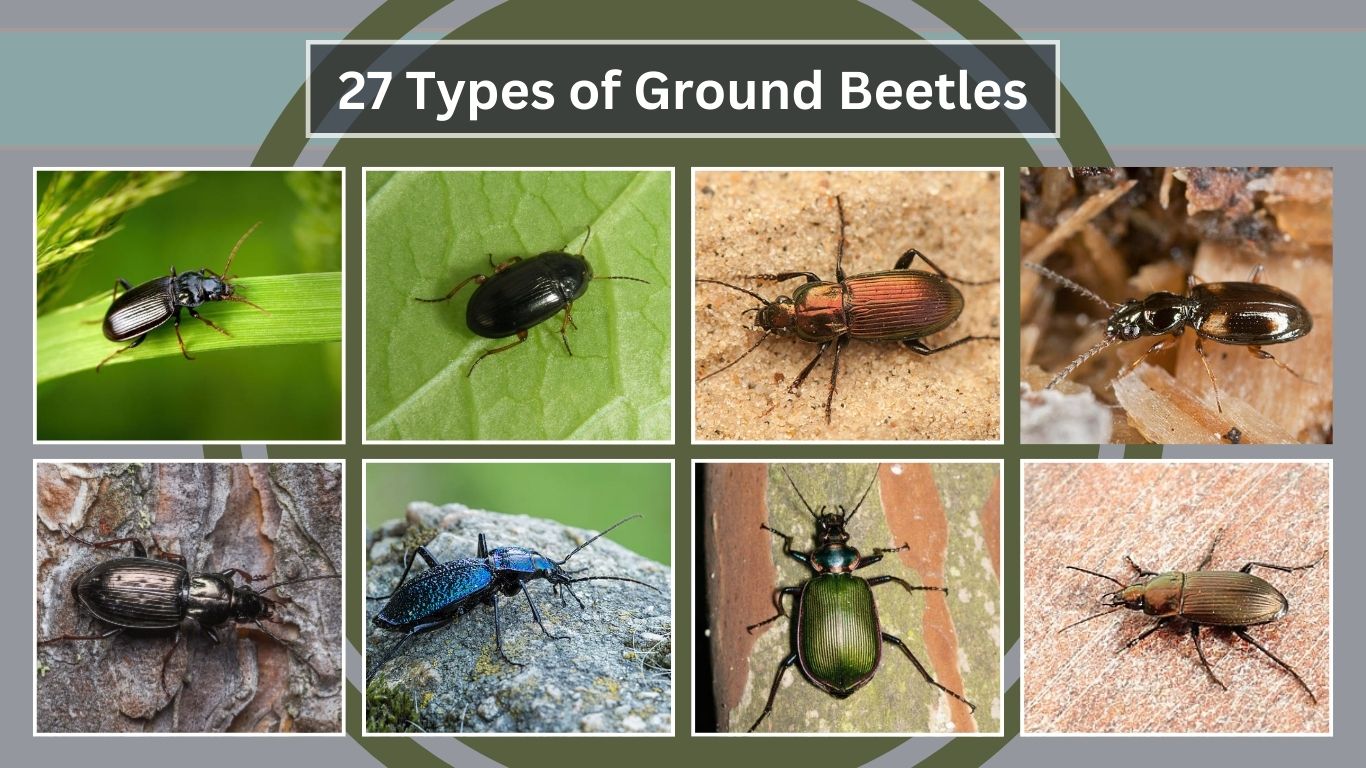
Ground beetles (Carabidae) are a diverse group of predatory insects found worldwide, playing a vital role in natural pest control. With their strong mandibles, fast movements, and nocturnal hunting habits, they help balance ecosystems by preying on caterpillars, slugs, and other invertebrates. Ranging from small seed-eating beetles to large, metallic predators, these 27 species showcase the fascinating variety within the ground beetle family.
1. Carabus auratus (Golden Ground Beetle)

The Golden Ground Beetle (Carabus auratus) is one of the most striking beetles in Europe, known for its metallic green body and golden highlights along the wing cases and legs. It is a highly active predator, often found in farmlands, meadows, and gardens where it plays an important role in controlling pests like caterpillars and slugs.
Identification
- Metallic green body with golden edges on the wing covers
- Long legs adapted for running
- Size ranges between 20–30 mm
- Distinct grooved elytra (wing cases)
Habitat
Carabus auratus prefers open and sunny areas such as meadows, fields, and gardens. It is often found in agricultural lands where it thrives in moist soil conditions and abundant vegetation cover.
Behavior
This beetle is a strong runner and an efficient hunter. It is mostly nocturnal, searching for prey at night, but it can also be active during the day. It relies on its sharp mandibles to attack soft-bodied insects and larvae.
Diet
Golden Ground Beetles primarily feed on caterpillars, slugs, and other small invertebrates, making them beneficial for natural pest control in gardens and farmlands.
Nest and Reproduction
Females lay eggs in soil during spring and summer. The larvae are also predatory, living in the soil and feeding on small insects before pupating into adults.
2. Carabus nemoralis (European Ground Beetle)

The European Ground Beetle (Carabus nemoralis) is a common beetle across Europe and North America, introduced as a beneficial insect for pest control. It has a dark, often bronze or violet metallic sheen on its wing covers and is a strong predator of slugs, caterpillars, and other soil-dwelling pests.
Identification
- Body length between 20–28 mm
- Elytra (wing covers) dark bronze, coppery, or violet metallic
- Deep grooves and faint ridges on the wing covers
- Long legs and antennae, typical of ground beetles
Habitat
This beetle thrives in forests, fields, gardens, and farmland. It prefers moist soil and areas with good ground cover, where it can hide during the day and hunt at night.
Behavior
Carabus nemoralis is nocturnal and an active hunter. It hides under stones, leaves, or logs during the day. When disturbed, it can release a foul-smelling defensive secretion to deter predators.
Diet
Its diet mainly consists of slugs, snails, caterpillars, and other soft-bodied insects. Farmers and gardeners consider it highly beneficial for reducing pest populations.
Nest and Reproduction
Females lay eggs in soil, and the larvae develop underground. Both larvae and adults are predatory, contributing to effective natural pest control throughout their life cycle.
3. Carabus granulatus (Granulate Ground Beetle)

The Granulate Ground Beetle (Carabus granulatus) is a widespread species across Europe and Asia, known for its adaptability to diverse habitats. Its body has a metallic bronze or copper color with a granular texture on the wing covers, giving the beetle its name. It is a nocturnal predator that helps regulate populations of slugs and insects.
Identification
- Body size ranges between 20–30 mm
- Elytra (wing covers) show a granular, rough surface
- Bronze, coppery, or green metallic sheen
- Slender legs and antennae typical of ground beetles
Habitat
Carabus granulatus inhabits forests, meadows, wetlands, and farmland. It prefers moist soil and is often found under logs, stones, or leaf litter. It adapts well to both wild and cultivated landscapes.
Behavior
This species is nocturnal, emerging at night to hunt. It is an active runner and relies on strong mandibles to subdue prey. During the day, it hides under debris or soil to avoid predators.
Diet
Its primary diet includes slugs, caterpillars, worms, and other small invertebrates. Both adult and larval stages are carnivorous, making them valuable for natural pest control.
Nest and Reproduction
Females deposit eggs in the soil during warmer months. The larvae grow underground as active predators before pupating into adults, continuing the life cycle.
4. Carabus hortensis (Garden Ground Beetle)

The Garden Ground Beetle (Carabus hortensis) is a large and striking beetle commonly found across Europe and parts of Asia. It is recognized by its dark metallic body, often tinged with green or violet reflections. Active mainly at night, this beetle is an efficient predator of slugs, worms, and other soft-bodied invertebrates, making it a gardener’s ally.
Identification
- Large body, measuring 25–35 mm
- Elytra (wing covers) dark brown to black with metallic green or violet sheen
- Strong, ridged elytra with fine punctures
- Long legs and antennae suited for fast movement
Habitat
Carabus hortensis prefers damp environments such as forests, gardens, meadows, and farmland. It hides under stones, logs, or leaf litter during the day and emerges at night to forage.
Behavior
This species is nocturnal and highly active, using its speed to chase and capture prey. When threatened, it can release a strong-smelling defensive secretion to ward off predators.
Diet
Its diet mainly includes slugs, worms, caterpillars, and other small insects. Both larvae and adults are voracious predators, helping control garden pests naturally.
Nest and Reproduction
Eggs are laid in the soil during spring and summer. The larvae, like the adults, are predatory and develop underground before pupating into mature beetles.
5. Carabus cancellatus (Cancellate Ground Beetle)

The Cancellate Ground Beetle (Carabus cancellatus) is a medium-to-large beetle native to Europe and Asia, easily recognized by the distinctive net-like pattern on its wing covers. It is a highly adaptable species found in farmland, gardens, and woodlands, where it actively hunts pests such as slugs, caterpillars, and beetle larvae.
Identification
- Body length ranges from 20–32 mm
- Elytra (wing covers) have a reticulated or “cancellate” pattern of ridges
- Color varies from bronze to coppery-green with metallic reflections
- Strong mandibles and long legs suited for predatory behavior
Habitat
Carabus cancellatus thrives in cultivated land, meadows, and forest edges. It often shelters under stones, logs, and dense vegetation during the day, preferring moist soils with good ground cover.
Behavior
This beetle is mostly nocturnal, actively hunting at night. It is a fast runner and releases a foul-smelling chemical as a defense mechanism when threatened.
Diet
It preys on caterpillars, beetle larvae, worms, and slugs. Both adults and larvae are effective natural pest controllers, making this beetle beneficial for agriculture.
Nest and Reproduction
Females lay eggs in soil during warm months. The larvae develop underground, feeding on invertebrates before pupating and emerging as adults to continue the predatory cycle.
6. Carabus intricatus (Blue Ground Beetle)

The Blue Ground Beetle (Carabus intricatus) is one of the largest and rarest ground beetles in Europe, admired for its deep metallic blue sheen. Unlike many other ground beetles, it is less common and has a patchy distribution, often restricted to ancient woodlands with rich moss and decaying wood. Its striking appearance and scarcity make it a protected species in several countries.
Identification
- Large beetle, measuring 24–35 mm
- Distinctive metallic blue or violet body
- Elytra (wing covers) strongly ridged with rough textures
- Long legs and antennae adapted for active hunting
Habitat
Carabus intricatus prefers damp, shaded woodland habitats. It is often associated with ancient forests where moss, lichens, and decaying logs are abundant, providing cover and hunting grounds.
Behavior
This beetle is nocturnal and hides under bark, moss, or logs during the day. It is a slow mover compared to other Carabus species but an efficient predator. Its rarity makes it a key species for conservation efforts.
Diet
Its main prey consists of slugs, snails, and other soft-bodied invertebrates. It uses strong mandibles to pierce and consume its prey, playing an important role in controlling slug populations in forest ecosystems.
Nest and Reproduction
Females lay eggs in moist soil or rotting wood. The larvae, also predatory, feed on invertebrates before completing their life cycle and emerging as adults.
7. Carabus violaceus (Violet Ground Beetle)

The Violet Ground Beetle (Carabus violaceus) is a large, widespread beetle across Europe and parts of Asia, easily identified by its dark body with a violet or purple sheen around the edges. It is a powerful nocturnal predator and often found in gardens, forests, and grasslands, making it one of the most commonly encountered ground beetles.
Identification
- Body length 20–30 mm
- Dark black body with metallic violet or purple margins on elytra and pronotum
- Elytra smooth with faint ridges
- Strong mandibles and long legs for running and hunting
Habitat
This species inhabits woodlands, fields, hedgerows, and gardens. It hides under stones, logs, or leaf litter during the day and prefers damp, shaded areas with rich vegetation.
Behavior
Carabus violaceus is mainly nocturnal, emerging at night to hunt. When disturbed, it can secrete a strong, foul-smelling chemical to deter predators. Unlike some other beetles, it rarely flies and relies on running.
Diet
The diet includes slugs, snails, caterpillars, and other soft-bodied invertebrates. Its role as a natural pest controller makes it beneficial in both wild and cultivated environments.
Nest and Reproduction
Females lay eggs in soil or under decaying vegetation. The predatory larvae feed underground on invertebrates before pupating and emerging as adults.
8. Carabus coriaceus (Leather Beetle)

The Leather Beetle (Carabus coriaceus) is the largest ground beetle species in Europe, with an imposing size and matte black appearance. Unlike many metallic-colored Carabus species, it has a rough, leathery texture on its wing covers, which inspired its name. Despite its intimidating look, it is harmless to humans and highly valuable as a natural predator of garden pests.
Identification
- Very large body, 30–40 mm in length
- Matte black coloration with a rough, leathery texture on the elytra
- Strongly ridged wing covers, not shiny like other Carabus species
- Long legs and antennae typical of ground beetles
Habitat
Carabus coriaceus inhabits forests, woodlands, and occasionally gardens and farmland. It prefers moist, shaded areas with plenty of hiding spots under logs, bark, or stones.
Behavior
This beetle is mostly nocturnal and a slow but determined hunter. When threatened, it secretes a foul-smelling fluid as a defense mechanism. Despite its size, it rarely flies and depends on running for mobility.
Diet
It feeds primarily on slugs, worms, caterpillars, and insect larvae. Both adults and larvae are predatory, contributing to pest control in natural and cultivated habitats.
Nest and Reproduction
Females lay eggs in moist soil or rotting wood. The larvae are also voracious predators, completing their development underground before transforming into adult beetles.
9. Pterostichus melanarius (Black Ground Beetle)

The Black Ground Beetle (Pterostichus melanarius) is a widespread and common species found across Europe, Asia, and North America. It is entirely black, shiny, and slightly smaller than many Carabus species, but equally important in controlling pests. Highly adaptable, it thrives in farmland, gardens, and urban areas.
Identification
- Medium-sized beetle, 12–18 mm long
- Shiny black body, smooth and elongated
- Elytra (wing covers) with faint longitudinal grooves
- Long legs and antennae designed for rapid running
Habitat
This species is commonly found in agricultural land, meadows, grasslands, and gardens. It prefers moist environments and shelters under stones, logs, or soil clumps during the day.
Behavior
Pterostichus melanarius is nocturnal and very active at night. It is a strong runner, rarely flying, and will release defensive chemicals when disturbed. Its adaptability allows it to thrive in disturbed habitats, including crop fields.
Diet
It preys on slugs, snails, caterpillars, insect larvae, and other small invertebrates. Because of its feeding habits, it is considered one of the most beneficial ground beetles for farmers and gardeners.
Nest and Reproduction
Eggs are laid in soil during the warmer months. The larvae, like adults, are carnivorous and develop underground before pupating into adult beetles.
10. Pterostichus madidus (Common Black Ground Beetle)

The Common Black Ground Beetle (Pterostichus madidus) is one of the most familiar ground beetles in Europe. It is often seen in gardens, farmland, and woodland edges, where it plays a vital role as a natural predator of slugs and insects. With its glossy body and reddish legs, it is easily distinguished from other black ground beetles.
Identification
- Medium to large size, 14–20 mm in length
- Shiny black or dark brown body
- Distinct reddish-brown legs and antennae
- Elytra (wing covers) have shallow grooves running lengthwise
Habitat
This species is highly adaptable, occurring in woodlands, grasslands, gardens, and cultivated fields. It prefers moist soil and hides beneath logs, stones, or leaf litter during daylight hours.
Behavior
Pterostichus madidus is nocturnal and emerges at night to hunt. It is a strong runner but rarely uses its wings for flight. When threatened, it secretes a pungent defensive liquid to repel predators.
Diet
Its diet includes slugs, caterpillars, worms, and insect larvae. Both adults and larvae are carnivorous, making this beetle highly valuable for natural pest regulation in agricultural landscapes.
Nest and Reproduction
Eggs are laid in soil during spring and summer. The larvae develop underground, preying on soil invertebrates, before pupating into adults to continue the life cycle.
11. Pterostichus oblongopunctatus

Pterostichus oblongopunctatus is a medium-sized ground beetle widely distributed across Europe and parts of Asia. Unlike some other shiny black species, it has a more matte appearance and is adapted to life in woodlands, particularly in damp, shaded areas. It is an active predator that contributes to maintaining ecological balance in forest ecosystems.
Identification
- Medium size, 10–14 mm long
- Dark brown to black body with a slightly matte finish
- Elytra (wing covers) with characteristic oblong punctures (elongated pits) along the grooves
- Slender legs and long antennae, typical of ground beetles
Habitat
This beetle prefers damp coniferous and deciduous forests. It can often be found under logs, bark, and moss in shaded woodland environments. It thrives in areas with rich soil and leaf litter.
Behavior
Pterostichus oblongopunctatus is mainly nocturnal, hiding during the day and foraging at night. It is a quick runner and uses chemical secretions as a defense mechanism when disturbed.
Diet
Its diet includes slugs, insect larvae, and other soft-bodied invertebrates. Both the adult beetles and their larvae are predatory, which helps in regulating pest populations in forest habitats.
Nest and Reproduction
Eggs are laid in moist soil or decaying organic matter. The larvae develop underground, feeding on invertebrates before pupating and becoming adults.
12. Pterostichus niger

Pterostichus niger is a large and robust ground beetle widely found across Europe and Asia. With its glossy black body and powerful build, it is one of the most recognizable species in its genus. It prefers damp, shaded habitats and plays an important role as a predator of soil-dwelling invertebrates, making it an ecologically significant species.
Identification
- Large body, measuring 18–26 mm
- Shiny black coloration across the entire body
- Elytra (wing covers) smooth with faint longitudinal grooves
- Strong mandibles and sturdy legs for hunting and running
Habitat
This beetle inhabits damp forests, meadows, and grasslands. It is often found under logs, stones, and leaf litter, especially in areas with moist soil. Unlike some smaller beetles, it prefers more natural, undisturbed habitats.
Behavior
Pterostichus niger is nocturnal and an active hunter. During the day, it hides in soil crevices or under debris. When threatened, it can release a pungent defensive secretion to deter predators.
Diet
It primarily feeds on slugs, snails, caterpillars, and soil invertebrates. Its predatory habits make it an important natural pest controller in woodland ecosystems.
Nest and Reproduction
Eggs are deposited in moist soil or leaf litter. The larvae are predatory and develop underground, feeding on invertebrates before emerging as adults.
13. Harpalus rufipes (Strawberry Ground Beetle)

The Strawberry Ground Beetle (Harpalus rufipes) is a widespread species found throughout Europe, Asia, and introduced to North America. Unlike many other ground beetles, it has more omnivorous habits, often feeding on both insects and plant material, including ripe strawberries—hence its common name. It is especially common in farmland and gardens.
Identification
- Medium-sized beetle, 10–15 mm long
- Shiny black body with reddish-brown legs and antennae
- Elytra (wing covers) smooth with faint striations
- Distinct contrast between dark body and red appendages
Habitat
This beetle is typically found in agricultural fields, grasslands, and gardens. It thrives in disturbed habitats and can often be seen on the soil surface at night.
Behavior
Harpalus rufipes is nocturnal and very active after dark, often foraging in open spaces. It is a strong runner and uses chemical secretions to protect itself when threatened.
Diet
Unlike strictly carnivorous ground beetles, this species is omnivorous. It feeds on insect larvae, caterpillars, and soft-bodied invertebrates, but also consumes seeds, fruits, and strawberries, sometimes causing minor agricultural damage.
Nest and Reproduction
Females lay eggs in the soil during warmer months. The larvae, like adults, are opportunistic feeders, developing underground before pupating into adults.
14. Harpalus affinis

Harpalus affinis is a common ground beetle species widely distributed across Europe, Asia, and introduced to North America. Known for its metallic sheen and adaptability, it thrives in a variety of habitats, from farmland to urban gardens. Like many in its genus, it has omnivorous feeding habits, making it both a predator and a seed-eater.
Identification
- Medium-sized beetle, 8–12 mm long
- Elytra (wing covers) metallic green, bronze, or bluish with faint grooves
- Legs and antennae usually reddish to dark brown
- Compact body shape with smooth, shiny surface
Habitat
This species lives in open habitats such as meadows, agricultural fields, grasslands, and gardens. It often hides under stones, logs, or soil clumps during the day and becomes active at night.
Behavior
Harpalus affinis is nocturnal and an agile runner. It is highly adaptable, tolerating disturbed environments, including crop fields. It also has the ability to feed on a wide variety of food sources, which supports its widespread presence.
Diet
This beetle is omnivorous. It consumes insect larvae, caterpillars, and small invertebrates, but also feeds on grass seeds and plant material, sometimes impacting crop seeds in agricultural areas.
Nest and Reproduction
Eggs are deposited in soil, where larvae develop as opportunistic feeders. Both larvae and adults maintain similar feeding habits, ensuring their survival in diverse conditions.
15. Harpalus pensylvanicus (Pennsylvania Ground Beetle)

The Pennsylvania Ground Beetle (Harpalus pensylvanicus) is a widespread species across North America, well known for its role as both a predator and a seed consumer. Farmers often value it as a natural ally in controlling insect pests and weed seeds, making it an important species in agricultural ecosystems.
Identification
- Medium-sized beetle, 12–16 mm long
- Shiny black body with a slightly elongated oval shape
- Elytra (wing covers) finely striated with a smooth surface
- Reddish-brown legs and antennae, contrasting with its dark body
Habitat
This beetle is commonly found in farmland, grasslands, gardens, and forest edges. It thrives in disturbed soils, especially crop fields, where food sources are abundant.
Behavior
Harpalus pensylvanicus is nocturnal and spends the day hidden under soil, stones, or debris. It is an active surface runner at night and has strong mandibles for breaking down both insect prey and seeds.
Diet
This species is omnivorous, feeding on insect larvae, caterpillars, and other soft-bodied invertebrates. Uniquely, it also consumes large quantities of weed seeds, making it beneficial for reducing invasive plant growth in farmlands.
Nest and Reproduction
Eggs are laid in soil during warm months. The larvae, like adults, feed on both insects and seeds underground before completing their life cycle and emerging as adults.
16. Amara aenea (Bronze Ground Beetle)

The Bronze Ground Beetle (Amara aenea) is a small but widespread species found across Europe, Asia, and North America. It is easily recognized by its bronze to coppery metallic sheen and is often seen running across open ground in sunny habitats. Unlike many ground beetles, it has a largely seed-based diet, though it occasionally consumes small insects.
Identification
- Small to medium-sized beetle, 6–9 mm long
- Bronze, coppery, or green metallic sheen on the body
- Elytra (wing covers) smooth with faint longitudinal lines
- Legs and antennae usually reddish to brown
Habitat
This beetle thrives in open habitats such as grasslands, meadows, farmland, and gardens. It prefers sunny locations with loose, dry soil where it can easily burrow and forage.
Behavior
Amara aenea is diurnal, unlike many nocturnal ground beetles. It is active during the day, often running quickly across soil and vegetation in search of seeds. It rarely flies but can disperse effectively on foot.
Diet
Primarily granivorous, this species feeds on seeds of grasses, weeds, and other plants. Occasionally, it supplements its diet with small insects and larvae, especially when food is scarce.
Nest and Reproduction
Eggs are laid in soil during the warm months. Larvae are mainly seed-eaters, completing their development underground before pupating into adults.
17. Amara communis

Amara communis is one of the most widespread species in the Amara genus, found across Europe, Asia, and extending into parts of North America. It is a small, shiny ground beetle that favors open fields and grasslands. Like many in its group, it has a strong preference for seeds but will occasionally feed on small invertebrates.
Identification
- Small beetle, 7–10 mm long
- Shiny black or dark bronze body with smooth elytra
- Elytra (wing covers) marked with faint striations
- Legs and antennae are reddish-brown to dark brown
Habitat
This species prefers grasslands, farmlands, field margins, and meadows. It thrives in sunny, open areas with loose soil and is commonly found in agricultural fields.
Behavior
Amara communis is mostly diurnal, actively foraging during the day. It is a fast runner and highly adaptable, tolerating disturbed environments such as farmland and urban gardens.
Diet
Primarily granivorous, feeding on grass and weed seeds, but it may also consume small insects and larvae. Its seed-eating habits make it useful in limiting weed growth in cultivated fields.
Nest and Reproduction
Eggs are deposited in soil during summer. The larvae, like adults, are mainly seed feeders, developing underground before transforming into adults.
18. Amara familiaris

Amara familiaris is a common seed-feeding ground beetle that belongs to the Amara genus. It is widely distributed across Europe and parts of Asia, often found in agricultural land, meadows, and grassy habitats. Like other Amara species, it contributes to natural weed control by consuming large quantities of seeds.
Identification
- Small beetle, 6–9 mm long
- Body shiny dark brown to black, sometimes with a faint bronze tint
- Elytra (wing covers) smooth with shallow striations
- Legs and antennae reddish-brown
Habitat
This species is usually present in open, grassy environments such as fields, farmland, meadows, and road verges. It favors dry, loose soils where seeds are abundant.
Behavior
Amara familiaris is diurnal, actively searching for food during daylight hours. It is a fast-moving beetle and can cover large ground surfaces in search of seeds. It rarely flies, preferring to stay close to the soil surface.
Diet
Mainly granivorous, feeding on grass seeds, cereal grains, and weed seeds. Occasionally, it supplements its diet with small insects or larvae when available.
Nest and Reproduction
Eggs are laid in the soil during the warmer months. The larvae, like the adults, feed primarily on seeds underground before pupating into mature beetles.
19. Nebria brevicollis (Short-Necked Ground Beetle)

The Short-Necked Ground Beetle (Nebria brevicollis) is one of the most widespread species in Europe and has also become established in North America. It is a highly adaptable predator, often encountered in gardens, woodlands, and agricultural fields. Its adaptability and abundance make it one of the most frequently seen ground beetles.
Identification
- Medium-sized beetle, 12–16 mm long
- Body elongated, dark brown to black, with a matte to slightly glossy surface
- Pronotum (area behind the head) relatively short and rounded, giving the “short-necked” appearance
- Elytra (wing covers) marked with deep grooves
- Legs reddish-brown
Habitat
This species thrives in diverse habitats, including forests, grasslands, farmland, gardens, and even urban areas. It shelters under stones, logs, or leaf litter during the day and prefers moist soil.
Behavior
Nebria brevicollis is nocturnal, actively hunting at night. It is a quick runner and highly adaptable, allowing it to dominate in both natural and disturbed habitats. When threatened, it can emit a defensive chemical secretion.
Diet
It preys on slugs, insect larvae, caterpillars, and small invertebrates, making it beneficial for natural pest control. Unlike some other beetles, it is almost entirely carnivorous.
Nest and Reproduction
Eggs are laid in soil, where larvae develop as predators. The larvae live underground, feeding on invertebrates before pupating and becoming adults.
20. Nebria gyllenhali

Nebria gyllenhali is a lesser-known but widely distributed ground beetle species found across parts of Europe and Asia. It belongs to the genus Nebria, which includes species that prefer cooler and moist habitats. Like its relatives, it is a fast-moving predator that contributes to controlling insect populations in its environment.
Identification
- Medium-sized beetle, usually 10–14 mm long
- Body elongated and narrow, dark brown to black in color
- Elytra (wing covers) with well-marked longitudinal grooves
- Pronotum (neck shield) slightly elongated compared to Nebria brevicollis
- Legs and antennae generally reddish-brown
Habitat
This beetle favors damp habitats, including riverbanks, forest floors, wetlands, and moist meadows. It often hides under stones, moss, or leaf litter during the day.
Behavior
Nebria gyllenhali is primarily nocturnal, emerging at night to hunt. It is a strong runner but does not rely on flight, preferring ground movement. Like other Nebria species, it secretes defensive chemicals when disturbed.
Diet
Carnivorous in nature, it feeds on small invertebrates such as insect larvae, worms, and slugs. Its role as a natural predator makes it valuable in maintaining ecosystem balance.
Nest and Reproduction
Eggs are deposited in soil or moist organic matter. The larvae, also predatory, develop underground before pupating and emerging as adult beetles.
21. Poecilus cupreus (Copper Ground Beetle)

The Copper Ground Beetle (Poecilus cupreus) is a common and colorful species found throughout Europe, Asia, and introduced in North America. Known for its metallic coppery or green sheen, it is one of the most attractive ground beetles. It plays an important role in farmland ecosystems, where it helps control pest populations.
Identification
- Medium-sized beetle, 10–15 mm long
- Elytra (wing covers) shiny metallic green, bronze, or copper-colored
- Body elongated and flattened with fine striations on elytra
- Legs usually reddish to brown, contrasting with the metallic body
Habitat
This species is most abundant in farmland, meadows, and grasslands. It thrives in cultivated fields and disturbed soils, where it shelters under stones, logs, and plant debris during the day.
Behavior
Poecilus cupreus is both nocturnal and diurnal, showing activity during the day as well as at night. It is a fast runner and highly adaptable, making it one of the most common ground beetles in agricultural landscapes.
Diet
Primarily carnivorous, feeding on insect larvae, caterpillars, aphids, and small invertebrates. It occasionally consumes seeds, but its role as a natural predator of crop pests makes it highly beneficial to farmers.
Nest and Reproduction
Females lay eggs in soil during warmer months. The larvae are predatory and develop underground, feeding on insects before pupating into adults.
22. Poecilus versicolor

Poecilus versicolor is a striking and widespread ground beetle species found across Europe and parts of Asia. As its name suggests, it is known for its variable metallic coloration, which can range from green to violet or bronze. Like other members of the Poecilus genus, it is an active predator that contributes to pest control in farmland and natural habitats.
Identification
- Medium-sized beetle, 12–17 mm long
- Elytra (wing covers) metallic green, bronze, or violet with fine longitudinal striations
- Head and pronotum (neck shield) often darker, sometimes with a metallic shine
- Legs and antennae reddish-brown to dark brown
Habitat
This species inhabits grasslands, meadows, farmland, and forest edges. It is often found in open, sunny areas with moist soil and can be seen sheltering under stones, plant debris, or logs during the day.
Behavior
Poecilus versicolor is mainly nocturnal but can also be active on warm days. It is a fast runner and rarely flies. When disturbed, it secretes defensive chemicals to deter predators.
Diet
Carnivorous, feeding on insect larvae, aphids, caterpillars, and other small invertebrates. Its feeding habits make it an important natural predator in agricultural ecosystems.
Nest and Reproduction
Eggs are laid in soil during the spring and summer. The larvae are predatory, living underground and feeding on soil invertebrates before emerging as adults.
23. Calosoma sycophanta (Forest Caterpillar Hunter)

The Forest Caterpillar Hunter (Calosoma sycophanta) is one of the most remarkable ground beetles, both for its size and its bright metallic colors. Originally native to Europe and Asia, it was intentionally introduced to North America in the early 20th century as a natural control agent for invasive gypsy moth caterpillars. It is highly valued for its voracious appetite and effectiveness as a biological control insect.
Identification
- Large beetle, 25–35 mm long
- Brilliant metallic green, blue, or violet sheen on the body
- Elytra (wing covers) strongly ridged and shiny with a textured appearance
- Long legs adapted for running and climbing trees
Habitat
This beetle inhabits forests, especially deciduous woodlands rich in caterpillar populations. Unlike most ground beetles, it is also known to climb trees in search of prey, making it unique within its family.
Behavior
Calosoma sycophanta is active both day and night. It is an agile hunter, capable of running quickly and climbing vegetation to capture caterpillars. It can also release a foul odor as a defense mechanism when threatened.
Diet
Its diet primarily consists of caterpillars, including pest species such as gypsy moths and tent caterpillars. Both adults and larvae are voracious predators, consuming large numbers of caterpillars throughout their development.
Nest and Reproduction
Females lay eggs in the soil. The larvae are active hunters, feeding on caterpillars until pupation. Once adults emerge, they continue their predatory lifestyle, making this species highly effective for pest control.
24. Calosoma inquisitor

Calosoma inquisitor is a striking ground beetle found across Europe and parts of Asia, well known for its climbing ability and predatory habits. It is slightly smaller than its relative, the Forest Caterpillar Hunter (Calosoma sycophanta), but equally efficient at preying on caterpillars, including harmful forest pests. Its glossy metallic body makes it one of the more visually attractive ground beetles.
Identification
- Medium to large beetle, 18–24 mm long
- Metallic bronze, green, or blue body with a shiny surface
- Elytra (wing covers) strongly ridged with fine punctures
- Long legs and antennae; capable of climbing trees and shrubs
Habitat
This species prefers deciduous and mixed forests, especially areas where caterpillars are abundant. It is often found under bark, leaf litter, or logs during the day and becomes active when caterpillars are present.
Behavior
Calosoma inquisitor is both nocturnal and diurnal, actively hunting whenever prey is available. Unlike many ground beetles, it climbs trees and shrubs to pursue caterpillars. When threatened, it emits a pungent chemical secretion for defense.
Diet
Primarily feeds on caterpillars, including forest pests such as oak processionary caterpillars. Both adults and larvae are predatory, making them beneficial for forest health and pest management.
Nest and Reproduction
Eggs are laid in soil or leaf litter. The larvae are active hunters and feed on caterpillars until they pupate into adults, continuing the predatory cycle.
25. Bembidion properans

Bembidion properans is a small but active ground beetle commonly found across Europe and parts of Asia. Unlike many larger beetles, this species is more agile and often seen darting quickly across the ground in open habitats. Despite its small size, it is an important predator of tiny soil invertebrates and plays a key role in natural pest control.
Identification
- Small beetle, 5–7 mm long
- Elongated, narrow body, usually dark brown to black with a slight metallic sheen
- Elytra (wing covers) finely striated with a smooth appearance
- Legs and antennae light brown to reddish-brown
Habitat
This species thrives in open, sunny areas such as farmland, grasslands, gardens, and roadsides. It prefers sandy or loose soil where it can move quickly and hide in soil crevices.
Behavior
Bembidion properans is fast-moving and mainly diurnal, often seen running actively on bare soil surfaces. Unlike many other ground beetles, it can also fly, giving it greater mobility to colonize new habitats.
Diet
Feeds on small insects, larvae, mites, and other tiny invertebrates. Its predatory activity makes it useful in controlling pests in cultivated fields.
Nest and Reproduction
Eggs are laid in soil during spring and summer. The larvae, like adults, are predatory and live underground before completing their life cycle as adult beetles.
26. Bembidion quadrimaculatum

Bembidion quadrimaculatum is a small, fast-moving ground beetle notable for the four pale spots on its wing covers, which make it one of the more easily recognized species in the Bembidion genus. Widely distributed across Europe and parts of Asia, it is commonly found in open and sandy habitats where it actively hunts tiny invertebrates.
Identification
- Very small beetle, 4–6 mm long
- Dark brown to black body with a slight metallic reflection
- Elytra (wing covers) marked with four distinct yellowish or pale spots (two on each wing cover)
- Legs and antennae reddish to light brown
Habitat
This beetle prefers sandy or gravelly soils, riverbanks, farmland, grasslands, and open meadows. It hides in soil cracks and under small stones when not active.
Behavior
Bembidion quadrimaculatum is highly active and diurnal, quickly running across open ground. Unlike many ground beetles, it frequently takes flight, allowing it to disperse rapidly across different habitats.
Diet
Carnivorous, feeding on tiny insects, mites, and other soil invertebrates. Its rapid hunting style makes it effective at capturing prey in exposed habitats.
Nest and Reproduction
Eggs are laid in sandy or loose soil during warm months. The larvae, like adults, are predatory and remain hidden underground until pupation, after which adults emerge to continue the cycle.
27. Bembidion lampros

Bembidion lampros is a very common small ground beetle in Europe and is especially well known for its beneficial role in agriculture. Despite its tiny size, it is a highly effective predator of crop pests, making it one of the most studied and valued Bembidion species in farmland ecosystems.
Identification
- Very small beetle, 4–6 mm long
- Shiny dark bronze to black body with a metallic reflection
- Elytra (wing covers) finely striated without distinct spots (unlike Bembidion quadrimaculatum)
- Legs and antennae reddish-brown
Habitat
This species is widespread in farmland, meadows, and grasslands. It thrives in cultivated fields and disturbed soils, where it hides under soil clumps, stones, or plant debris during the day.
Behavior
Bembidion lampros is mostly diurnal, actively hunting in crop fields and open ground. It is a fast runner and capable of short flights, making it quick to colonize new habitats.
Diet
Carnivorous, feeding on aphids, mites, springtails, and other small invertebrates. Its predation on aphids in particular makes it highly beneficial for controlling agricultural pests.
Nest and Reproduction
Eggs are laid in soil, and larvae develop underground as predators of soil-dwelling invertebrates. The life cycle is relatively fast, allowing multiple generations within a year in favorable conditions.