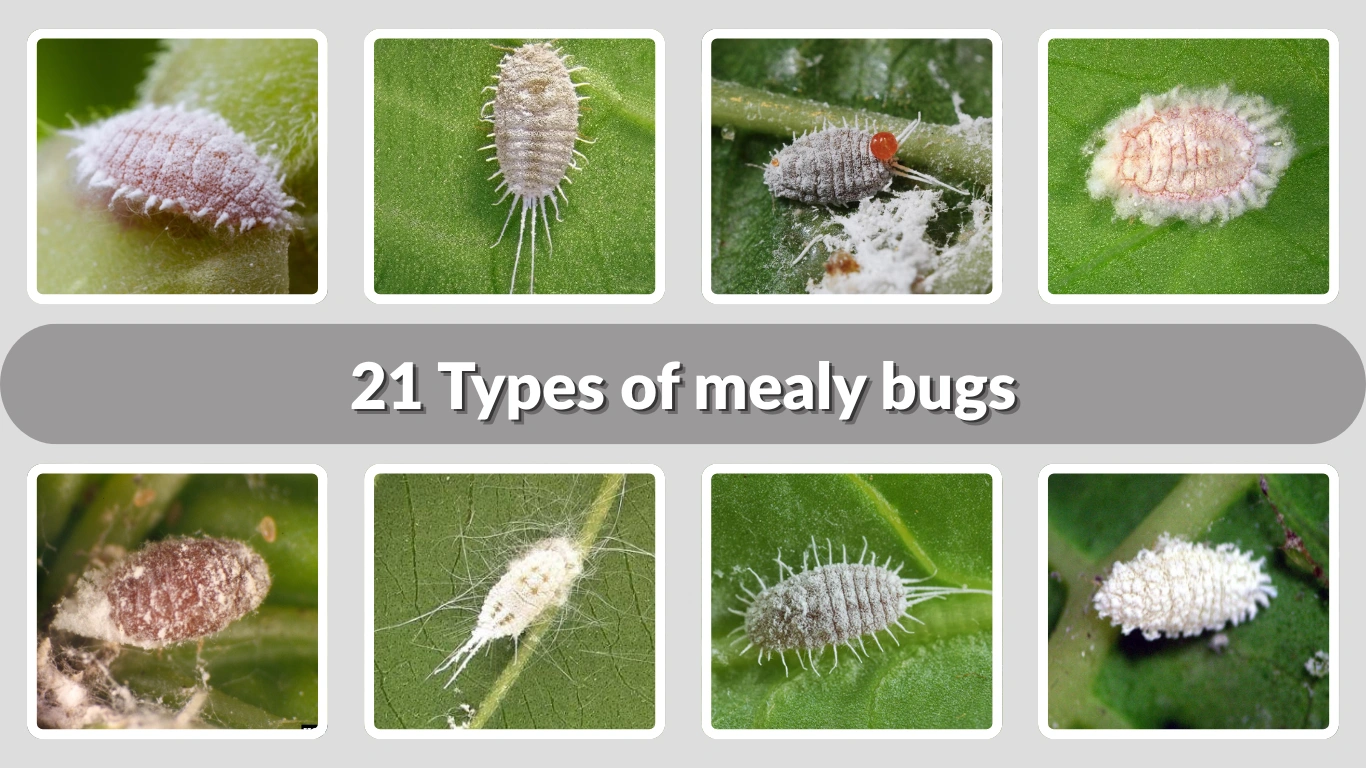
Mealybugs are small, sap-sucking insects that infest a wide range of ornamental plants, fruit trees, and crops. Recognizable by their cottony wax coating, they cause leaf yellowing, stunted growth, and fruit damage. Many species also produce honeydew, which attracts ants and encourages mold. This guide explores 21 common types of mealybugs, focusing on their identification, habitat preferences, behaviors, and lifecycles for easy recognition and management.
1. Citrus Mealybug (Planococcus citri)

The Citrus Mealybug is one of the most widespread and destructive mealybug species, attacking a wide range of crops and ornamental plants. It is especially harmful to citrus trees, grapes, and greenhouse plants, where it causes leaf yellowing, fruit deformation, and mold growth due to its honeydew secretion.
Identification
- Soft-bodied and oval-shaped, about 3–4 mm long
- Covered in white, waxy filaments giving a cottony appearance
- Has short spines around the body edge and a pair of short tail filaments
- Females are wingless; males are tiny and have two wings
- Often found clustered on stems, leaf nodes, or fruit crevices
Habitat
Citrus Mealybugs thrive in warm, humid environments, commonly infesting orchards, greenhouses, and indoor plants. They prefer sheltered areas like leaf axils, fruit undersides, and bark crevices where they can hide from predators and environmental stress.
Behaviors
This species is a sap-sucking pest, feeding on plant juices through its piercing-sucking mouthparts. It secretes honeydew, which encourages sooty mold growth and attracts ants that protect the mealybugs from predators. Infestations spread rapidly through plant contact or movement of infested material.
Diet
Citrus Mealybugs feed on sap from fruits, stems, and leaves of citrus trees, grapes, coffee, ornamental plants, and succulents. Heavy infestations cause stunted growth, leaf drop, and fruit damage, reducing both yield and quality.
Lifecycle
The lifecycle includes egg, nymph, and adult stages. Females lay up to 600 eggs in cottony sacs on plant surfaces. Eggs hatch within 7–10 days into mobile crawlers that disperse across the plant. The insects mature in 6–8 weeks, with multiple overlapping generations per year, especially in greenhouse and tropical conditions.
2. Longtailed Mealybug (Pseudococcus longispinus)

The Longtailed Mealybug is a distinctive species easily recognized by its long waxy filaments extending from the body. Commonly found on ornamental plants, fruits, and greenhouse crops, it is a persistent pest that weakens plants by draining their sap and promoting mold growth.
Identification
- Elongated oval body about 4–5 mm long
- Covered in white, powdery wax
- Two long tail filaments almost equal to body length
- Short wax filaments along the sides
- Often found in groups on leaf nodes, fruits, and stems
Habitat
Longtailed Mealybugs thrive in tropical and subtropical regions and are common in greenhouses and indoor gardens. They prefer warm, sheltered plant parts, such as under leaves and near fruit clusters.
Behaviors
This species is viviparous, meaning females give birth to live young instead of laying eggs, allowing populations to spread quickly. They secrete honeydew, which leads to sooty mold and attracts ants.
Diet
Longtailed Mealybugs feed on the sap of ornamental plants, citrus, pineapples, and greenhouse crops. Continuous feeding causes leaf curling, chlorosis, and reduced fruit quality.
Lifecycle
The lifecycle includes three main stages: nymph, immature female/male, and adult. Females live about 4–6 weeks and produce several generations annually. Under warm indoor conditions, infestations persist year-round due to the absence of a dormant stage.
3. Grape Mealybug (Pseudococcus maritimus)

The Grape Mealybug is a common pest found in vineyards and fruit orchards across North America and Europe. It damages grapevines by sucking plant sap and excreting honeydew, which promotes mold and attracts ants. Severe infestations can reduce fruit yield and quality significantly.
Identification
- Oval, white body covered with powdery wax
- Size: 3–5 mm long
- Short waxy filaments along the body edges
- Two short tail filaments at the rear
- Pinkish fluid visible when crushed
Habitat
Grape Mealybugs live on grapevines, fruit trees, and ornamentals, especially in dry, warm climates. They prefer sheltered areas like bark crevices, leaf stems, and the undersides of grape clusters.
Behaviors
This species is most active in spring and summer, with populations peaking during fruit ripening. Adults and nymphs produce honeydew, which encourages sooty mold growth. They often move to roots or bark during winter for protection.
Diet
Grape Mealybugs feed on sap from grapevines, figs, apples, and pears. Their feeding causes fruit distortion, leaf yellowing, and reduced sugar levels in grapes, affecting wine production quality.
Lifecycle
Their lifecycle includes egg, nymph, and adult stages. Females lay up to 500 eggs in cottony sacs under bark or leaves. Eggs hatch in 6–10 days, and nymphs mature in about 6 weeks. The species completes two generations per year, overwintering as nymphs under bark.
4. Pink Hibiscus Mealybug (Maconellicoccus hirsutus)

The Pink Hibiscus Mealybug is a highly invasive pest found across Asia, Africa, and the Americas. It infests over 300 plant species, including fruit trees, vegetables, and ornamentals. Its rapid reproduction and toxin secretion make it one of the most damaging mealybugs worldwide.
Identification
- Pinkish oval body about 3–4 mm long
- Covered in white, fluffy wax filaments
- Females produce dense cottony masses on stems and fruits
- Males are small, winged, and short-lived
- When crushed, the insect releases a pink fluid
Habitat
Pink Hibiscus Mealybugs thrive in tropical and subtropical climates, especially in gardens, orchards, and forests. They prefer new plant growth, leaf buds, and fruit clusters for feeding and breeding.
Behaviors
This species is highly reproductive, producing overlapping generations year-round. It injects toxins while feeding, causing leaf curling, stunted growth, and dieback. The honeydew secretion encourages mold growth and ant activity.
Diet
Pink Hibiscus Mealybugs attack hibiscus, mango, citrus, papaya, and cotton, among many others. Heavy infestations can cause severe leaf and fruit deformation and may kill young plants.
Lifecycle
The lifecycle includes egg, nymph, and adult stages. Females lay up to 600 eggs in cottony sacs. Eggs hatch within a few days, and crawlers disperse quickly. Adults mature in 3–4 weeks. In warm regions, they reproduce continuously, completing up to 10 generations annually.
5. Solanum Mealybug (Phenacoccus solani)

The Solanum Mealybug is a widespread pest that primarily targets potatoes, tomatoes, and eggplants. It thrives in warm climates and greenhouse environments, where it causes extensive damage by feeding on plant sap and spreading viral diseases.
Identification
- Oval, grayish-white body about 3–4 mm long
- Covered in powdery wax coating
- Short waxy filaments around the body edge
- Two slightly longer filaments at the posterior end
- Secretes sticky honeydew while feeding
Habitat
Solanum Mealybugs inhabit greenhouses, gardens, and agricultural fields, especially where nightshade-family plants grow. They hide under leaves, near root collars, or within fruit clusters to avoid predators.
Behaviors
This species is slow-moving and forms dense colonies. It prefers shaded, moist environments and spreads through infested soil, tools, and plant material. Ants often protect colonies in exchange for honeydew.
Diet
Solanum Mealybugs feed on solanaceous crops such as potatoes, tomatoes, peppers, and eggplants. Their feeding weakens plants, causing yellowing, leaf curl, and reduced fruit production.
Lifecycle
The lifecycle includes egg, nymph, and adult stages. Females lay 100–200 eggs in white wax sacs near roots or stems. Nymphs hatch in 5–8 days and mature within 4–6 weeks. Populations can complete up to 5 generations per year, especially in warm climates or indoor settings.
6. Coffee Mealybug (Planococcus kenyae)

The Coffee Mealybug is a notorious pest of coffee plantations in Africa, Asia, and South America. Its feeding on coffee branches and fruits leads to reduced yield and quality. The pest’s honeydew secretion also promotes sooty mold, further affecting photosynthesis.
Identification
- Oval, white body about 3–5 mm long
- Covered with waxy filaments and short spines
- Pale yellow or pink body underneath the wax
- Two short tail filaments at the rear
- Dense colonies form on coffee stems and fruit clusters
Habitat
Coffee Mealybugs are prevalent in humid tropical and subtropical regions, thriving in coffee plantations, gardens, and shaded forest edges. They prefer the undersides of leaves and fruit bunches where moisture is high.
Behaviors
This species is gregarious and forms compact colonies. Ants frequently attend to them for honeydew, which helps the mealybugs survive by deterring predators. Infestations often start on lower branches and move upward.
Diet
Coffee Mealybugs feed on coffee plant sap, especially from young shoots, fruits, and stems. Their feeding causes yellowing, leaf drop, and deformation of coffee cherries.
Lifecycle
The lifecycle includes egg, nymph, and adult stages. Females produce cottony sacs containing 300–500 eggs, which hatch within 7–10 days. Nymphs go through three molts before adulthood. Populations can produce several generations per year, particularly in shaded and humid environments.
7. Cactus Mealybug (Hypogeococcus festerianus)

The Cactus Mealybug is a sap-sucking pest that primarily infests cacti and succulents. Originally from South America, it has spread to many regions due to the global trade of ornamental plants. While small, it can cause severe deformities in cacti and even lead to plant death if left untreated.
Identification
- Small, oval, and covered in white waxy filaments
- Size ranges from 2–3 mm long
- Body color is pinkish-gray beneath the wax coating
- Forms dense white cottony masses around cactus joints and spines
- Females are wingless, while males are smaller and short-lived
Habitat
Cactus Mealybugs thrive in dry, arid environments, including deserts, greenhouses, and indoor gardens. They prefer succulent plant families like Cactaceae and Euphorbiaceae, colonizing base joints, spines, and roots.
Behaviors
This species is highly resilient and tolerates dry conditions. It often hides in cactus crevices, making early infestations difficult to detect. When disturbed, it secretes wax and sticky honeydew, attracting ants and encouraging mold growth.
Diet
Cactus Mealybugs feed exclusively on cacti and succulents, including prickly pears and ornamental varieties. Their feeding causes yellowing, shriveling, and tissue collapse, weakening or killing plants over time.
Lifecycle
The lifecycle includes egg, nymph, and adult stages. Females lay 100–200 eggs in white cottony masses. Nymphs hatch within a week, maturing into adults in about 30 days. Multiple overlapping generations occur annually, especially in warm, dry climates.
8. Bamboo Mealybug (Palmicultor lumpurensis)

The Bamboo Mealybug is a specialized pest that infests bamboo species across Asia and tropical regions. It weakens bamboo shoots by sucking sap and producing honeydew, which leads to black sooty mold. Though small, large infestations can significantly reduce bamboo health and growth rate.
Identification
- Oval, white, and covered in powdery wax
- Measures about 3–4 mm long
- Body with short wax filaments and a faint ridge along the back
- Clusters often form at leaf sheaths and node joints
- Sticky honeydew secretion visible on infested surfaces
Habitat
Bamboo Mealybugs live in bamboo plantations, ornamental gardens, and natural bamboo forests. They prefer warm, humid conditions, especially around new bamboo shoots and internodes.
Behaviors
This species is gregarious, forming colonies under the leaf sheaths of bamboo culms. It remains hidden from direct sunlight, protected by the wax coating and honeydew layers. Ants frequently tend to colonies, protecting them from predators.
Diet
The Bamboo Mealybug feeds mainly on bamboo sap, targeting tender shoots, nodes, and culms. Continuous feeding causes yellowing, stunted growth, and reduced shoot production.
Lifecycle
The lifecycle consists of egg, nymph, and adult stages. Females lay clusters of 200–300 eggs beneath waxy coverings. Eggs hatch in about a week, and nymphs develop into adults in 4–5 weeks. Several overlapping generations occur yearly in tropical and subtropical environments.
9. Mango Mealybug (Drosicha mangiferae)

The Mango Mealybug is a serious pest of mango trees across Asia and Africa, causing extensive damage to flowers, shoots, and fruits. Heavy infestations can reduce yields drastically and weaken trees due to sap loss.
Identification
- Oval, grayish-white body, about 4–6 mm long
- Covered in dense, powdery wax
- Adult females are wingless; males have transparent wings
- Long waxy filaments around the body
- Colonies appear as cottony patches on stems and branches
Habitat
Mango Mealybugs thrive in tropical and subtropical regions, especially in mango orchards and fruit gardens. They cluster near flower panicles, young shoots, and under bark crevices where humidity remains high.
Behaviors
This species is seasonally active, peaking during spring and early summer when mango trees flower. They release honeydew, encouraging mold growth and attracting ants that protect colonies. Adult females remain stationary while males actively fly to mate.
Diet
Mango Mealybugs feed primarily on mango sap, but they also infest guava, custard apple, and citrus. Feeding leads to leaf curling, drying of inflorescences, and fruit deformation.
Lifecycle
The lifecycle includes egg, nymph, and adult stages. Females lay up to 500 eggs in soil cracks or bark crevices during winter. Eggs hatch in early spring, and nymphs climb trees to feed on fresh shoots. One generation occurs per year, with eggs overwintering in soil.
10. Cotton Mealybug (Phenacoccus solenopsis)

The Cotton Mealybug is a destructive pest of cotton and vegetable crops found across Asia, Africa, and the Americas. It spreads quickly through infested seedlings and can devastate fields within weeks, reducing both yield and fiber quality.
Identification
- Oval, white to light pink body about 3–5 mm long
- Covered with white wax filaments
- Short spines along the body edges
- Two distinct tail filaments at the rear
- Secretes sticky honeydew, causing black sooty mold
Habitat
Cotton Mealybugs inhabit cotton fields, vegetable gardens, and ornamental plants. They thrive in hot, dry regions but can survive in greenhouses as well. They hide under leaves, at stem joints, and on tender shoots.
Behaviors
This species reproduces rapidly, producing overlapping generations year-round in warm conditions. Colonies are often attended by ants that protect them from predators. Heavy infestations can spread through irrigation water and infested soil.
Diet
Cotton Mealybugs feed on cotton, okra, tomato, eggplant, and ornamental plants. Feeding weakens plants, causing leaf curling, yellowing, and stunted growth. In severe cases, plants may wilt and die.
Lifecycle
The lifecycle consists of egg, nymph, and adult stages. Females lay up to 500 eggs in cottony sacs on plant surfaces. Nymphs emerge within 4–7 days, developing into adults in about 25–30 days. Populations can complete 8–10 generations per year under ideal warm conditions.
11. Sugarcane Mealybug (Saccharicoccus sacchari)

The Sugarcane Mealybug is a major pest affecting sugarcane plantations across Asia, Africa, and South America. It infests both wild and cultivated sugarcane varieties, leading to reduced sugar content, stunted growth, and yield loss.
Identification
- Small, oval, pinkish-white body about 2–3 mm long
- Covered in a thin layer of white, powdery wax
- Lacks long tail filaments (compact appearance)
- Clusters around the nodes and leaf sheaths of cane
- Females are wingless; males are minute and rarely seen
Habitat
Sugarcane Mealybugs inhabit sugarcane fields, grassy areas, and humid plantations. They prefer moist environments and hide in the leaf axils, under leaf sheaths, and near cane joints, protected from direct sunlight.
Behaviors
This species is gregarious and forms dense colonies that weaken the plant by continuous sap extraction. It secretes honeydew, leading to sooty mold, which interferes with photosynthesis. Infestations are often accompanied by ant activity.
Diet
Sugarcane Mealybugs feed exclusively on sugarcane sap, drawing nutrients from tender shoots and joints. Prolonged feeding reduces sugar accumulation in cane juice and causes reddish discoloration and leaf curling.
Lifecycle
The lifecycle includes egg, nymph, and adult stages. Females lay 100–200 eggs inside waxy sacs on leaf bases. Eggs hatch within 5–7 days, and nymphs mature in about 30 days. The pest completes 4–6 generations annually, thriving in continuously warm and humid climates.
12. Papaya Mealybug (Paracoccus marginatus)

The Papaya Mealybug is a highly invasive pest that affects papaya and over 60 other plant species. Native to Central America, it has spread to Asia, Africa, and Oceania, causing severe agricultural losses. Its rapid reproduction and protective wax covering make it hard to control.
Identification
- Oval, white body about 3–4 mm long
- Covered in thick, cottony wax filaments
- Pale yellow body beneath the wax
- Females produce dense waxy clusters on leaves and fruit
- Males are winged and smaller, rarely seen
Habitat
Papaya Mealybugs thrive in tropical and subtropical regions, particularly in papaya orchards, vegetable gardens, and ornamental plantings. They prefer young shoots, fruit clusters, and leaf undersides for colonization.
Behaviors
This species is highly mobile and spreads through infested planting material, wind, and ants. It secretes sticky honeydew, attracting ants and promoting sooty mold growth. Infestations can rapidly cover entire plants, leading to severe damage.
Diet
Papaya Mealybugs feed on papaya, hibiscus, cassava, mango, guava, and cotton, sucking sap from leaves, stems, and fruits. Feeding causes leaf curl, chlorosis, fruit deformation, and plant wilting.
Lifecycle
The lifecycle includes egg, nymph, and adult stages. Females lay up to 600 eggs in cottony sacs on plant surfaces. Eggs hatch within 3–5 days, and nymphs reach maturity in 25–30 days. Populations reproduce continuously in warm climates, completing 8–10 generations per year.
13. Banana Mealybug (Dysmicoccus brevipes)

The Banana Mealybug is a destructive pest of banana and pineapple crops, found in tropical and subtropical regions worldwide. It weakens plants by sucking sap and transmitting plant viruses, often leading to reduced fruit yield and quality.
Identification
- Oval, white body about 3–4 mm long
- Covered in powdery white wax with short wax filaments
- Pinkish body visible when crushed
- Colonies form dense, cottony clusters on roots and stems
- Males are small, winged, and rarely observed
Habitat
Banana Mealybugs inhabit banana plantations, pineapple fields, and ornamental gardens, especially in humid, warm climates. They typically hide in the leaf axils, root crowns, and under leaf sheaths, where moisture is retained.
Behaviors
This species is stationary and colonial, with females producing wax to protect eggs and nymphs. Ants often defend them in exchange for honeydew, helping infestations persist. Heavy infestations may lead to plant wilting and poor fruiting.
Diet
Banana Mealybugs feed mainly on banana, pineapple, sugarcane, and taro, extracting sap from the plant’s roots and lower stems. Prolonged feeding leads to yellowing, leaf drop, and reduced fruit development.
Lifecycle
The lifecycle includes egg, nymph, and adult stages. Females lay 200–300 eggs in cottony sacs near the root zone or leaf bases. Eggs hatch in 7–10 days, and nymphs mature within 25–30 days. Several overlapping generations occur annually in tropical environments.
14. Jackfruit Mealybug (Ferrisia virgata)

The Jackfruit Mealybug, also known as the striped mealybug, is a highly adaptable pest found in Asia, Africa, and the Pacific Islands. It infests over 150 plant species, including jackfruit, guava, and cotton, and is recognized by its two long waxy tails.
Identification
- Elongated oval body, about 3–5 mm long
- Covered in white wax with two long tail filaments at the rear
- Distinct gray longitudinal stripes on the body
- Short waxy filaments along the sides
- Females are wingless; males are small and short-lived
Habitat
Jackfruit Mealybugs inhabit fruit orchards, gardens, and shaded areas, especially in warm, humid regions. They prefer fruit surfaces, leaf undersides, and stem joints, forming visible white colonies.
Behaviors
This species is highly mobile and spreads easily through infested fruit and plant material. It secretes honeydew, promoting sooty mold and attracting ants that protect the colony.
Diet
Jackfruit Mealybugs feed on jackfruit, guava, cotton, hibiscus, and papaya, drawing sap from fruits, young shoots, and leaves. Feeding results in leaf curling, yellowing, and fruit deformation.
Lifecycle
The lifecycle includes egg, nymph, and adult stages. Females lay up to 300 eggs in loose cottony wax on fruits or leaves. Eggs hatch in 5–7 days, and nymphs develop into adults in about 3–4 weeks. Populations thrive year-round in warm climates, producing multiple generations annually.
15. Passionfruit Mealybug (Planococcus minor)

The Passionfruit Mealybug is a small but destructive pest found throughout Asia, Africa, and Oceania. It infests fruit-bearing plants and ornamentals, especially passionfruit, citrus, and grapes. This species closely resembles the citrus mealybug but is smaller and more agile, often causing extensive fruit and leaf damage.
Identification
- Oval, white or pale gray body about 2.5–4 mm long
- Covered with fine waxy powder
- Short tail filaments and slight ridges on the back
- Secretes sticky honeydew, promoting sooty mold
- Pinkish fluid visible when crushed
Habitat
Passionfruit Mealybugs inhabit tropical and subtropical areas, thriving in orchards, vineyards, and greenhouses. They prefer sheltered plant parts, such as fruit surfaces, stems, and leaf nodes.
Behaviors
This species is mobile and adaptable, moving between host plants and spreading via infested seedlings or wind. Colonies grow quickly in warm, humid conditions. Ants often guard them for honeydew protection.
Diet
Passionfruit Mealybugs feed on passionfruit, grapes, citrus, guava, and coffee, extracting sap from stems, fruit clusters, and leaves. Their feeding results in leaf drop, stunted growth, and poor fruit development.
Lifecycle
The lifecycle includes egg, nymph, and adult stages. Females lay 200–400 eggs in cottony sacs on leaves and fruits. Eggs hatch in 5–8 days, and nymphs reach maturity within 3–4 weeks. The species completes multiple generations annually under warm tropical conditions.
16. Guava Mealybug (Ferrisia dasylirii)

The Guava Mealybug is a common pest of fruit trees and ornamental plants in Asia, Africa, and the Americas. Though named for guava, it also infests a wide range of plants, including citrus, hibiscus, and succulents. It’s known for its two long waxy tails and cottony body.
Identification
- Oval, soft-bodied insect about 3–5 mm long
- Covered in white wax with two long tail filaments
- Distinct grayish stripe running down the back
- Found in clusters on stems, fruits, and leaves
- Males are winged, while females are wingless
Habitat
Guava Mealybugs inhabit fruit orchards, nurseries, and gardens, particularly in warm, humid areas. They prefer young shoots, leaf joints, and fruit clusters, where they feed and reproduce.
Behaviors
This species is gregarious and often forms dense colonies. It secretes large amounts of honeydew, encouraging mold growth and ant activity. Infestations spread through infested nursery stock and wind.
Diet
Guava Mealybugs feed on guava, hibiscus, citrus, and succulents, sucking sap from soft plant tissues. Their feeding causes leaf wilting, fruit scarring, and stunted growth, leading to reduced yield and aesthetic damage.
Lifecycle
The lifecycle includes egg, nymph, and adult stages. Females lay 250–400 eggs in loose waxy sacs. Eggs hatch within a week, and nymphs develop into adults in 25–30 days. The pest breeds continuously in tropical regions, producing many overlapping generations each year.
17. Pineapple Mealybug (Dysmicoccus neobrevipes)

The Pineapple Mealybug is a major pest of pineapple plantations worldwide, particularly in tropical and subtropical regions. It weakens plants, causes fruit deformation, and transmits the Pineapple Mealybug Wilt Virus (PMWaV), making it one of the most economically significant mealybug species.
Identification
- Oval, soft-bodied insect about 3–4 mm long
- Covered in white, waxy coating with short filaments along the sides
- Pinkish body visible beneath the wax
- Secretes sticky honeydew that attracts ants
- Females are wingless; males are small and short-lived
Habitat
Pineapple Mealybugs inhabit pineapple fields, greenhouses, and ornamental gardens. They are found on the base of leaves, roots, and under leaf sheaths, where humidity provides protection.
Behaviors
This species is highly gregarious, often forming dense colonies around the plant base. They have a mutualistic relationship with ants, which protect them from predators while spreading the pest between plants.
Diet
Pineapple Mealybugs feed on pineapple sap, causing yellowing, leaf curling, and growth retardation. Feeding leads to wilt disease, leaf tip burn, and poor fruiting due to toxin and virus transmission.
Lifecycle
The lifecycle includes egg, nymph, and adult stages. Females lay 100–200 eggs in waxy ovisacs near roots or under leaf bases. Eggs hatch within a week, and nymphs reach adulthood in 25–30 days. Continuous reproduction occurs year-round in tropical climates, resulting in multiple overlapping generations.
18. Avocado Mealybug (Nipaecoccus nipae)

The Avocado Mealybug is a widespread pest affecting avocado, citrus, and ornamental plants. Originally from Asia, it is now found in tropical and subtropical regions worldwide. It damages plants by sucking sap and secreting honeydew, which encourages sooty mold development.
Identification
- Oval body, about 3–4 mm long
- Covered with thick, white wax and short spines
- Body beneath wax is yellowish or pinkish
- Two short tail filaments at the rear
- Honeydew and cottony secretions visible on leaves and stems
Habitat
Avocado Mealybugs thrive in avocado orchards, citrus groves, and greenhouses, especially in humid, shaded environments. They cluster on leaf undersides, fruit stems, and bark crevices.
Behaviors
This species is gregarious and often colonizes areas with dense foliage. Ants are commonly seen protecting colonies in exchange for honeydew. Infestations spread through infested nursery plants or by wind.
Diet
Avocado Mealybugs feed on avocado, citrus, coffee, guava, and ornamentals, draining sap from stems, leaves, and fruits. Feeding causes leaf drop, yellowing, and reduced fruit size, as well as black mold growth from honeydew.
Lifecycle
The lifecycle includes egg, nymph, and adult stages. Females lay 200–300 eggs in waxy sacs. Eggs hatch in about 5 days, and nymphs mature within 3–4 weeks. The pest reproduces throughout the year, completing 8–10 generations annually under warm conditions.
19. Cassava Mealybug (Phenacoccus manihoti)

The Cassava Mealybug is one of the most destructive pests of cassava crops across Africa, Asia, and South America. Originally from South America, it spread to Africa in the 1970s, causing massive yield losses before natural predators were introduced for control.
Identification
- Oval, white, wax-covered body, about 2–3 mm long
- Short filaments around the body with slightly longer ones at the tail end
- Pale pink body visible beneath wax
- Produces sticky honeydew that promotes mold growth
- Often forms clusters on leaf petioles and shoot tips
Habitat
Cassava Mealybugs inhabit cassava plantations and smallholder farms in warm, tropical regions. They prefer young leaves, shoot tips, and stems, where plant sap is abundant.
Behaviors
This species is parthenogenetic, meaning females reproduce without males, allowing rapid population growth. They remain stationary while feeding and are tended by ants that defend them from predators.
Diet
Cassava Mealybugs feed almost exclusively on cassava sap, causing leaf curling, wilting, yellowing, and stunted growth. Severe infestations can completely defoliate plants and drastically reduce tuber yield.
Lifecycle
The lifecycle includes egg, nymph, and adult stages. Females lay up to 400 eggs in waxy sacs on stems and leaves. Eggs hatch within 3–5 days, and nymphs reach adulthood in about 30 days. Under tropical conditions, up to 10 generations can occur annually.
20. Orchid Mealybug (Pseudococcus microcirculus)

The Orchid Mealybug is a serious pest in orchid nurseries and greenhouses, affecting both ornamental and commercial plant production. It weakens orchids by feeding on sap, leading to stunted growth and reduced flowering.
Identification
- Small, oval insect about 3 mm long
- Covered with white, cotton-like wax
- Short filaments along the body and two slightly longer tail filaments
- Leaves behind white, cottony residue on stems and roots
- Pinkish body visible when crushed
Habitat
Orchid Mealybugs thrive in humid greenhouses, indoor gardens, and tropical nurseries. They hide in leaf axils, root junctions, and behind flower sheaths, where they are protected from moisture and sprays.
Behaviors
This species is slow-moving and secretive, often infesting orchids unnoticed until severe damage occurs. It produces honeydew, attracting ants and encouraging black sooty mold on leaves and flowers.
Diet
Orchid Mealybugs feed on orchids, bromeliads, and ornamental plants, sucking sap from leaves, pseudobulbs, and flower stalks. Prolonged feeding leads to yellowing, leaf drop, and flower deformities.
Lifecycle
The lifecycle includes egg, nymph, and adult stages. Females lay 150–250 eggs in white cottony sacs near leaf bases or roots. Eggs hatch in 5–7 days, and nymphs reach adulthood within 3–4 weeks. In greenhouse environments, reproduction is continuous, leading to multiple generations year-round.
21. Greenhouse Mealybug (Pseudococcus viburni)

The Greenhouse Mealybug, also known as the Obscure Mealybug, is a persistent pest in greenhouses, nurseries, and indoor gardens. It attacks a wide range of ornamental and fruiting plants, thriving in controlled environments where natural predators are limited.
Identification
- Oval, soft-bodied insect about 3–4 mm long
- Covered in white, powdery wax with short filaments along the edges
- Pale pink body visible beneath the wax
- Two slightly longer filaments at the rear
- Secretes sticky honeydew and cottony wax deposits on leaves and stems
Habitat
Greenhouse Mealybugs inhabit indoor gardens, greenhouses, and ornamental plant nurseries. They prefer humid, warm conditions and are typically found on leaf undersides, stems, and flower stalks.
Behaviors
This species is highly adaptable and difficult to control. It reproduces rapidly in stable indoor climates, forming dense colonies. The insects release honeydew, fostering sooty mold growth and attracting ants that aid in their spread.
Diet
Greenhouse Mealybugs feed on a wide variety of plants, including citrus, grapes, ferns, orchids, and succulents. Continuous feeding weakens plants, leading to leaf drop, yellowing, and reduced flowering or fruiting.
Lifecycle
The lifecycle includes egg, nymph, and adult stages. Females lay 200–400 eggs in cottony sacs along plant surfaces. Eggs hatch within 5–10 days, and nymphs develop into adults in about 4–6 weeks. In warm, enclosed environments, they reproduce continuously, producing multiple overlapping generations throughout the year.