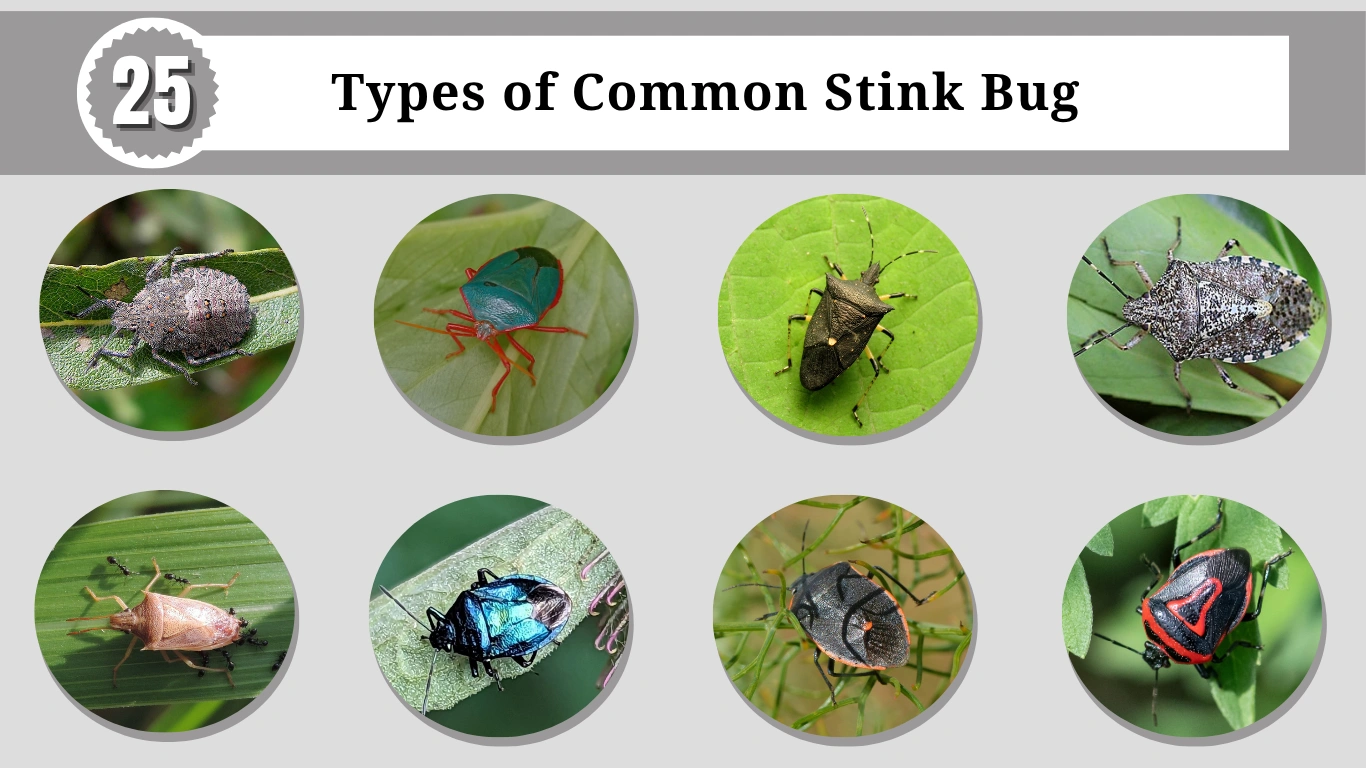
Stink bugs are widespread insects known for their distinctive odor and shield-shaped bodies. While some species are harmless or even beneficial, others cause serious damage to crops and gardens. Found across the globe, stink bugs vary in color, size, and feeding habits. This guide explores 25 common stink bugs, highlighting their identification features, preferred habitats, and lifecycles to help you recognize and manage them effectively.
1. Brown Marmorated Stink Bug (Halyomorpha halys)

The Brown Marmorated Stink Bug is one of the most widespread and recognizable stink bugs, originally from East Asia but now found across North America and Europe. Known for its mottled brown color and shield-like body, it emits a strong odor when disturbed. This species is notorious for invading homes during cooler months and feeding on a wide range of crops.
Identification
- Shield-shaped body measuring 12–17 mm in length
- Mottled brown and gray coloration with marbled appearance
- Distinct white bands on antennae and legs
- Alternating light and dark markings along the abdomen edge
- Emits a pungent odor when threatened or crushed
Habitat
The Brown Marmorated Stink Bug thrives in gardens, farms, orchards, and wooded areas. It prefers warm climates during summer but seeks shelter indoors—under siding, in attics, or behind walls—during fall and winter.
Behaviors
This species is a strong flyer and often attracted to light. It is primarily active during the day and feeds by piercing plant tissue to suck out sap. During autumn, adults gather in large numbers to find overwintering spots, frequently entering homes through cracks and vents.
Diet
Brown Marmorated Stink Bugs are polyphagous feeders, meaning they eat many plant species. They target fruits, vegetables, and ornamental plants, including apples, peaches, corn, tomatoes, and soybeans. Their feeding causes spotting, deformation, and premature fruit drop.
Lifecycle
The lifecycle includes egg, nymph, and adult stages. Females lay clusters of 20–30 eggs on leaf undersides. Nymphs hatch within a week, undergoing five molts before adulthood. The species completes one to two generations per year, with adults overwintering in sheltered sites until spring.
2. Green Stink Bug (Chinavia hilaris)

The Green Stink Bug is one of the most common stink bug species in North America, easily recognized by its bright green color and triangular shield shape. While not as invasive as the brown marmorated species, it still poses a significant threat to crops and garden plants due to its sap-sucking feeding habits.
Identification
- Bright, uniform green coloration across the body
- Shield-shaped body measuring 13–18 mm long
- Edges of the thorax and abdomen have fine, pale lines
- Short, segmented antennae with light-colored tips
- Emits a strong, bitter odor when disturbed or crushed
Habitat
Green Stink Bugs are found in gardens, crop fields, forests, and meadows. They prefer warm, humid regions and are frequently seen on soybean, corn, tomato, and fruit plants. In winter, adults seek shelter in plant debris or under bark.
Behaviors
This species is a daytime feeder and a strong flier, often moving between host plants throughout the season. It uses its piercing-sucking mouthparts to draw nutrients from fruits and leaves, causing discoloration and shriveling.
Diet
The Green Stink Bug feeds on fruits, legumes, and grains, including beans, corn, tomatoes, peaches, and citrus. Both nymphs and adults feed on plant sap, often reducing crop yields and fruit quality.
Lifecycle
The lifecycle consists of egg, nymph, and adult stages. Females lay clusters of 20–80 barrel-shaped eggs on the undersides of leaves. Nymphs hatch within a week, molting five times before adulthood. Adults are active from spring to early fall, with one to two generations per year depending on climate.
3. Southern Green Stink Bug (Nezara viridula)

The Southern Green Stink Bug is a globally distributed species, thriving in tropical and subtropical regions. Often mistaken for the common green stink bug, it’s a serious agricultural pest that damages crops like beans, soybeans, and cotton by feeding on developing seeds and fruits.
Identification
- Bright green body, about 12–15 mm long
- Smooth, shield-shaped body with rounded edges
- Three small white spots between the shoulders (a key feature)
- Pale green legs and antennae with darker tips
- Emits a distinct, sharp odor when disturbed
Habitat
Southern Green Stink Bugs inhabit farmlands, gardens, and orchards, especially in warm, humid environments. They are highly adaptable and can survive year-round in mild climates, hiding under leaves or debris during cooler periods.
Behaviors
This species is highly mobile, moving between crops as they ripen. Adults are strong fliers and form large clusters on preferred host plants. When populations are high, they can cause significant agricultural losses.
Diet
The Southern Green Stink Bug feeds on legumes, tomatoes, corn, peppers, and cotton. It pierces fruits and seeds with its needle-like mouthpart, causing deformation and premature drop of produce.
Lifecycle
The lifecycle includes egg, nymph, and adult stages. Females lay up to 150 eggs in clusters under leaves. Nymphs undergo five molts before becoming adults. In warm regions, up to four or five generations can occur annually.
4. Brown Stink Bug (Euschistus servus)

The Brown Stink Bug is a native North American species that commonly infests corn, soybeans, and cotton fields. Although less notorious than invasive species, it is still a major agricultural pest due to its widespread distribution and feeding damage.
Identification
- Light to dark brown body, 11–16 mm long
- Shield-shaped with slightly rough texture
- Yellowish or pale undersides
- Sharp edges on the pronotum (shoulder area)
- Antennae with alternating dark and light segments
Habitat
Brown Stink Bugs inhabit fields, pastures, gardens, and forest edges. They prefer warm and open areas with abundant crops and weeds. In cooler seasons, adults seek shelter in leaf litter or under bark.
Behaviors
This species is active during the day and moves easily between wild and cultivated plants. It often feeds in groups, especially during the nymphal stage. Adults can migrate long distances to find new feeding grounds.
Diet
Brown Stink Bugs feed on corn, soybeans, tomatoes, peaches, and grains. Their feeding causes shriveled kernels, sunken fruits, and reduced seed quality, making them economically significant pests.
Lifecycle
The lifecycle follows three main stages: egg, nymph, and adult. Eggs are laid in small clusters of 20–40 on leaves. Nymphs hatch within a week, maturing in 4–6 weeks. Typically, two generations occur annually, with adults overwintering in debris or field edges.
5. Dusky Stink Bug (Euschistus tristigmus)

The Dusky Stink Bug is a native North American species often found in woodlands, gardens, and farmlands. Though not as destructive as some of its relatives, it occasionally feeds on fruits and vegetables, making it a minor pest. Its dusky coloration helps it blend perfectly with bark and soil surfaces.
Identification
- Dark brown to grayish-black body, 10–14 mm long
- Rough, granular texture on thorax and wings
- Broad shoulders and narrow head
- Short, dark antennae with faint banding
- Lighter brown underside with small pale spots
Habitat
Dusky Stink Bugs inhabit wooded areas, gardens, and field edges, often resting on tree trunks, weeds, or crops. They prefer shaded, moist environments and are frequently seen during late summer.
Behaviors
This species is a solitary and slow-moving predator compared to other stink bugs. It often hides during the day and feeds at dusk or dawn. Adults are capable fliers and may migrate to crops from surrounding vegetation.
Diet
The Dusky Stink Bug feeds on fruits, seeds, and legumes, including beans, soybeans, and tomatoes. Occasionally, it also preys on small insects, making it partly omnivorous.
Lifecycle
The lifecycle consists of egg, nymph, and adult stages. Females deposit small egg clusters under leaves. Nymphs develop through five molts before reaching adulthood. Typically, one or two generations occur each year depending on the region.
6. Rice Stink Bug (Oebalus pugnax)

The Rice Stink Bug is a major agricultural pest in the southern United States, primarily attacking rice and other cereal crops. Its feeding can cause significant economic loss by deforming and discoloring rice grains. It’s commonly seen around paddy fields and grassy areas.
Identification
- Narrow, flattened, and pale brown body, about 10–12 mm long
- Distinct pointed “shoulders” on the thorax
- Straw-colored or light tan appearance
- Dark legs and antennae with pale tips
- Emits a sharp odor when disturbed
Habitat
Rice Stink Bugs thrive in rice paddies, grassy fields, and crop edges. They prefer moist, open areas where grains are abundant, often moving between wild grasses and cultivated rice.
Behaviors
This species is an active daytime feeder, often found in large numbers during the rice flowering stage. Adults and nymphs both cause damage by puncturing grains and sucking out their contents.
Diet
Rice Stink Bugs feed primarily on rice, wheat, barley, and wild grasses. Their feeding leads to “pecky rice”, where kernels become discolored and brittle, lowering grain quality.
Lifecycle
The lifecycle includes egg, nymph, and adult stages. Females lay eggs in two neat rows on grass blades or rice leaves. Nymphs hatch in about a week and mature in 25–35 days. The species can produce three or more generations per year in warm regions.
7. Harlequin Bug (Murgantia histrionica)

The Harlequin Bug, also called the calico bug, is one of the most colorful stink bug species found in North and Central America. Known for its bold red, orange, and black pattern, it is a serious pest of cruciferous plants like cabbage and broccoli. Its striking appearance makes it easily recognizable in gardens and fields.
Identification
- Bright orange, red, or yellow with black markings
- Rounded, shield-shaped body about 8–12 mm long
- Glossy shell with symmetrical color patterns
- Short antennae and legs
- Emits a strong odor when disturbed
Habitat
Harlequin Bugs inhabit gardens, farmlands, and weedy fields, especially where cabbage, kale, mustard, and broccoli grow. They prefer warm climates and can survive year-round in southern regions.
Behaviors
This species is an active feeder, clustering in large groups on host plants. Both nymphs and adults feed on plant sap, causing leaves to wilt, discolor, or die. Their bright warning colors also deter predators.
Diet
Harlequin Bugs feed mainly on cruciferous vegetables, including cabbage, cauliflower, mustard, and radish. Feeding causes white or yellow blotches and stunted plant growth, sometimes leading to total crop loss in heavy infestations.
Lifecycle
The lifecycle includes egg, nymph, and adult stages. Females lay rows of black-and-white barrel-shaped eggs on leaf undersides. Nymphs molt five times before adulthood. Several generations occur each year in warm climates, with adults overwintering in plant debris.
8. Red-shouldered Stink Bug (Thyanta custator)

The Red-shouldered Stink Bug is a bright and attractive species common in North and Central America. It is often found on various crops and wild plants, feeding on fruits, vegetables, and legumes. While not as destructive as other species, it can occasionally cause noticeable agricultural damage.
Identification
- Green to yellow-green body with a distinct reddish or pink spot on each shoulder
- Measures 12–15 mm long
- Smooth, shiny, shield-shaped body
- Pale underside and reddish eyes
- Emits a strong odor when threatened
Habitat
Red-shouldered Stink Bugs inhabit gardens, fields, pastures, and orchards. They prefer open, sunny environments with abundant flowering plants and crops. They are most active in summer and early fall.
Behaviors
This species is a slow-moving feeder, often seen basking on leaves during warm days. It may gather in small clusters on fruiting plants. Adults are strong fliers and can migrate short distances between host plants.
Diet
Red-shouldered Stink Bugs feed on soybeans, tomatoes, corn, and fruits. Their feeding punctures cause small discolored spots on fruits and seeds, sometimes leading to deformed produce.
Lifecycle
The lifecycle consists of egg, nymph, and adult stages. Eggs are laid in tight clusters on leaves. Nymphs hatch in about a week and undergo five molts before adulthood. In warm regions, two or more generations may occur annually, with adults overwintering under plant debris or bark.
9. Anchor Stink Bug (Stiretrus anchorago)

The Anchor Stink Bug is one of the most distinctive and beneficial stink bugs in North and Central America. Named for the dark, anchor-shaped marking on its back, it is a predatory species rather than a plant feeder. It helps control agricultural pests by preying on caterpillars and beetle larvae.
Identification
- Round, shield-shaped body about 8–12 mm long
- Brightly colored—orange, yellow, or red—with a dark anchor-shaped marking on the back
- Short antennae and strong legs
- Smooth, glossy shell
- Emits a mild odor when disturbed
Habitat
Anchor Stink Bugs inhabit gardens, meadows, fields, and forest edges, especially where pest larvae are abundant. They prefer sunny, vegetated areas and are often found on plants infested with caterpillars.
Behaviors
This species is an active predator, moving between plants to hunt. It pierces its prey with its proboscis and injects digestive fluids to consume soft tissues. Despite its bright coloration, it is harmless to humans and crops.
Diet
Unlike most stink bugs, the Anchor Stink Bug feeds on caterpillars, beetle larvae, and other soft-bodied insects. It is a natural biological control agent, often helping reduce populations of agricultural pests.
Lifecycle
The lifecycle includes egg, nymph, and adult stages. Females lay clusters of barrel-shaped eggs on the undersides of leaves near prey populations. Nymphs hatch in about a week and develop through five molts before adulthood. Typically, two to three generations occur each year.
10. Two-spotted Stink Bug (Perillus bioculatus)

The Two-spotted Stink Bug, also known as the double-eyed soldier bug, is a beneficial predatory species native to North America. It is recognized by the two bold black spots on its reddish-orange back. Farmers often welcome this species because it preys on major crop pests, especially the Colorado potato beetle.
Identification
- Bright red or orange body with two large black spots on the wings
- Shield-shaped, about 10–13 mm long
- Black legs and antennae
- Smooth, shiny shell with slightly flared edges
- Emits a mild odor when handled
Habitat
Two-spotted Stink Bugs are found in gardens, farmlands, and forest edges, especially in potato, tomato, and corn fields. They prefer warm, open areas with dense vegetation and abundant prey.
Behaviors
This species is an active hunter, patrolling plants for larvae and beetle eggs. It uses its sharp mouthparts to pierce and feed on prey, playing a vital role in natural pest management.
Diet
The Two-spotted Stink Bug primarily feeds on Colorado potato beetle larvae, but it also consumes caterpillars and other soft-bodied insects. It is considered one of the most effective natural enemies of crop pests.
Lifecycle
The lifecycle progresses through egg, nymph, and adult stages. Females lay eggs in clusters of 20–30 on leaf surfaces near infested plants. Nymphs hatch within a week, developing through five molts before reaching adulthood. Two generations typically occur each year in temperate regions.
11. Rough Stink Bug (Brochymena quadripustulata)

The Rough Stink Bug is a grayish, bark-like species common throughout North America. Unlike many agricultural pests, it is mostly harmless and sometimes even predatory, feeding on other insects. Its rough, camouflaged texture makes it easy to mistake for tree bark or debris.
Identification
- Mottled gray or brown body about 13–17 mm long
- Rough, bumpy texture on thorax and wings
- Edges of the abdomen show alternating light and dark bands
- Small orange or red spots near the shoulders (four in total)
- Antennae with alternating dark and light segments
Habitat
Rough Stink Bugs inhabit woodlands, gardens, and orchards, often resting on tree trunks, bark, and branches. Their camouflage helps them avoid predators and overwinter successfully under loose bark or leaf litter.
Behaviors
This species is slow-moving and primarily solitary, often basking in sunlight during the day. It rarely enters homes and poses no threat to humans. Adults are strong fliers and can relocate to new areas as seasons change.
Diet
Rough Stink Bugs feed on tree fruits, seeds, and sometimes other insects. They prefer acorns, walnuts, and ornamental trees. Their feeding causes minimal damage compared to true agricultural pests.
Lifecycle
The lifecycle consists of egg, nymph, and adult stages. Eggs are laid on bark or leaves and hatch in about a week. Nymphs go through five molts before adulthood. Typically, one generation per year occurs, with adults overwintering in natural shelters.
12. Spined Soldier Bug (Podisus maculiventris)

The Spined Soldier Bug is one of the most well-known beneficial stink bugs in North America. It preys on numerous crop pests and is widely used in biological control programs. Recognized by the spines on its shoulders, this species helps farmers naturally reduce harmful insect populations.
Identification
- Brownish-gray body about 10–13 mm long
- Distinct spines on the shoulders (pronotum)
- Light underside with dark spots (“maculiventris” means spotted belly)
- Triangular scutellum (shield plate) on the back
- Antennae with darkened tips
Habitat
Spined Soldier Bugs inhabit gardens, farmlands, and forests, particularly in soybean, corn, and cotton fields. They prefer areas with abundant prey and are often seen on crops during late spring and summer.
Behaviors
This species is a vigorous predator, stalking and ambushing caterpillars and beetle larvae. It uses its sharp proboscis to pierce prey and inject paralyzing enzymes. Despite its fierce hunting behavior, it is harmless to humans.
Diet
The Spined Soldier Bug feeds on caterpillars, beetle larvae, and other soft-bodied insects, including armyworms and Colorado potato beetles. It is considered one of the most effective biological control agents in agriculture.
Lifecycle
The lifecycle follows the typical egg–nymph–adult pattern. Females lay clusters of barrel-shaped eggs on leaves near prey sources. Nymphs hatch in 4–7 days and develop through five molts. There are usually two to three generations per year, depending on climate and prey availability.
13. Forest Stink Bug (Elasmostethus cruciatus)

The Forest Stink Bug is a colorful, tree-dwelling species found across North America, Europe, and Asia. Known for its striking green and red pattern, it primarily feeds on trees and shrubs rather than crops. This species is often seen on birch, alder, and willow trees during the warmer months.
Identification
- Bright green body with red or orange markings along the edges
- About 10–13 mm long
- Shield-shaped with smooth, glossy texture
- Small black dots on the wings
- Red or brown antennae with segmented tips
Habitat
Forest Stink Bugs inhabit woodlands, forest edges, and gardens. They are especially common in areas with broadleaf trees such as birch, poplar, and alder. In autumn, adults seek shelter under bark or leaf litter to overwinter.
Behaviors
This species is diurnal (active during the day) and can often be seen basking on leaves. It is a moderate flier and not known to invade homes. Adults and nymphs remain close to host trees throughout their development.
Diet
Forest Stink Bugs feed on tree sap, seeds, and developing buds. They prefer soft plant tissues and rarely cause serious damage to trees, making them less of a concern than agricultural stink bugs.
Lifecycle
The lifecycle includes egg, nymph, and adult stages. Females lay clusters of barrel-shaped eggs on leaf undersides in late spring. Nymphs pass through five molts before adulthood. Typically, one generation per year occurs, with adults overwintering in forest debris.
14. Conchuela Stink Bug (Chlorochroa ligata)

The Conchuela Stink Bug, native to North and Central America, is easily recognized by its bright green color bordered with red or orange. It is an occasional agricultural pest but more commonly found in gardens and grasslands. Its vivid pattern serves as a warning to predators.
Identification
- Bright green body with red or orange margin around the edges
- Measures 12–16 mm in length
- Smooth, shiny shield-shaped back
- Pale green underside
- Emits a strong odor when handled
Habitat
Conchuela Stink Bugs inhabit grasslands, gardens, orchards, and farmlands, especially in southwestern United States and Mexico. They prefer sunny, dry regions with plenty of vegetation.
Behaviors
This species is a strong flier and active forager, moving between host plants throughout the growing season. It is diurnal and often seen resting on leaves or flowers during the day.
Diet
Conchuela Stink Bugs feed on alfalfa, cotton, sorghum, and fruit crops, using their piercing mouthparts to extract sap. Feeding damage causes small, discolored spots and shriveled fruit surfaces.
Lifecycle
The lifecycle consists of egg, nymph, and adult stages. Females lay clusters of 20–40 eggs on host plant leaves. Nymphs hatch within a week and molt several times before maturity. There are typically two generations per year, with adults overwintering in field margins or debris.
15. Say’s Stink Bug (Chlorochroa sayi)

The Say’s Stink Bug, named after the American entomologist Thomas Say, is a common species found throughout North America. It closely resembles the green stink bug but can be distinguished by its deeper green hue and slightly larger size. It’s known for feeding on both crops and wild plants.
Identification
- Bright to dark green body with a smooth, shield-like shape
- About 13–17 mm long
- Fine black speckles across the wings
- Pale yellow or orange borders around the thorax and abdomen
- Emits a strong odor when disturbed
Habitat
Stink Bugs are typically found in meadows, gardens, and agricultural fields, particularly in the Midwest and southern United States. They favor warm climates and often rest on leaves or flower heads during the day.
Behaviors
This species is a slow-moving, plant-feeding insect. Adults and nymphs are active during warm months, especially from late spring through early fall. During cold weather, they seek shelter under bark, stones, or leaf litter.
Diet
Say’s Stink Bugs feed on soybeans, tomatoes, alfalfa, and sunflower seeds. Their feeding leads to small, sunken spots and discolored patches on fruits and pods. They can also feed on wild plants when crop hosts are unavailable.
Lifecycle
The lifecycle follows egg, nymph, and adult stages. Females lay clusters of 20–40 eggs on the undersides of leaves. Nymphs hatch within a week, molting five times before adulthood. Generally, there are two generations per year, with adults overwintering in protected outdoor areas.
16. Red-legged Stink Bug (Edessa meditabunda)

The Red-legged Stink Bug is a large and colorful species native to Central and South America, now also found in parts of southern North America. Its name comes from its vivid red legs, which contrast with its dark body. It’s both visually striking and a significant pest in tropical agricultural regions.
Identification
- Dark brown or black body with bright red legs
- About 15–20 mm in length
- Smooth, shiny back with a broad shield shape
- Red edges along the abdomen and thorax
- Short, thick antennae with dark tips
Habitat
Red-legged Stink Bugs prefer tropical and subtropical regions, often inhabiting bean, soybean, and corn fields. They thrive in humid environments and are active year-round in warm climates.
Behaviors
This species is gregarious, often found in clusters feeding on the same plant. Adults are strong fliers and may migrate between crops as seasons change. When disturbed, they release a potent odor for defense.
Diet
The Red-legged Stink Bug feeds on legume pods, corn kernels, and fruit-bearing plants, extracting plant sap and damaging seeds. Feeding leads to discolored and shriveled crops, reducing both yield and quality.
Lifecycle
Its lifecycle includes egg, nymph, and adult stages. Females lay clusters of up to 100 eggs on plant leaves. Nymphs hatch in 5–7 days, passing through five developmental stages before becoming adults. Multiple generations occur yearly in tropical climates, with populations peaking during the wet season.
17. Blue Shield Bug (Zicrona caerulea)

The Blue Shield Bug, also known as the Steel Blue Stink Bug, is a small, metallic-blue species found across Europe, Asia, and North America. Unlike most stink bugs, this one is predatory, feeding on other insects rather than plants. Its iridescent blue coloration makes it one of the most visually stunning members of its family.
Identification
- Shiny, metallic blue-green or steel-blue body
- About 6–8 mm in length (smaller than most stink bugs)
- Oval, shield-shaped body with smooth edges
- Dark legs and antennae
- Slightly reflective surface that gleams in sunlight
Habitat
Blue Shield Bugs inhabit grasslands, forests, and agricultural fields, especially where aphids and caterpillars are abundant. They prefer temperate climates and are commonly found on shrubs and low vegetation.
Behaviors
This species is a daytime hunter, moving actively on leaves in search of prey. Though small, it’s highly effective at subduing soft-bodied insects. It rarely emits odor unless threatened and is harmless to humans.
Diet
Blue Shield Bugs feed on caterpillars, aphids, and beetle larvae, using their proboscis to pierce and consume their prey’s body fluids. Because of their predatory nature, they are beneficial insects for natural pest control.
Lifecycle
The lifecycle follows egg, nymph, and adult stages. Eggs are laid in small groups on the underside of leaves. Nymphs resemble adults but are duller in color. The species typically has one generation per year, with adults overwintering under bark or leaf litter.
18. Rice Leaf Stink Bug (Leptoglossus phyllopus)

The Rice Leaf Stink Bug, sometimes called the leaf-footed bug, is a long-legged, plant-feeding species native to North America. Despite its name, it’s not a true rice pest but does feed on a wide range of crops and ornamental plants. Its distinctive leaf-like hind legs make it easy to recognize.
Identification
- Elongated brown body, about 18–22 mm long
- Leaf-like expansions on the hind legs
- Yellow or orange line running across the back
- Long, thin antennae with white tips
- Emits a sharp odor when disturbed
Habitat
Rice Leaf Stink Bugs inhabit gardens, fields, and woodlands, especially around citrus trees, beans, and grains. They prefer warm, sunny regions and are common throughout the southern United States.
Behaviors
This species is a fast and strong flier, often seen resting on leaves or flowers. It’s active throughout the day and may invade homes during cooler months. Adults use their long legs to startle predators and leap away quickly.
Diet
Rice Leaf Stink Bugs feed on fruits, seeds, and vegetables, including beans, corn, citrus, and tomatoes. They use piercing mouthparts to suck out plant juices, causing blemishes, wilting, and fruit drop.
Lifecycle
The lifecycle consists of egg, nymph, and adult stages. Females lay rows of 20–50 eggs on plant stems or leaves. Nymphs hatch within a week and pass through five molts before maturing. Two to three generations occur yearly in warmer climates, with adults overwintering in leaf litter or bark crevices.
19. Western Conifer Seed Bug (Leptoglossus occidentalis)

The Western Conifer Seed Bug is a large, leaf-footed stink bug native to western North America but now spread worldwide. It primarily feeds on pine and fir seeds, making it a common inhabitant of conifer forests. During fall, it often enters homes seeking warmth, which can cause alarm though it poses no harm.
Identification
- Brownish, elongated body about 16–20 mm long
- Distinct leaf-like expansions on the hind legs
- White zigzag line across the back
- Long antennae with pale bands
- Emits a strong, pine-like odor when disturbed
Habitat
Western Conifer Seed Bugs live in pine forests, parks, and residential areas near conifer trees. They are often found on pinecones and needles, feeding on developing seeds. In colder seasons, adults seek refuge indoors.
Behaviors
This species is a strong flier and capable of covering long distances. It is most active during warm days and becomes sluggish in cool weather. While harmless, it can be a nuisance when it enters homes in large numbers.
Diet
The Western Conifer Seed Bug feeds mainly on pine, spruce, and fir seeds, piercing cones with its long proboscis. It occasionally feeds on ornamental trees and fruit plants but causes little agricultural damage.
Lifecycle
The lifecycle includes egg, nymph, and adult stages. Eggs are laid in rows on pine needles. Nymphs develop through five molts before adulthood. Usually, one generation per year occurs, with adults overwintering inside sheltered structures or buildings.
20. Green Soldier Bug (Acrosternum hilare)

The Green Soldier Bug, also called the Green Stink Bug in some regions, is a widespread North American species known for its vivid color and plant-feeding habits. Though it looks similar to the Southern Green Stink Bug, it can be identified by its slightly larger size and more intense green hue.
Identification
- Bright lime-green body, about 13–18 mm long
- Broad, shield-like shape with smooth texture
- Yellowish edges along the abdomen
- Short antennae with pale tips
- Emits a pungent odor when handled
Habitat
Green Soldier Bugs are common in gardens, farms, and forest edges, particularly on soybeans, tomatoes, and fruit trees. They prefer warm, humid regions and can be seen on crops from late spring to early autumn.
Behaviors
This species is active during the day, often basking on leaves and stems. It moves quickly when disturbed and releases a sharp odor as a defense mechanism. Adults migrate between crops as host plants mature.
Diet
The Green Soldier Bug feeds on fruits, vegetables, and legumes, using its proboscis to pierce and suck sap. Feeding causes discoloration, deformation, and reduced yield, particularly in fruiting plants.
Lifecycle
The lifecycle involves egg, nymph, and adult stages. Females lay clusters of 20–80 eggs on leaves or stems. Nymphs hatch within a week and pass through five molts before adulthood. Typically, two generations per year occur, with adults overwintering in debris or soil near host plants.
21. Mottled Stink Bug (Brochymena viridicorne)

The Mottled Stink Bug is a well-camouflaged species found throughout North America, often mistaken for tree bark due to its rough texture and coloration. Though it occasionally feeds on fruit trees, it’s mostly harmless and sometimes even predatory, helping to control other insects.
Identification
- Mottled gray, brown, or greenish-gray body about 13–17 mm long
- Rough, bark-like surface texture
- Alternating light and dark bands along the abdomen edge
- Small, pointed shoulders
- Short, thick antennae with dark tips
Habitat
Mottled Stink Bugs prefer woodlands, orchards, and gardens, particularly around oak, hickory, and maple trees. Their excellent camouflage makes them almost invisible against bark, where they rest during the day.
Behaviors
This species is generally slow-moving and solitary. It rarely invades homes and typically stays outdoors. Adults overwinter beneath bark or leaf litter and emerge in spring to mate and feed.
Diet
Mottled Stink Bugs feed on tree fruits, acorns, nuts, and seeds, occasionally puncturing leaves or stems. They also prey on soft-bodied insects like caterpillars, making them mildly beneficial to ecosystems.
Lifecycle
Their lifecycle consists of egg, nymph, and adult stages. Females lay small clusters of eggs on bark or foliage. Nymphs resemble miniature adults and molt five times before reaching maturity. Usually, one generation per year occurs, with adults overwintering in forest debris.
22. Black Stink Bug (Cosmopepla lintneriana)

The Black Stink Bug, sometimes called the Twice-stabbed Stink Bug, is a striking species recognized by its glossy black body and two bright orange or red spots on its back. It’s found across North and Central America and is primarily a seed-feeding insect, often seen on native plants.
Identification
- Shiny black body, about 7–9 mm long
- Two distinct orange or red spots on the wings near the center
- Oval, compact body shape
- Short antennae and reddish legs
- Emits a mild but noticeable odor when handled
Habitat
Black Stink Bugs inhabit gardens, meadows, and fields, especially where milkweed, thistles, and wildflowers grow. They prefer sunny, open areas and are active from late spring through early fall.
Behaviors
This species is diurnal and often found in small groups feeding on seed heads. While not a major pest, it can occasionally feed on cultivated plants. Its bright markings serve as a warning to predators.
Diet
The Black Stink Bug feeds primarily on seeds and developing fruits, particularly from milkweed and mallow plants. Its feeding causes only minor damage, and it poses no significant agricultural threat.
Lifecycle
The lifecycle includes egg, nymph, and adult stages. Females lay clusters of barrel-shaped eggs on leaves or seed pods. Nymphs hatch in a week and develop through five molts before adulthood. Typically, two generations per year occur, with adults overwintering in plant debris.
23. Red-bordered Stink Bug (Piezodorus guildinii)

The Red-bordered Stink Bug, also known as the small green stink bug, is a major pest of soybean crops across North and South America. Its distinctive red or pink border along the edge of its body makes it easy to identify. Although similar to the green stink bug, this species is smaller and more destructive to legumes.
Identification
- Bright green body with a thin red or pink border around the edge
- About 10–13 mm long
- Smooth, shield-shaped body
- Short antennae with dark tips
- Emits a strong odor when disturbed
Habitat
Red-bordered Stink Bugs are common in soybean, cotton, and alfalfa fields, as well as grassy meadows and gardens. They prefer warm, humid environments and often migrate between host plants during the growing season.
Behaviors
This species is a gregarious feeder, often found in groups on soybean pods and other legumes. It is a strong flier and capable of dispersing quickly to new fields. Adults are most active during daylight hours.
Diet
The Red-bordered Stink Bug feeds on soybeans, peanuts, beans, and cotton bolls. It pierces pods to suck out plant juices, causing shriveled seeds and lower crop yields. Heavy infestations can lead to severe agricultural losses.
Lifecycle
The lifecycle follows the egg–nymph–adult pattern. Females lay clusters of up to 80 eggs on leaf undersides. Nymphs hatch in 5–7 days, passing through five molts before becoming adults. Multiple generations occur each year, especially in tropical climates.
24. Yellow-edged Stink Bug (Euschistus ictericus)

The Yellow-edged Stink Bug is a medium-sized species native to North America, notable for its brownish body and yellowish borders. It is less destructive than other agricultural stink bugs but can still damage fruit and seed crops in large numbers.
Identification
- Brown to tan body, 11–15 mm long
- Yellow border around the thorax and abdomen
- Light underside with faint spotting
- Antennae with alternating light and dark bands
- Emits a typical strong odor when handled
Habitat
Yellow-edged Stink Bugs inhabit gardens, forests, and crop fields, especially in eastern and central United States. They prefer warm, open habitats and are often seen on broadleaf plants and shrubs.
Behaviors
This species is active during warm days, feeding on developing fruits and seeds. It often seeks shelter under bark or in leaf litter during winter. Adults may also cluster near crops in late summer when food is abundant.
Diet
Yellow-edged Stink Bugs feed on berries, seeds, legumes, and fruit crops such as tomatoes, corn, and beans. Feeding results in small, discolored spots and occasional deformation of produce.
Lifecycle
Their lifecycle consists of egg, nymph, and adult stages. Females lay clusters of 20–40 eggs under leaves. Nymphs hatch in about a week, molting five times before adulthood. Typically, there are two generations per year, with adults overwintering in plant debris or under bark.
25. Rough Green Stink Bug (Nezara antennata)

The Rough Green Stink Bug is a vibrant species native to East Asia, especially common in Japan, Korea, and China. It’s closely related to the Southern Green Stink Bug but has a slightly rougher surface and lighter coloration. Though not highly destructive, it feeds on crops and ornamental plants.
Identification
- Bright yellow-green body, about 12–15 mm long
- Slightly roughened surface on the thorax and wings
- Yellowish or pale green legs and antennae
- Edges of abdomen often show faint orange or yellow bands
- Emits a mild odor when handled
Habitat
Rough Green Stink Bugs inhabit farmlands, orchards, and gardens, thriving in warm, humid environments. They are often seen on legume plants, fruit trees, and ornamental shrubs, particularly in late summer.
Behaviors
This species is active during the day and often rests on the upper surfaces of leaves. Adults are strong fliers and may migrate short distances between host plants. During colder months, they overwinter in sheltered vegetation or soil litter.
Diet
Rough Green Stink Bugs feed on soybeans, beans, rice, and fruit crops, using their piercing mouthparts to extract plant juices. Prolonged feeding causes discoloration, pitting, and fruit deformation.
Lifecycle
The lifecycle includes egg, nymph, and adult stages. Females lay clusters of 20–50 eggs on leaf undersides. Nymphs molt five times before reaching maturity. In warmer regions, two to three generations may occur each year, while adults overwinter in plant debris until spring.