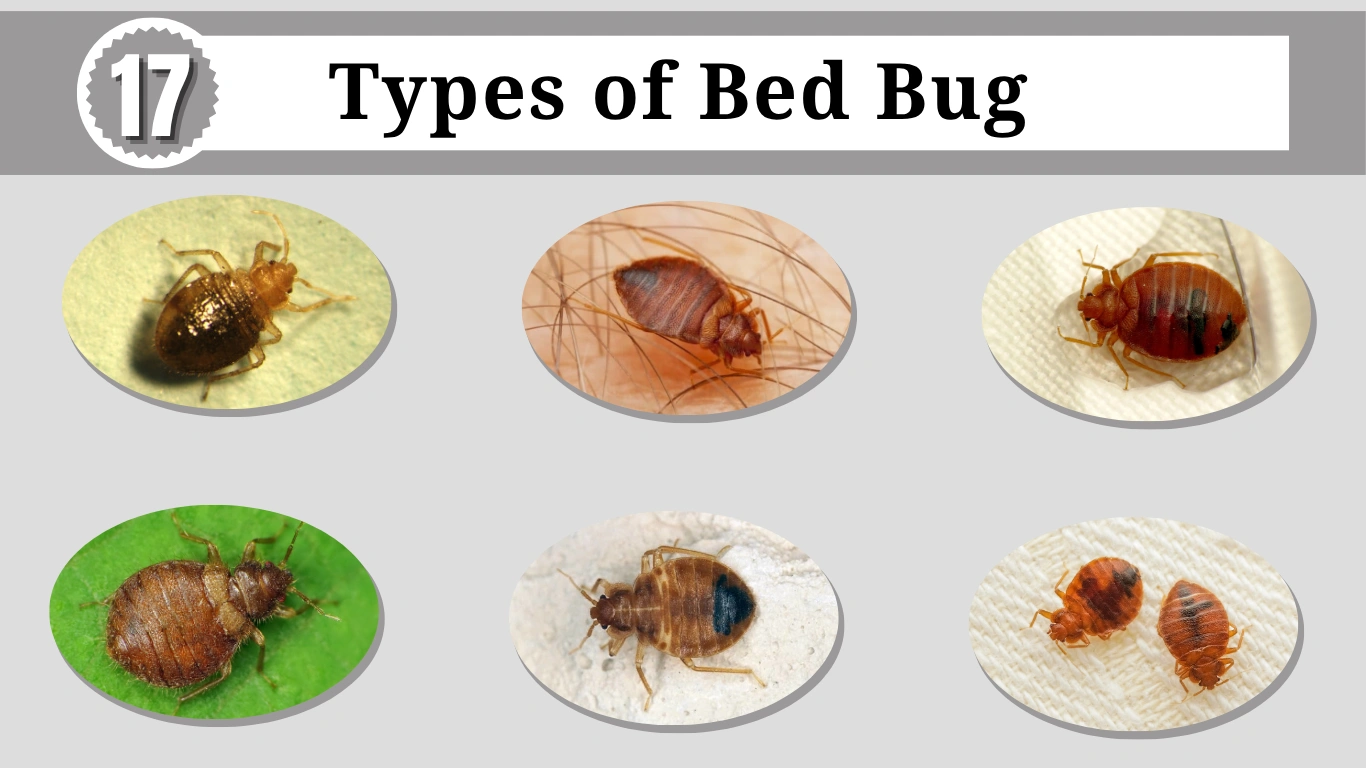
Bed bugs are small, blood-feeding insects that infest homes, wildlife nests, and animal shelters worldwide. While most people know the common bed bug, many other species exist—some targeting bats, birds, or poultry. Understanding their differences helps in accurate identification and control. This guide explores 17 types of bed bugs, detailing their appearance, bites, risks, and preferred habitats in clear, structured sections.
1. Cimex lectularius

The Cimex lectularius, commonly known as the common bed bug, is the most widespread species found in human dwellings. These insects are nocturnal blood feeders that prefer human hosts but can also feed on pets. Known for their resilience and adaptability, they thrive in warm environments such as bedrooms, hotels, and shelters.
Identification
- Reddish-brown, flat, and oval-shaped body
- About 4–5 mm in length (size of an apple seed)
- Wingless, with short antennae and visible segmented abdomen
- Emits a musty odor from scent glands
- Nymphs are smaller and lighter in color
Bite
Cimex lectularius bites are painless at first but develop into itchy, red welts arranged in clusters or lines. They usually occur on exposed skin such as the face, neck, arms, or legs. Although their bites do not transmit diseases, scratching can lead to secondary infections or allergic reactions.
Risk
The main risk from Cimex lectularius infestations is psychological distress—including insomnia, anxiety, and embarrassment. Frequent scratching can cause skin irritation or infection. Infestations spread quickly through travel, shared furniture, or close living conditions, making control and eradication challenging.
Habitat
This species hides in small crevices near sleeping areas—such as mattress seams, bed frames, baseboards, or behind wallpaper. They prefer temperatures between 21°C and 28°C (70°F–82°F) and can survive months without feeding, allowing them to persist unnoticed for long periods.
2. Cimex hemipterus

The Cimex hemipterus, or tropical bed bug, is commonly found in warmer climates across Asia, Africa, and South America. Similar to the common bed bug, this species feeds exclusively on blood, primarily from humans. They are slightly smaller but more aggressive, thriving in humid environments and densely populated areas.
Identification
- Reddish-brown, oval, and slightly smaller than Cimex lectularius
- Length around 4–4.5 mm
- Flattened body with well-defined pronotum (shield-like plate)
- Lacks wings; emits a strong musty odor when disturbed
- Eggs are white, oval, and about 1 mm long
Bite
Cimex hemipterus bites are more frequent and can cause intense itching and swelling. The bites appear in clusters or zigzag patterns, often accompanied by allergic reactions in sensitive individuals. Although not known to transmit diseases, their bites may lead to secondary skin infections due to excessive scratching.
Risk
This tropical species poses risks of allergic dermatitis, anxiety, and sleep deprivation. Heavy infestations can result in constant itching and irritation. They are highly resistant to some insecticides, which makes eradication more difficult in urban and tropical settings.
Habitat
Cimex hemipterus prefers tropical and subtropical regions. It hides in bedding, cracks in walls, luggage, or furniture joints. Unlike its temperate cousin, it thrives in higher humidity levels and can spread easily through travel or secondhand furniture.
3. Leptocimex boueti

The Leptocimex boueti is a bed bug species primarily found in West Africa and parts of South America. Unlike other bed bugs, it feeds on both humans and bats, often living in homes close to bat colonies. Its adaptability to different hosts makes it a unique vector in tropical environments.
Identification
- Light to dark brown, oval-shaped body
- Measures about 5 mm in length
- Slightly longer legs than Cimex species
- Flattened, wingless, and equipped with piercing mouthparts
- Often found near bat roosts in human dwellings
Bite
Leptocimex boueti bites cause mild to moderate itching, redness, and irritation. Since they feed on both bats and humans, reactions can vary based on host sensitivity. Bites often appear in small clusters on exposed skin areas, particularly during nighttime feeding.
Risk
While not known to transmit diseases, infestations can cause significant discomfort and psychological stress. The dual feeding behavior (on bats and humans) increases the likelihood of exposure in rural or poorly sealed homes. Repeated bites may lead to allergic reactions or secondary infections.
Habitat
This species thrives in warm, humid climates, nesting in walls, ceilings, and attics shared with bat populations. They often migrate from bat roosts into bedrooms or living areas. Leptocimex boueti prefers areas with minimal light and can survive long periods without blood meals.
4. Cimex pilosellus

The Cimex pilosellus, also known as the bat bug, is closely related to bed bugs but primarily targets bats as hosts. Occasionally, when bats vacate roosts, these bugs may bite humans, leading to confusion with true bed bug infestations.
Identification
- Similar in size to Cimex lectularius (around 5 mm)
- Covered in fine hairs, giving a fuzzy appearance
- Brownish and oval-shaped body
- Longer fringe hairs on the thorax compared to bed bugs
- Found near bat roosts in attics, chimneys, or walls
Bite
Cimex pilosellus rarely bites humans, but when it does, the bites are itchy and cause small, red bumps. The reaction is mild and temporary, as the species is not fully adapted to human hosts. Bites are often mistaken for those of common bed bugs.
Risk
The main risk involves misidentification—leading to unnecessary bed bug treatments. While not known to spread diseases, infestations can cause anxiety and discomfort. These insects may persist if bats return to the same nesting sites repeatedly.
Habitat
Cimex pilosellus lives in bat roosting areas such as attics, barns, caves, or old buildings. They prefer dark crevices and cracks near roosts. When bats migrate or die off, these bugs move toward human living spaces in search of a blood meal.
5. Cimex adjunctus

The Cimex adjunctus is a species closely related to the common bed bug but primarily associated with bat colonies. Occasionally, when bats leave their roosts, this species may invade human dwellings and bite people. It is found throughout North America, especially in attics or buildings with bat populations.
Identification
- Brownish, oval, and flat-bodied
- Measures about 4–6 mm in length
- Covered in fine body hairs
- Longer legs than Cimex lectularius
- Usually discovered near bat nesting sites rather than beds
Bite
Cimex adjunctus bites humans only when its primary host (bats) is unavailable. The bites cause redness, itching, and mild swelling but are generally less frequent and intense than true bed bug bites. They do not transmit any known diseases.
Risk
The major risk is infestation following bat removal. Once bats are gone, these bugs may migrate toward humans seeking a new food source. Psychological effects such as stress or discomfort are common, especially if mistaken for bed bug infestations.
Habitat
Cimex adjunctus prefers dark, warm areas near bat roosts, such as attics, barns, and wall voids. They thrive in secluded spaces, emerging at night to feed. Effective control usually involves both bat exclusion and insecticide treatment around roosting sites.
6. Cimex antennatus

The Cimex antennatus is a rare species of bed bug primarily parasitizing bats. It occasionally bites humans when disturbed but rarely establishes infestations in homes. Found mostly in temperate regions, it thrives in locations where bats are common, such as attics and abandoned buildings.
Identification
- Reddish-brown with an oval, flattened shape
- Slightly smaller than Cimex lectularius
- Distinctive long antennae (hence the name “antennatus”)
- Fine hairs on the body and thorax
- Found near bat droppings or roosting areas
Bite
Cimex antennatus bites may cause mild itching and irritation but typically go unnoticed. They bite humans only when bats are absent or displaced. Bites appear as small, red welts and usually subside within a few days without medical treatment.
Risk
The risk level is low, but temporary infestations can occur if bats are evicted without proper pest control. Anxiety and minor allergic reactions are the most common concerns. This species is not known to transmit any pathogens to humans.
Habitat
Cimex antennatus lives in bat roosts located in attics, eaves, and hollow walls. They prefer warm, dry areas protected from light. When bats migrate or die, these insects may move into nearby human living spaces, though they cannot reproduce effectively without their natural hosts.
7. Cimex japonicus

The Cimex japonicus is a bed bug species native to East Asia, particularly Japan, China, and Korea. Although it mainly feeds on bats and birds, it occasionally bites humans in shared environments. This species resembles common bed bugs but is slightly smaller and more regionally confined.
Identification
- Reddish-brown and oval-shaped body
- About 4 mm long and wingless
- Slightly narrower thorax compared to Cimex lectularius
- Dense body hairs visible under magnification
- Commonly found near bird nests or bat roosts
Bite
Bites from Cimex japonicus are uncommon but can cause itchy, red welts similar to other bed bug bites. The irritation usually lasts a few days and may lead to mild allergic reactions. They bite exposed skin areas, typically at night when the host is asleep.
Risk
The species poses minimal health risk but can cause localized infestations in rural homes or temples shared with bats or birds. Persistent scratching may result in infection. Its presence indicates nearby wildlife nests that need removal to prevent re-infestation.
Habitat
Cimex japonicus inhabits bat caves, bird roosts, and traditional wooden structures. They prefer dark crevices, tatami mats, and cracks in wooden beams. Infestations are seasonal, peaking during warmer months when hosts are active.
8. Cimex latipennis

The Cimex latipennis is a bat-associated bed bug species found in North America and parts of Europe. Though not a true human parasite, it can bite people when displaced from bat roosts, often after exclusion efforts or environmental changes.
Identification
- Flattened, oval, and reddish-brown body
- Slightly broader abdomen than other Cimex species
- Measures around 5 mm in length
- Short antennae and fine body hairs
- Found near bat droppings and wall voids
Bite
Cimex latipennis bites occur rarely and produce small, itchy welts. The reactions are mild, with discomfort lasting only a few days. Unlike human-adapted bed bugs, they do not persistently feed on humans or reproduce indoors.
Risk
The main risk lies in temporary infestations following bat removal. While harmless in terms of disease, the psychological stress and confusion with common bed bugs can lead to unnecessary pest treatments.
Habitat
Cimex latipennis live in bat roosting sites such as attics, barns, caves, and abandoned houses. They hide in cracks, under insulation, and behind beams. When disturbed, they may migrate short distances to human-occupied spaces but cannot sustain large infestations without bats.
9. Cimex pipistrelli

The Cimex pipistrelli, commonly called the European bat bug, primarily parasitizes bats but occasionally bites humans. It is widespread across Europe and parts of Asia, especially in older buildings and attics shared with bat colonies. Its close resemblance to the common bed bug often leads to misidentification.
Identification
- Oval, flat, and reddish-brown body
- Around 5 mm in length
- Dense fringe hairs longer than those of Cimex lectularius
- Wingless and emits a faint musty odor
- Commonly found near bat roosts and ceilings
Bite
Cimex pipistrelli bites humans only when bats are absent. Bites cause small, red, and itchy swellings, usually appearing in clusters. The irritation is mild and temporary, often mistaken for that of true bed bugs.
Risk
Health risks are minimal, as this species is not known to transmit diseases. The primary concern is psychological discomfort and anxiety due to its presence in living spaces. Proper identification is essential to avoid mistaking it for human-feeding bed bugs.
Habitat
Cimex pipistrelli inhabits attics, roof spaces, and cracks near bat roosts. They prefer dark, warm areas, and can survive several months without feeding. When bats migrate or die, they may wander into bedrooms, especially through ceiling gaps or vents.
10. Cimex incrassatus

The Cimex incrassatus is a rare bat-associated bed bug found mainly in North America. Like other bat bugs, it feeds on bat blood but can occasionally bite humans when bats vacate their roosts. Its robust body shape and behavior make it distinguishable from other Cimex species.
Identification
- Dark reddish-brown and oval-bodied
- Slightly thicker and more rigid exoskeleton
- Length about 4.5–5 mm
- Fine hairs visible on legs and thorax
- Found in bat roosts, walls, and attics
Bite
Bites from Cimex incrassatus are uncommon and mild. They cause small red marks accompanied by mild itching. Biting occurs only when bats are unavailable, and the bugs are forced to seek alternate hosts. Symptoms usually subside quickly.
Risk
The species poses little medical risk but may cause alarm due to its appearance and activity near human dwellings. Its presence is often an indicator of nearby bat infestations, making bat control essential for long-term management.
Habitat
Cimex incrassatus thrives in warm, secluded roosting areas such as attics, barns, and abandoned buildings. They prefer cracks and crevices near bat colonies and can survive for extended periods without feeding, especially during colder months.
11. Oeciacus vicarius

The Oeciacus vicarius, also known as the swallow bug, primarily infests cliff swallows but can occasionally bite humans when birds abandon their nests. It is found mainly in North America, especially in areas where cliff swallows build mud nests on buildings and bridges.
Identification
- Flat, oval, and light brown body
- About 4–5 mm long and wingless
- Covered in short golden hairs
- Antennae slightly longer than common bed bugs
- Often located near bird nests or ledges
Bite
Oeciacus vicarius bites humans when displaced from bird nests. The bites cause itchy red welts that can last several days. Though unpleasant, they do not transmit any known diseases. Biting activity typically peaks when swallows migrate away.
Risk
The primary risk is seasonal infestation in homes or buildings near bird nesting sites. Repeated bites may lead to allergic reactions or skin irritation. These insects are also known for hiding in cracks and reemerging annually when birds return.
Habitat
Oeciacus vicarius lives in cliff swallow nests, attics, and roof eaves. They can survive for months without a blood meal, waiting for birds to return. Infestations often occur in rural or semi-urban areas where bird colonies are dense.
12. Oeciacus hirundinis

The Oeciacus hirundinis, or European swallow bug, is a close relative of Oeciacus vicarius and primarily feeds on swallows and martins. Native to Europe and parts of Asia, it occasionally invades human homes when birds leave their nesting sites.
Identification
- Brownish, oval, and slightly elongated body
- Around 4.5 mm in length
- Covered in fine hairs with prominent thorax edges
- Similar in appearance to common bed bugs but lighter in color
- Found near bird nests on walls, attics, or ledges
Bite
Bites from Oeciacus hirundinis are itchy and inflamed, appearing in small clusters. Humans are accidental hosts, and bites usually occur when swallows migrate. Reactions vary from mild redness to severe itching depending on skin sensitivity.
Risk
Though not dangerous, infestations cause significant discomfort and anxiety. The insects may persist indoors during migration seasons. Proper nest removal and exclusion are vital to prevent re-infestation.
Habitat
This species inhabits bird nests, attics, and cracks in exterior walls. They are most active during spring and summer when birds breed. When the nests are vacated, these bugs may move indoors seeking warmth and alternative hosts.
13. Haematosiphon inodorus

The Haematosiphon inodorus, also known as the Mexican chicken bug or poultry bug, is a parasitic insect that primarily targets poultry and wild birds. Found in North and Central America, it occasionally bites humans who handle infested birds or live near poultry farms.
Identification
- Oval, reddish-brown, and wingless body
- Around 5–6 mm in length
- Flat body with fine golden hairs
- Resembles a bed bug but slightly larger and broader
- Commonly found in poultry houses and nesting boxes
Bite
Bites from Haematosiphon inodorus cause itchy, painful welts that may persist for several days. People working with chickens are more prone to bites. Although not known to transmit diseases, heavy infestations can cause anemia and stress in birds.
Risk
This species poses a significant risk to poultry health, leading to reduced egg production and poor bird condition. For humans, the main risks include allergic reactions, skin irritation, and psychological discomfort when infestations spread indoors.
Habitat
Haematosiphon inodorus thrives in poultry farms, coops, and bird nests. They hide in cracks, under bedding, and around roosting areas. These bugs prefer warm, humid conditions and can survive for long periods without feeding if hosts are removed.
14. Primicimex cavernis

The Primicimex cavernis is a rare bed bug species found mainly in Central and South America. It feeds on bats and occasionally on humans when its primary hosts are unavailable. Its large size and unique body structure distinguish it from other Cimicidae species.
Identification
- Large, flat, and dark brown body
- Measures up to 6–7 mm in length
- Strong legs and longer hairs on the abdomen
- Thicker exoskeleton than most bed bugs
- Found near bat colonies in caves or old buildings
Bite
Primicimex cavernis bites are uncommon but irritating when they occur. The bites cause redness, itching, and mild swelling, similar to other bed bug species. They usually feed at night when hosts are at rest.
Risk
The health risk to humans is minimal, but their presence often indicates nearby bat activity. Infestations can cause anxiety and discomfort, especially in rural or cave-adjacent dwellings. There are no known disease transmissions from this species.
Habitat
This species prefers bat-inhabited caves, attics, and old wooden structures. They hide in cracks and crevices near roosting bats and may enter homes during host migrations. Their survival strategy allows them to withstand months without blood meals.
15. Cimex columbarius

The Cimex columbarius, commonly known as the pigeon bug, primarily feeds on pigeons and other birds. It is distributed across Europe, North Africa, and parts of Asia. While it rarely infests humans, it may enter homes located close to pigeon nests or roosts, especially in urban settings.
Identification
- Oval, flattened, and reddish-brown body
- Around 4.5–5 mm long
- Slightly more elongated than Cimex lectularius
- Fine body hairs and short antennae
- Typically found near pigeon nests or lofts
Bite
Cimex columbarius bites humans only when pigeons are absent. The bites cause small, itchy bumps with mild swelling and redness. The reaction is temporary and non-dangerous but can be mistaken for common bed bug bites.
Risk
The primary risk is temporary human infestation following pigeon nest removal. These bugs do not transmit diseases but can cause allergic reactions and emotional distress. Improper handling of infested nests can lead to the bugs entering indoor spaces.
Habitat
Cimex columbarius inhabits pigeon nests, roofs, balconies, and ledges. They prefer dry, sheltered environments and can survive months without feeding. Infestations often occur in urban buildings where pigeons roost near windows or attics.
16. Cimex pulveratus

The Cimex pulveratus is a lesser-known bed bug species found in Asia and Eastern Europe. It primarily parasitizes bats and birds, with occasional human contact. Its life cycle and feeding habits are similar to those of common bed bugs, though it is more regionally restricted.
Identification
- Oval, dark brown, and wingless
- Measures about 4–5 mm in length
- Slightly broader thorax and thicker legs
- Covered with short fine hairs
- Found in old buildings, bat caves, and bird roosts
Bite
Cimex pulveratus bites are rare and mild, leading to small red welts and itching. Humans are accidental hosts, usually bitten when in close proximity to infested nests or roosting areas. Bites subside quickly without major complications.
Risk
Risks include temporary infestations and mild allergic reactions. While harmless medically, its presence may cause anxiety or discomfort. These insects are not known to spread pathogens but may indicate nearby bat or bird populations.
Habitat
This species prefers secluded, dark areas like attics, barns, and roofs where bats or birds roost. They thrive in warm climates and can survive long periods without feeding, making them resilient in vacant structures or seasonal habitats.
17. Cimex insuetus

The Cimex insuetus is a rare species of bed bug primarily associated with bat colonies. It is found in parts of Europe, Asia, and North America, often inhabiting caves, attics, or abandoned buildings where bats roost. Human encounters are infrequent and typically accidental.
Identification
- Oval, flattened, and reddish-brown body
- Measures about 4–5 mm in length
- Slightly narrower than Cimex lectularius
- Covered with fine body hairs and short legs
- Commonly located near bat droppings or roosts
Bite
Cimex insuetus bites humans only when displaced from its bat hosts. The bites cause mild itching, redness, and minor swelling that resolves within a few days. They rarely bite multiple times and are not known to transmit any diseases.
Risk
The risk from Cimex insuetus is primarily psychological, as infestations near human dwellings can cause anxiety and confusion with true bed bugs. Although harmless, their presence often indicates nearby bat activity that requires removal.
Habitat
Cimex insuetus lives in bat roosting sites—such as attics, caves, and abandoned buildings. They hide in cracks, under insulation, and behind beams close to their hosts. When bats migrate or die off, these bugs may temporarily invade human spaces in search of blood meals.